
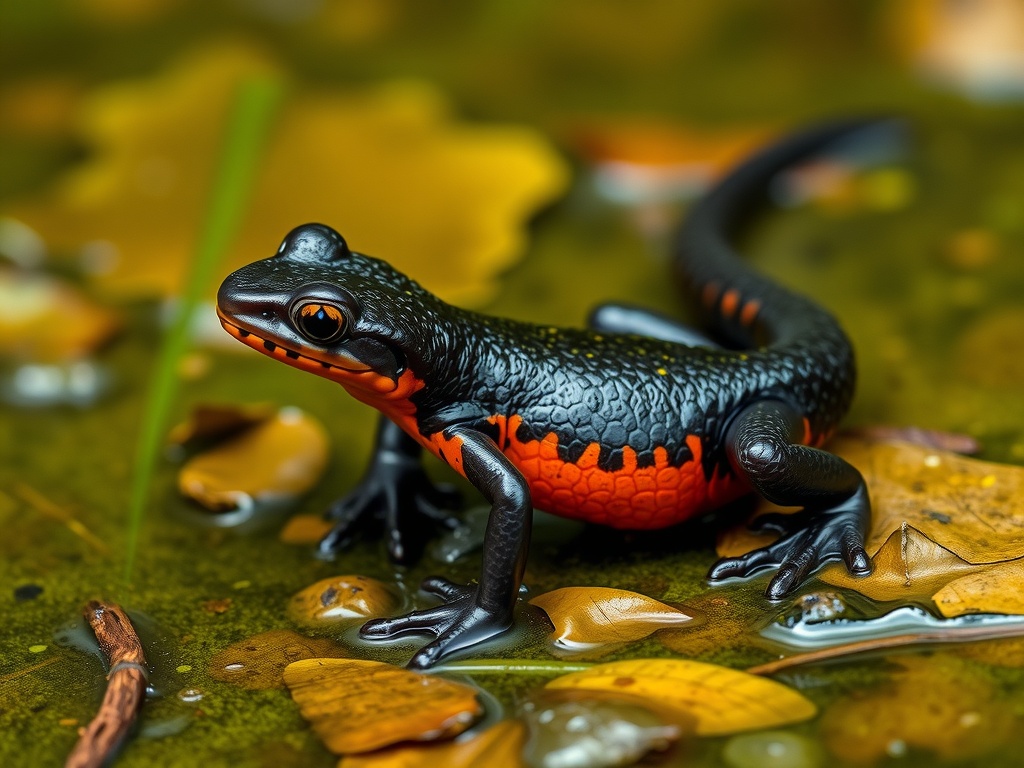
About the Japanese Fire-bellied Newt
The Japanese Fire-bellied Newt is a small, semi-aquatic amphibian native to Japan, renowned for its striking black dorsum and vivid orange-red belly. This coloration serves as a warning to predators about its toxic skin secretions. It inhabits ponds, marshes, and slow-moving streams, spending part of its life in water and part on land. The species is popular in the pet trade but faces threats from habitat loss and overcollection.
Fascinating facts
Colorful Warning
The Japanese Fire-bellied Newt displays a bright red or orange belly to warn predators of its toxic skin secretions.
Regeneration Masters
They possess impressive regenerative abilities, capable of regrowing limbs, tails, and even parts of their organs.
Semi-Aquatic Lifestyle
These newts spend substantial time both in water and on land, especially during breeding season when they return to aquatic environments.
Detailed description
The Japanese Fire-bellied Newt (Cynops pyrrhogaster) is a medium-sized salamandrid amphibian, typically measuring 8 to 15 cm in total length, with females generally larger than males. Its dorsal surface is dark brown to black, often with a granular texture, while the ventral side is vividly colored in shades of orange to red, sometimes interspersed with black spots or blotches unique to each individual. The skin is moist and slightly rough, adapted for both aquatic and terrestrial environments. The head is broad with prominent eyes and a rounded snout, and the tail is laterally compressed, aiding in swimming. Limbs are relatively short but robust, with four fingers on the forelimbs and five toes on the hindlimbs. This species is semi-aquatic, spending significant time both in water and on land, especially outside the breeding season. It is primarily nocturnal, seeking shelter under rocks, logs, or leaf litter during the day. The Japanese Fire-bellied Newt possesses specialized skin glands that secrete tetrodotoxin, a potent neurotoxin, as a defense against predators. Its aposematic (warning) coloration is a classic example of anti-predator adaptation, signaling its toxicity to potential threats.
Did you know?
Despite their toxicity, Japanese Fire-bellied Newts are sometimes preyed upon by snakes that have evolved resistance to their toxins.
Research & sources
Wikipedia summary
The Japanese fire-bellied newt or Japanese fire-bellied salamander is a species of newt endemic to Japan. The skin on its upper body is dark and its lower regions bright red, although coloration varies with age, genetics, and region. Adults are 8 to 15 cm long. To deter predators, Japanese fire-bellied newts contain high levels of tetrodotoxin, a neurotoxin accumulated mainly from their diet.
Behaviour & social structure
Japanese Fire-bellied Newts are solitary outside of the breeding season, exhibiting territorial behavior, especially among males. They are primarily crepuscular and nocturnal, becoming most active at dusk and during the night. In the wild, they forage for small invertebrates such as worms, insect larvae, crustaceans, and occasionally small fish or amphibian eggs. Hunting is mainly by ambush or slow stalking, using their keen sense of smell and vision to locate prey. When threatened, they display the unken reflex—arching their back and limbs to expose the bright ventral coloration as a warning. Social interactions are limited, but during breeding, males may compete for access to females through displays and gentle nudging. Outside the breeding season, individuals avoid each other and maintain defined home ranges.
Reproduction & life cycle
Breeding occurs from late winter to early spring (typically February to May), triggered by rising temperatures and increased rainfall. Males court females with a series of tactile and visual displays, including tail fanning and body undulations. Fertilization is internal; the male deposits a spermatophore, which the female picks up with her cloaca. Females lay 100–400 eggs per season, attaching them singly to submerged aquatic plants. The eggs hatch after 2–4 weeks, depending on water temperature. Larvae are fully aquatic and possess external gills; they feed on small aquatic invertebrates. Metamorphosis into terrestrial juveniles occurs after 2–3 months, though some populations exhibit paedomorphosis, retaining larval features and remaining aquatic as adults. Parental care is minimal, limited to careful placement of eggs to minimize predation risk.
Adaptations & survival
Cynops pyrrhogaster exhibits several notable adaptations. Its skin secretes tetrodotoxin, which is accumulated through its diet and deters most predators. The bright ventral coloration serves as an aposematic signal, warning of its toxicity. The species can regenerate lost limbs, tails, and even parts of the eye and heart, a trait of significant interest in regenerative biology. Its laterally compressed tail and webbed feet enhance swimming efficiency. The ability to switch between aquatic and terrestrial habitats allows it to exploit a wide range of environments and avoid desiccation during dry periods. Behavioral adaptations include the unken reflex and nocturnal activity patterns to reduce predation risk.
Cultural significance
In Japanese culture, the fire-bellied newt has been featured in folklore and traditional medicine. Its striking appearance and toxicity have led to its use as a cautionary symbol in local stories. Historically, some traditional remedies incorporated newt parts, though this practice is now rare and discouraged due to conservation concerns. The species is also popular in the pet trade, valued for its hardiness and vivid coloration, though this has contributed to overcollection in the wild. In modern times, it serves as a model organism in scientific research, particularly in studies of regeneration and toxin biology.
Recent research
Recent research has focused on the molecular mechanisms underlying limb and organ regeneration in Cynops pyrrhogaster, offering insights into potential applications in regenerative medicine. Studies have also examined the ecological role of tetrodotoxin, including its dietary sources and variation among populations. Genetic analyses have revealed significant regional variation, suggesting the existence of distinct evolutionary lineages within Japan. Ongoing conservation research is assessing the impact of habitat fragmentation and disease, with some efforts directed toward captive breeding and reintroduction programs. The species' response to environmental pollutants and climate change is an active area of study, given its sensitivity as an amphibian bioindicator.
Videos
Habitat
Freshwater ponds, marshes, and slow-moving streams in temperate forests


Conservation
The Japanese Fire-bellied Newt is currently classified as Near Threatened on the IUCN Red List.
Threats & challenges
The Japanese Fire-bellied Newt faces several conservation challenges. Habitat loss due to urbanization, agricultural expansion, and wetland drainage is a primary threat. Overcollection for the pet trade, both domestic and international, has led to population declines in some regions. Pollution, particularly from pesticides and fertilizers, degrades breeding habitats and affects larval development. Introduced predators and competitors, such as invasive fish species, further threaten local populations. Disease, including chytridiomycosis caused by the chytrid fungus (Batrachochytrium dendrobatidis), poses an emerging risk. The species is classified as Near Threatened by the IUCN, with some local populations considered vulnerable or declining.
Taxonomy
Scientific name
Cynops pyrrhogaster
- Kingdom
- Animalia
- Phylum
- Chordata
- Class
- Amphibia
- Order
- Urodela
- Family
- Salamandridae
- Genus
- Cynops
- Species
- pyrrhogaster
Community notes
Share your observations about the Japanese Fire-bellied Newt.
No community notes yet. Be the first!
Discover more wildlife
More fascinating animals from the encyclopedia.