
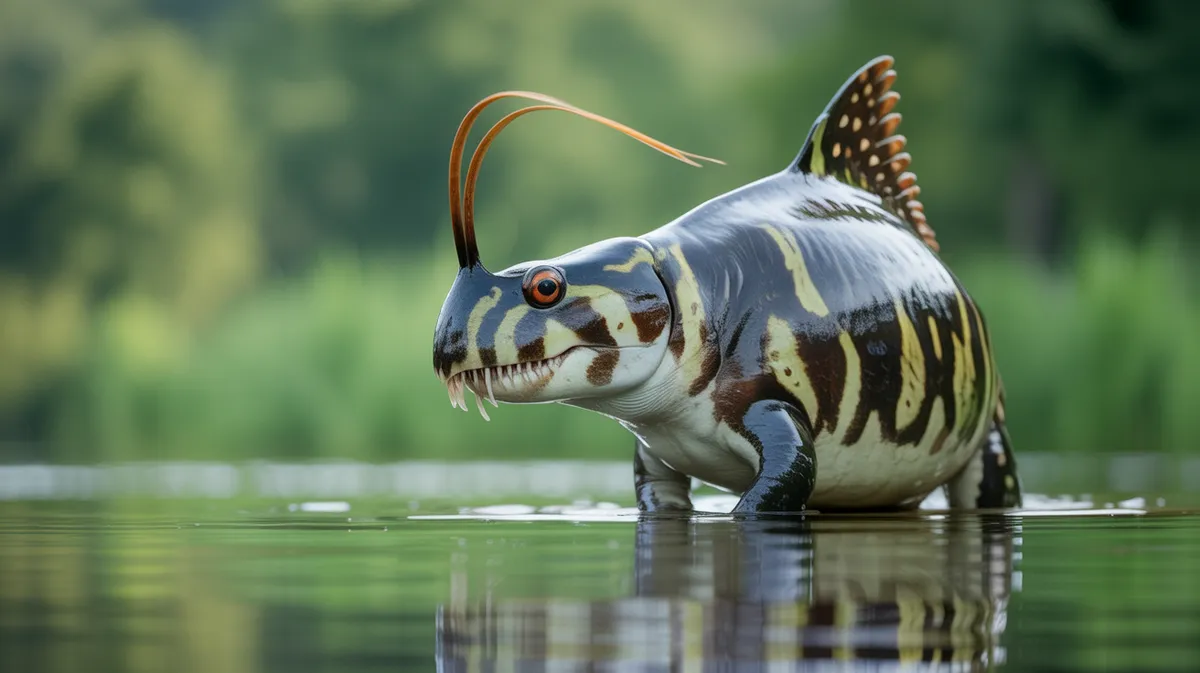
About the Klinodon
Klinodon is a genus of extinct jawless fish that lived during the Devonian period. Known primarily from fossilized remains, Klinodon possessed a distinctive bony armor and lacked jaws, features typical of early vertebrates known as ostracoderms. These ancient fish played an important role in the evolutionary history of vertebrates by showcasing the transition from armored, jawless forms to more advanced jawed fishes. Fossils of Klinodon have been found in what is now Russia, and they provide valuable insight into the diversity of early Devonian aquatic ecosystems.
Fascinating facts
Fossil Discovery
Klinodon is known exclusively through fossilized remains found in Devonian strata.
Bony Armor
Like many early jawless fish, Klinodon was protected by a hard, bony outer shell.
Filter Feeder
Klinodon likely fed by filtering detritus and microscopic organisms from the sediment.
Detailed description
Klinodon is a genus of extinct jawless vertebrates belonging to the class Osteostraci, a group of armored ostracoderms that flourished during the Early to Middle Devonian period, approximately 419–393 million years ago. Fossils of Klinodon are characterized by their robust, dorsoventrally flattened bodies, encased in a heavy cephalic shield composed of dermal bone, which provided both protection and hydrodynamic stability in ancient freshwater environments. The body length of Klinodon species is estimated to range from 15 to 30 centimeters, with a broad, rounded head shield and a tapering, scale-covered trunk. Unlike modern fishes, Klinodon lacked true jaws, instead possessing a ventrally positioned mouth adapted for bottom-feeding. Its sensory system included paired lateral line canals and well-developed pineal and orbital openings, suggesting a reliance on both tactile and visual cues. The gill openings were located ventrally, and the tail was heterocercal, aiding in maneuverability along the substrate. Klinodon likely exhibited a slow, benthic lifestyle, sifting through detritus and organic matter on river and lake beds. The genus is notable for its contribution to our understanding of early vertebrate evolution, particularly the development of cranial structures and the transition toward jawed vertebrates (gnathostomes). Fossil evidence from the Russian Devonian strata reveals a high degree of morphological diversity within the genus, indicating adaptation to a variety of microhabitats.
Did you know?
Klinodon fossils have contributed to our understanding of early vertebrate evolution, especially the development of protective body armor.
Research & sources
Behaviour & social structure
Klinodon is inferred to have been a benthic detritivore, spending most of its time on or near the substrate of freshwater rivers and lakes. Its flattened body and heavy head shield suggest a sedentary lifestyle, with limited swimming ability. Klinodon likely used its ventral mouth and oral plates to scoop up organic debris, decaying plant matter, and microorganisms from the sediment. The lateral line system would have been crucial for detecting vibrations and movements in the water, aiding in navigation and foraging. There is no direct evidence of complex social behavior, but fossil assemblages sometimes indicate that Klinodon individuals may have congregated in favorable feeding grounds, possibly forming loose aggregations. Defensive behaviors would have relied on the thick bony armor to deter predators, such as early placoderms or larger predatory fish.
Reproduction & life cycle
Direct fossil evidence of Klinodon reproduction is lacking, but by analogy with other ostracoderms and early vertebrates, it is likely that Klinodon reproduced via external fertilization, releasing eggs and sperm into the water column. The eggs were probably demersal, settling onto the substrate where they developed. There is no indication of parental care, as is typical for most early vertebrates. Spawning may have been seasonal, triggered by environmental cues such as water temperature or photoperiod. The development from egg to juvenile would have involved a free-living larval stage, gradually acquiring adult features as the bony armor developed.
Adaptations & survival
Klinodon exhibited several key adaptations to its benthic, detritivorous lifestyle. The broad, armored head shield protected vital sensory organs and provided a stable platform for bottom-feeding. The ventrally positioned mouth and oral plates were specialized for sifting and processing detritus. The lateral line system enhanced environmental awareness in turbid waters. Reduced or absent paired fins, along with a heterocercal tail, suggest limited but precise locomotion along the substrate. The heavy dermal armor served as both defense against predators and as ballast, anchoring the fish to the river or lake bed. These features represent evolutionary specializations for survival in dynamic freshwater ecosystems of the Devonian.
Cultural significance
Klinodon itself has no direct role in human culture, mythology, or traditional practices, as it was only discovered and described through paleontological research in the 20th century. However, ostracoderms as a group have occasionally featured in educational materials and museum exhibits to illustrate the early evolution of vertebrates. Klinodon fossils contribute to the broader scientific and cultural understanding of life's history and the origins of vertebrate anatomy.
Recent research
Recent paleontological studies have focused on the microstructure of Klinodon's dermal armor, revealing complex patterns of bone growth and sensory canal development. Ongoing research examines the phylogenetic relationships between Klinodon and other osteostracans, using both morphological and, where possible, molecular data from related taxa. Notably, recent discoveries in the Devonian deposits of the Timan-Pechora region have yielded new Klinodon specimens, providing insights into species diversity and paleoecology. Comparative studies with other jawless vertebrates are shedding light on the functional morphology of early vertebrate feeding mechanisms and the evolutionary origins of cranial sensory systems.
Sources
Devonian Heterostracan Agnathans from the Russian Platform
Ivanov, A., Karatajūtė-Talimaa, V., and Turner, S. (2018)
scientificDevonian Heterostracans from the Russian Platform: Systematics and Paleoecology
Novitskaya, L.I. (2004)
scientificVideos
Habitat
Ancient freshwater rivers and lakes

Conservation
The Klinodon is currently classified as Extinct on the IUCN Red List.
Threats & challenges
As an extinct genus, Klinodon no longer faces contemporary threats. However, during its existence, it would have contended with predation from larger jawed fishes and placoderms, competition for food resources, and environmental fluctuations such as changes in water chemistry or sedimentation rates. The eventual extinction of Klinodon and related ostracoderms is attributed to the rise and diversification of jawed vertebrates, which outcompeted jawless forms in many ecological niches. No conservation measures are applicable, but fossil preservation is subject to geological and anthropogenic factors affecting Devonian strata.
Taxonomy
Scientific name
Klinodon klinodon
- Kingdom
- Animalia
- Phylum
- Chordata
- Class
- Osteostraci
- Order
- Osteostraci incertae sedis
- Family
- Klinodontidae
- Genus
- Klinodon
- Species
- klinodon
Community notes
Share your observations about the Klinodon.
No community notes yet. Be the first!
Discover more wildlife
More fascinating animals from the encyclopedia.