
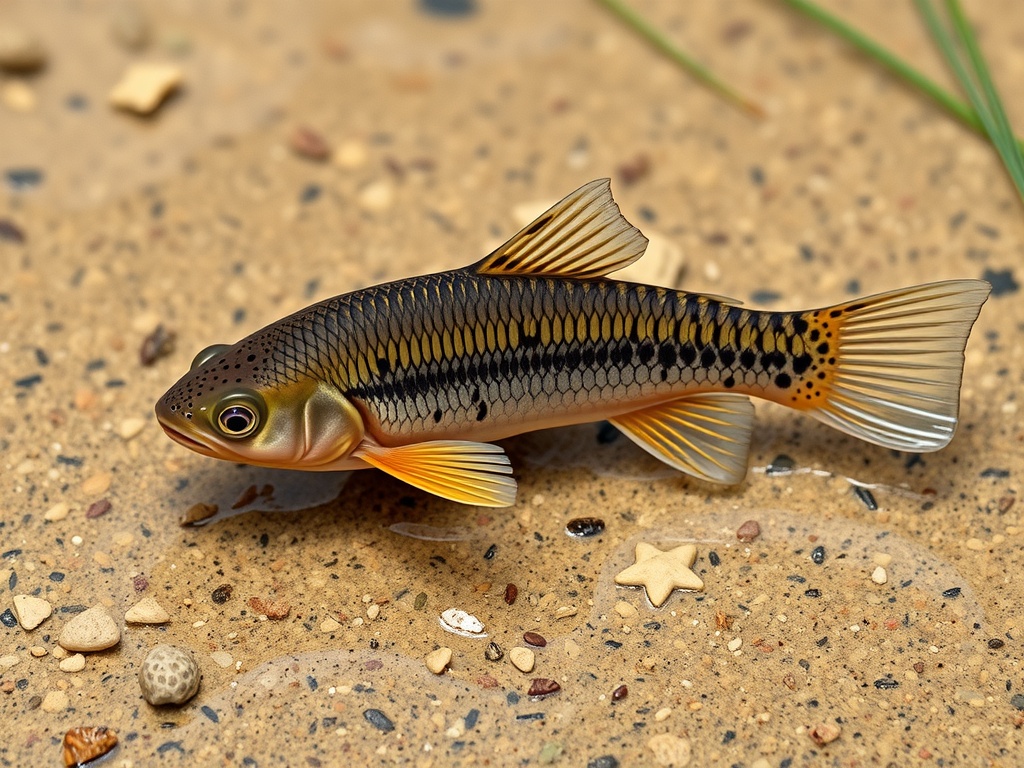
About the Kuhli Loach
The Kuhli loach is a small, slender freshwater fish known for its eel-like body and distinctive striped pattern. Native to Southeast Asia, this nocturnal species spends much of its time burrowing into soft substrates or hiding among aquatic plants. Kuhli loaches are peaceful and social, often seen in groups, making them a popular choice for community aquariums. Their shy nature and unique appearance have made them a favorite among aquarists worldwide.
Fascinating facts
Eel-Like Appearance
Despite being a fish, the Kuhli loach's long, slender body and movement resemble that of a small eel or snake.
Nocturnal Behavior
Kuhli loaches are most active at night, foraging for food under the cover of darkness, and often hide during the day.
Burrowing Experts
They love to dig and burrow in soft sand or mud, which helps them feel secure and mimics their natural habitat.
Detailed description
The Kuhli loach (Pangio kuhlii) is a slender, elongated fish reaching an adult length of 8–12 cm (3–5 inches), with a maximum recorded length of about 12 cm. Its body is laterally compressed and highly flexible, allowing it to navigate through dense vegetation and narrow crevices. The species is characterized by a series of 10–15 dark brown to black vertical bands alternating with yellowish-orange to pinkish body coloration, providing effective camouflage among leaf litter and substrate. The head is small and slightly flattened, with three pairs of sensitive barbels around the mouth that aid in detecting food in murky or dark environments. The eyes are partially covered by a transparent skin, and a suborbital spine (hidden under the skin) can be erected as a defense mechanism. Kuhli loaches lack a true lateral line, relying instead on their barbels and body sensitivity to sense vibrations and chemical cues. They are primarily nocturnal, emerging at dusk to forage, and spend daylight hours burrowed in soft substrates or hiding among roots and aquatic plants. Social by nature, they often form loose aggregations, though they do not exhibit strict schooling behavior. Their gentle temperament and adaptability to a range of water conditions have made them a staple in the aquarium trade. In the wild, they play an important role in benthic ecosystems by consuming detritus and small invertebrates, contributing to nutrient cycling.
Did you know?
Kuhli loaches can breathe atmospheric air using their intestines when oxygen levels in the water are low.
Research & sources
Wikipedia summary
The true Kuhli loach, which can be used synonymously with "coolie" loach, occasionally referred to as eel loach, is a small eel-like freshwater fish belonging to the loach family (Cobitidae). They originate from the island of Java in Indonesia. This serpentine, worm-shaped creature is very slender and nocturnal. Its distinctive orange-pink coloration with triangular black stripes and long lifespan makes it a popular aquarium species.
Behaviour & social structure
Kuhli loaches are crepuscular to nocturnal, becoming most active during twilight and nighttime hours. They are bottom-dwellers, spending much of their time sifting through sand or mud for food, which includes small crustaceans, insect larvae, worms, and organic detritus. Their feeding behavior involves probing the substrate with their sensitive barbels, often stirring up sediment in the process. Socially, they are peaceful and prefer the company of conspecifics or other small, non-aggressive fish. While not true schoolers, they display shoaling tendencies, especially when threatened or during foraging. Kuhli loaches exhibit a strong burrowing instinct, often disappearing beneath the substrate for extended periods. They are known for their shy disposition, quickly retreating to cover when startled. In captivity, they may become more diurnal and visible with time and acclimation.
Reproduction & life cycle
Reproduction in Pangio kuhlii is rarely observed in the wild and even less so in captivity, making detailed knowledge limited. Spawning typically occurs during the rainy season, when water levels rise and food becomes abundant. Females become noticeably rounder when gravid, carrying up to several hundred bright green eggs. Courtship involves males chasing and nudging females, often in dense vegetation. Spawning is believed to be group-based, with eggs scattered among submerged roots or plants. There is no parental care; eggs are left to develop and hatch independently. Incubation lasts approximately 24–48 hours, depending on temperature. Fry are initially planktonic and feed on microscopic organisms until large enough to forage on the substrate.
Adaptations & survival
Kuhli loaches possess several adaptations for a benthic, nocturnal lifestyle. Their elongated, flexible bodies allow them to navigate tight spaces and burrow into soft substrates for protection and foraging. The presence of sensitive barbels enhances their ability to detect food in low-visibility conditions. Their cryptic coloration and banded pattern provide camouflage among leaf litter and debris. The suborbital spine, though rarely used, serves as a deterrent to predators. Kuhli loaches can tolerate low oxygen conditions by gulping atmospheric air, absorbing oxygen through their intestines—a trait shared with many cobitids. Their ability to remain hidden for long periods reduces predation risk.
Cultural significance
The Kuhli loach has been a popular aquarium fish since the mid-20th century, valued for its peaceful nature and unique appearance. In the aquarium hobby, it is often referred to as the 'coolie loach,' a name derived from colonial-era English referencing its resemblance to a coiled Asian headscarf. There is no significant role in traditional mythology or folklore, but in Southeast Asia, loaches in general are sometimes associated with good fortune or used in traditional medicine, though such uses are not well documented for this species.
Recent research
Recent molecular studies have clarified the taxonomy of the Pangio genus, revealing cryptic diversity and the presence of several closely related species often misidentified as P. kuhlii in the aquarium trade. Ongoing research focuses on the ecology of Southeast Asian freshwater systems and the impact of habitat loss on benthic fish communities. Captive breeding protocols are being refined to reduce pressure on wild populations. Studies on the loach's intestinal respiration have contributed to understanding evolutionary adaptations to hypoxic environments.
Videos
Habitat
Slow-moving freshwater streams and rivers with sandy or muddy bottoms


Conservation
The Kuhli Loach is currently classified as Least Concern on the IUCN Red List.
Threats & challenges
Currently listed as Least Concern by the IUCN, Pangio kuhlii faces localized threats from habitat degradation, pollution, and over-collection for the aquarium trade. Deforestation, agricultural runoff, and urbanization can alter or destroy the slow-moving streams and rivers they inhabit. Unsustainable harvesting practices may impact wild populations, though much of the aquarium trade is now supplied by captive breeding. Climate change poses a long-term threat by altering hydrological cycles and water quality. Despite these challenges, the species remains widespread and resilient, with stable populations in many areas.
Taxonomy
Scientific name
Pangio kuhlii
- Kingdom
- Animalia
- Phylum
- Chordata
- Class
- Actinopterygii
- Order
- Cypriniformes
- Family
- Cobitidae
- Genus
- Pangio
- Species
- kuhlii
Community notes
Share your observations about the Kuhli Loach.
No community notes yet. Be the first!
Discover more wildlife
More fascinating animals from the encyclopedia.