
About the Lake sturgeon
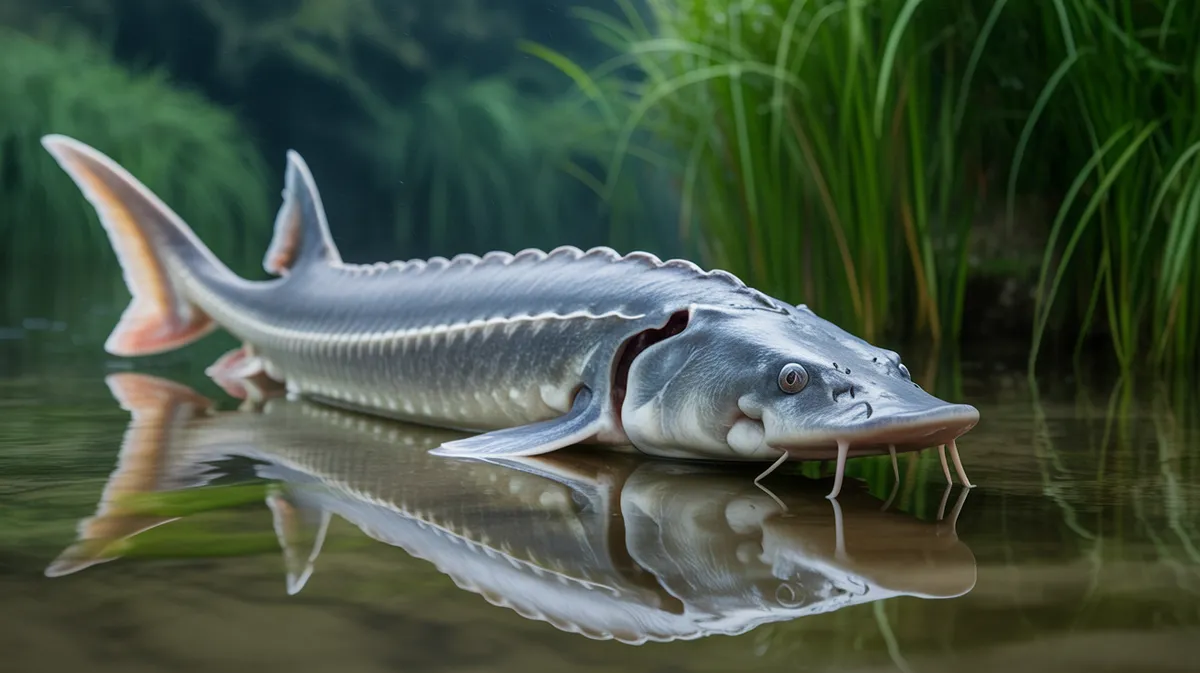
Acipenser fulvescens is a survivor of a lineage that predates most modern fish: sturgeon are cartilaginous-skeletoned bony fish armoured in rows of bony plates called scutes, with a heterocercal shark-like tail and a mouth on the underside of the head that fires out as a protrusible tube. They have no teeth, and they feed by cruising the bottom, dragging four whisker-like barbels through the sediment to detect insect larvae, molluscs and crayfish by touch and by electroreception, then vacuuming them up. Lake sturgeon grow to over 2 m and 90 kg and live extraordinarily long - the oldest verified was 152 years - but they mature agonisingly slowly, with females not spawning until they are around 20 to 25 years old, and then only every four to six years. That life history made them defenceless against nineteenth-century exploitation. Initially regarded as a nuisance that tore nets, they were killed and stacked on shore to rot or burned as fuel in steamboats; then the caviar and isinglass markets arrived and Great Lakes populations were annihilated within a few decades, falling by well over 99 percent. Recovery has been slow, and modern spawning runs on rivers like the Wolf in Wisconsin are the focus of intense conservation effort.
Fascinating facts
Living Fossil
Lake sturgeon have changed very little in appearance over the last 135 million years, earning them the nickname 'living fossils.'
Record Size
The largest lake sturgeon ever recorded weighed over 140 kg (310 lbs) and measured more than 2 meters (6.5 feet) in length.
Slow to Mature
Females can take 14-33 years to mature and have infrequent spawning cycles, making population recovery a slow process.
Detailed description
The lake sturgeon (Acipenser fulvescens) is a large, long-lived freshwater fish native to North America, particularly prevalent in the Great Lakes, Hudson Bay, and Mississippi River basins. Adults commonly reach lengths of 1–2 meters (3.3–6.6 ft) and can weigh over 100 kg (220 lbs), with some individuals documented at nearly 3 meters (9.8 ft) and 140 kg (310 lbs). Their bodies are elongated and torpedo-shaped, covered with five longitudinal rows of bony scutes that provide protection from predators. The skin is scaleless and tough, ranging in color from grayish-olive to brown dorsally, with a lighter ventral side. Lake sturgeon possess a heterocercal tail and a protrusible, toothless mouth located on the underside of the snout, which is equipped with four sensitive barbels for detecting prey. They are benthic feeders, relying on tactile and chemosensory cues to locate invertebrates, small fish, and organic matter along the substrate. Lake sturgeon are renowned for their longevity, with lifespans exceeding 100 years in females and 55 years in males. Their slow growth, late sexual maturity (females: 14–33 years, males: 8–22 years), and infrequent spawning events make their populations particularly vulnerable to overexploitation and environmental change. Despite their size, they are generally solitary outside of spawning aggregations and exhibit limited territoriality. Their ancient lineage, dating back over 150 million years, is reflected in their primitive anatomical features and resilience to environmental fluctuations.
Did you know?
Despite their massive size and prehistoric appearance, lake sturgeon are harmless to humans and feed primarily on small invertebrates found in the sediment.
Research & sources
Wikipedia summary
The lake sturgeon, also known as the rock sturgeon, is a North American temperate freshwater fish, one of 27 species of sturgeon. Like other sturgeons, this species is a bottom feeder and has a partly cartilaginous skeleton, an overall streamlined shape, and skin bearing rows of bony plates on the sides and back.
Behaviour & social structure
Lake sturgeon are primarily nocturnal, spending daylight hours resting in deeper waters and becoming more active at dusk and during the night. They exhibit a slow, methodical swimming style, often gliding along the bottom in search of food. Their feeding behavior involves using their barbels to detect prey, followed by suction feeding to ingest benthic invertebrates such as insect larvae, mollusks, crustaceans, and occasionally small fish or plant material. Social interactions are generally limited outside of the breeding season, with individuals maintaining loose associations in shared habitats. During spawning migrations, however, they form large aggregations in shallow, fast-flowing river sections. Lake sturgeon are known to undertake extensive seasonal migrations between feeding and spawning grounds, sometimes traveling hundreds of kilometers. They display strong site fidelity, often returning to natal rivers to spawn.
Reproduction & life cycle
Lake sturgeon exhibit a highly seasonal and episodic reproductive strategy. Spawning occurs in spring, typically between April and June, when water temperatures reach 11–17°C (52–63°F). Males arrive at spawning sites before females and remain for several days to weeks. Females spawn infrequently, at intervals of 4–9 years, while males may spawn every 1–3 years. Courtship involves multiple males pursuing a single female, who releases thousands to several million adhesive eggs over gravel or rocky substrates in fast-flowing river sections. Fertilization is external, and there is no parental care post-spawning. Eggs hatch in 7–14 days, depending on temperature, and larvae drift downstream to nursery habitats. Juveniles experience high mortality rates due to predation and environmental hazards, but survivors grow rapidly in their early years.
Adaptations & survival
Lake sturgeon possess several notable adaptations for benthic life and longevity. Their flattened snout and ventrally positioned mouth facilitate bottom-feeding, while the sensitive barbels detect prey hidden in sediment. The absence of teeth in adults is compensated by a powerful suction mechanism for ingesting food. Bony scutes provide armor against predators and abrasive substrates. Their cartilaginous skeleton, a primitive trait among bony fishes, contributes to buoyancy and flexibility. Physiologically, lake sturgeon exhibit remarkable tolerance to low oxygen levels and variable water conditions, aiding survival in diverse freshwater habitats. Their slow metabolism and delayed maturation are evolutionary strategies for maximizing reproductive output over a long lifespan.
Cultural significance
Lake sturgeon hold significant cultural and historical value for Indigenous peoples of the Great Lakes and St. Lawrence River regions, where they have been an important food source and feature in traditional ceremonies and stories. Sturgeon eggs (caviar) were highly prized in the 19th and early 20th centuries, leading to commercial overexploitation. The species is also a symbol of ecological restoration and conservation in North America, with numerous programs dedicated to its recovery. In some regions, sturgeon festivals and educational initiatives celebrate the species’ ancient lineage and ecological importance.
Recent research
Recent research on lake sturgeon has focused on genetic diversity, population structure, and the impacts of habitat fragmentation on gene flow. Advances in telemetry and tagging technologies have improved understanding of migration patterns and habitat use. Studies on reproductive physiology have informed captive breeding and stocking programs. Ongoing research investigates the effects of contaminants, such as PCBs and heavy metals, on sturgeon health and development. Conservation genetics is increasingly used to guide management, ensuring the maintenance of genetic diversity in restored populations. Long-term monitoring projects are critical for assessing the effectiveness of habitat restoration and fish passage initiatives.
Videos
Habitat
Freshwater rivers and lakes

Conservation
The Lake sturgeon is currently classified as Near Threatened on the IUCN Red List.
Threats & challenges
Lake sturgeon populations have declined drastically since the late 19th century, primarily due to overfishing for meat and caviar, habitat fragmentation from dam construction, pollution, and loss of spawning grounds. Their late maturity and infrequent spawning make recovery from population declines slow. Current threats include continued habitat degradation, illegal poaching, competition with invasive species, and climate change impacts on water quality and river flow regimes. Conservation challenges involve restoring connectivity between habitats, improving water quality, and implementing effective harvest regulations. While some populations are stable or increasing due to management efforts, others remain critically endangered or extirpated from parts of their historical range.
Taxonomy
Scientific name
Acipenser fulvescens
- Kingdom
- Animalia
- Phylum
- Chordata
- Class
- Actinopterygii
- Order
- Acipenseriformes
- Family
- Acipenseridae
- Genus
- Acipenser
- Species
- fulvescens
Community notes
Share your observations about the Lake sturgeon.
No community notes yet. Be the first!
Discover more wildlife
More fascinating animals from the encyclopedia.