
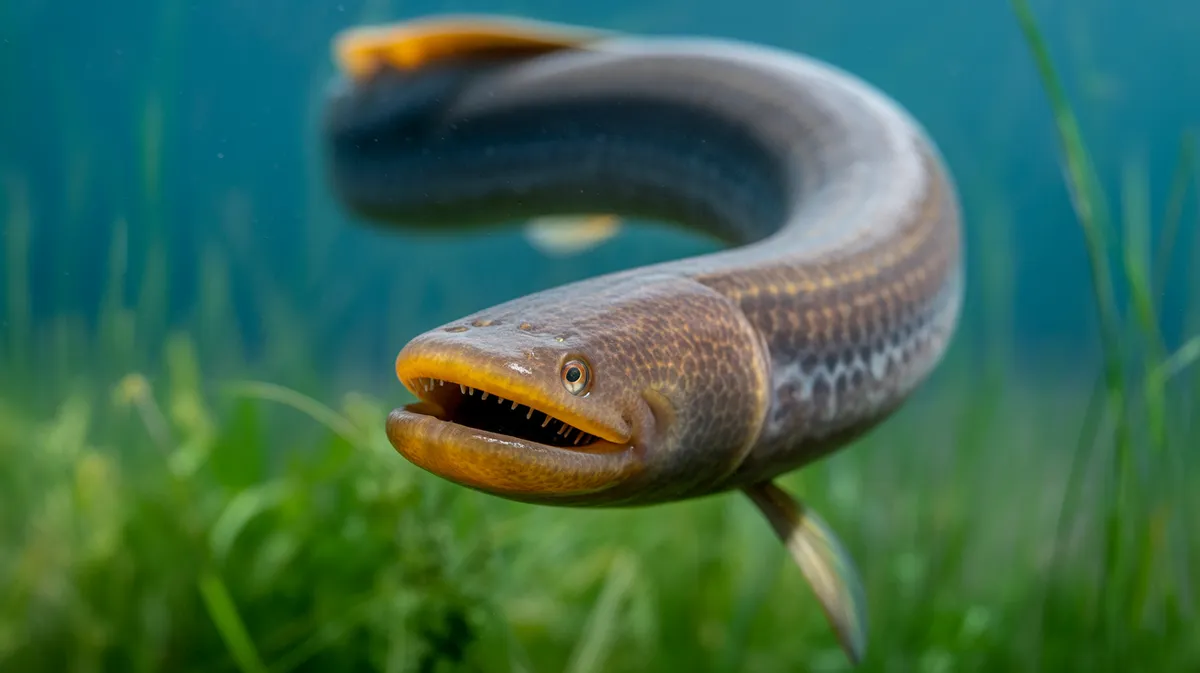
About the Lamprey
Lampreys are jawless fish - agnathans - and along with hagfish they are the only survivors of a body plan that dominated the seas before jaws evolved. They have no jaws, no paired fins, no bones, and a skeleton of cartilage; the mouth is a round sucking disc lined with rings of horny teeth and a rasping tongue. Parasitic species attach to a host fish, rasp through the skin, and feed on blood and body fluids, secreting an anticoagulant called lamphredin to keep the wound flowing. Only about half of the 40-odd species are parasitic; the rest never feed at all as adults, living on reserves built up during the larval stage and dying after spawning. That larval stage is where a lamprey spends most of its life: the ammocoete is blind, toothless, and burrows in stream silt for three to seven years, filter-feeding, before metamorphosing. The sea lamprey's invasion of the Great Lakes through shipping canals in the twentieth century collapsed the lake trout fishery and remains one of the most damaging aquatic invasions in history; it is now suppressed with a selective larvicide applied to spawning streams. Lampreys have been eaten in Europe for centuries, and King Henry I of England is traditionally said to have died from a surfeit of them.
Fascinating facts
Toothy Suction
Lampreys use their circular mouths filled with keratinized teeth to latch onto fish and feed on their blood.
Ancient Design
Lampreys are considered living fossils, having existed in much the same form for hundreds of millions of years.
Double Life
Many lamprey species migrate from freshwater to the sea and back again to complete their life cycle, similar to salmon.
Detailed description
The sea lamprey (Petromyzon marinus) is a primitive, jawless vertebrate with an elongated, eel-like body typically reaching 35–100 cm in length and weighing up to 2.5 kg. Its most distinctive feature is a round, sucker-like oral disc lined with concentric rows of keratinized teeth and a rasping tongue, which it uses to attach to host fish and feed on their blood and bodily fluids. Lampreys lack paired fins, scales, and true bones; instead, their skeleton is composed of cartilage. Their eyes are well-developed in adults, while the larval stage (ammocoete) is blind and filter-feeds on organic detritus. Lampreys possess seven pairs of gill openings on each side of the head, and their single nostril is located on the top of the head. The circulatory system is simple, with a two-chambered heart, and they have a notochord throughout life. Lampreys exhibit a complex life cycle: after hatching, larvae spend 3–7 years burrowed in soft sediment, undergoing metamorphosis before migrating to the sea or lakes as parasitic adults. Adults are semelparous, dying shortly after spawning. Their unique physiology allows them to osmoregulate in both freshwater and marine environments, and they play diverse ecological roles as both predators and prey.
Did you know?
Lampreys are among the few vertebrates that can regenerate spinal cord tissue after injury.
Research & sources
Wikipedia summary
Lampreys are a group of jawless fish comprising the order Petromyzontiformes, sole order in the class Petromyzontida. The adult lamprey is characterized by a toothed, funnel-like sucking mouth. The common name "lamprey" is probably derived from Latin lampetra, which may mean "stone licker", though the etymology is uncertain. "Lamprey" is sometimes seen for the plural form.
Behaviour & social structure
Adult sea lampreys are solitary and highly migratory, traveling long distances between freshwater spawning grounds and marine or lacustrine feeding habitats. As parasites, they locate hosts using chemosensory cues and attach using their oral disc, secreting anticoagulant compounds to facilitate feeding. Feeding bouts can last several days, after which the lamprey detaches and seeks another host. Lampreys are primarily nocturnal during their larval stage, emerging at night to feed on detritus. Adults are more active during twilight and nighttime, especially during upstream spawning migrations. Social interactions are minimal outside of breeding, though pheromonal communication is crucial for mate attraction and larval aggregation. Lampreys exhibit homing behavior, returning to natal streams to spawn, guided by olfactory cues from larval pheromones.
Reproduction & life cycle
Reproduction occurs in spring to early summer, triggered by rising water temperatures (typically 10–20°C). Adults cease feeding and migrate upstream, often overcoming significant obstacles using their suction mouth. Males construct nests by moving stones with their mouths to create depressions in gravel substrates. Females join the nest, and spawning involves external fertilization: the female releases thousands of eggs (30,000–100,000), which the male simultaneously fertilizes. After spawning, both sexes die within days. There is no parental care; eggs hatch in 10–20 days, and larvae drift downstream to suitable burrowing habitats. The larval stage (ammocoete) lasts 3–7 years, after which metamorphosis occurs, transforming the larvae into parasitic adults or, in some species, non-parasitic forms that do not feed as adults.
Adaptations & survival
Lampreys exhibit several evolutionary adaptations: their cartilaginous skeleton and flexible body allow efficient swimming and burrowing. The oral disc and rasping tongue are specialized for parasitic feeding, enabling attachment to a wide variety of host fish. Their anticoagulant saliva prevents host blood from clotting. Osmoregulatory adaptations permit survival in both freshwater and marine environments, facilitated by specialized gill and kidney function. Larval filter-feeding and burrowing reduce predation risk and exploit detritus-rich microhabitats. Adults have well-developed chemosensory systems for host detection and natal homing. Semelparity (single reproductive event) maximizes reproductive output in unpredictable environments.
Cultural significance
Lampreys have held cultural significance for millennia. In medieval Europe, lampreys were considered a delicacy, especially among royalty; King Henry I of England is famously said to have died from 'a surfeit of lampreys.' In Basque and Portuguese cuisine, lamprey dishes remain traditional. Lampreys appear in folklore and heraldry, sometimes symbolizing tenacity or transformation. Their unique biology has made them important model organisms in evolutionary and developmental biology, particularly for understanding vertebrate origins and neural regeneration.
Recent research
Recent research has focused on lamprey genomics, revealing insights into early vertebrate evolution and immune system development. Lampreys possess a unique adaptive immune system based on variable lymphocyte receptors (VLRs), distinct from jawed vertebrates. Their remarkable ability to regenerate spinal cord tissue has made them a model for neurobiological studies. Ongoing research addresses pheromonal communication for population management, impacts of invasive lampreys, and conservation genetics of declining native populations. Advances in lampricide specificity and fish passage technology are also active areas of applied research.
Videos
Habitat
Freshwater rivers and streams, occasionally coastal marine environments


Conservation
The Lamprey is currently classified as Least Concern on the IUCN Red List.
Threats & challenges
While the sea lamprey is listed as Least Concern globally, populations face localized threats including habitat fragmentation (dams, weirs), pollution, and water quality degradation. Invasive populations, such as those in the North American Great Lakes, have caused significant declines in native fish stocks and are subject to intensive control measures (e.g., lampricides, barriers, trapping). Conversely, native populations in Europe and parts of North America are declining due to loss of spawning habitat and river connectivity. Climate change may alter migration cues and spawning success. Conservation efforts focus on habitat restoration, fish passage improvement, and balancing control in invasive ranges with protection in native habitats.
Taxonomy
Scientific name
Petromyzon marinus
- Kingdom
- Animalia
- Phylum
- Chordata
- Class
- Hyperoartia
- Order
- Petromyzontiformes
- Family
- Petromyzontidae
- Genus
- Petromyzon
- Species
- marinus
Community notes
Share your observations about the Lamprey.
No community notes yet. Be the first!
Discover more wildlife
More fascinating animals from the encyclopedia.