
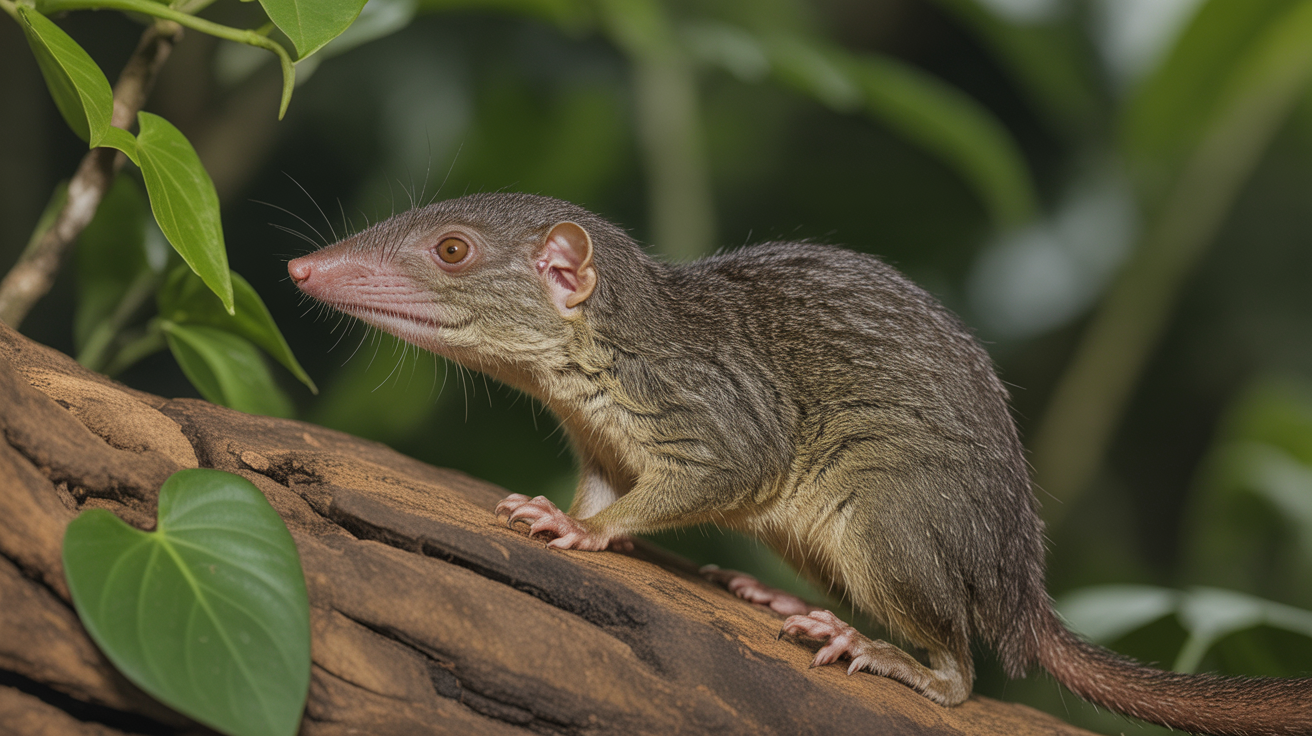
About the Large Treeshrew
The Large Treeshrew is a small, agile mammal native to Southeast Asia, particularly found on the islands of Borneo and Sumatra. Recognizable by its elongated snout, bushy tail, and brownish fur, it is considerably larger than other treeshrew species. Despite the name, treeshrews are not true shrews and are more closely related to primates. This diurnal animal is highly active, spending much of its time foraging on the forest floor and in low vegetation for insects, fruit, and small vertebrates.
Fascinating facts
Ground Dwellers
Despite being called treeshrews, Large Treeshrews spend most of their time foraging on the ground rather than up in the trees.
Special Teeth
They have a distinctive dental formula among treeshrews, with sharp teeth adapted for an omnivorous diet.
Evolutionary Link
Large Treeshrews are considered one of the closest extant relatives to primates, helping scientists understand mammalian evolution.
Detailed description
The Large Treeshrew (Tupaia tana) is a medium-sized scandentian mammal, with adults typically measuring 19–22 cm in head-body length and possessing a bushy tail of 16–21 cm. Adults weigh between 150 and 310 grams, making them the largest species within the genus Tupaia. Their fur is dense and coarse, generally dark brown to reddish-brown dorsally with paler, sometimes yellowish, underparts and a distinctive black stripe running down the back. The elongated, flexible snout is highly sensitive and adapted for probing leaf litter and crevices for food. Large Treeshrews have sharp, recurved claws and robust limbs, facilitating both terrestrial and arboreal locomotion, though they are primarily ground-dwelling. Their large eyes and keen sense of smell support their diurnal and crepuscular activity patterns. The ears are rounded and relatively large, aiding in acute hearing. Unlike many other treeshrew species, T. tana spends most of its time on the forest floor, only occasionally climbing low vegetation. The species is solitary or lives in monogamous pairs, with individuals maintaining well-defined territories marked by scent glands. Vocalizations, including high-pitched whistles and trills, are used for communication and territory defense.
Did you know?
The Large Treeshrew is one of the closest living relatives to primates, offering important insights into the evolutionary history of mammals.
Research & sources
Wikipedia summary
The large treeshrew is a treeshrew species within the Tupaiidae. It is native to Sumatra and adjacent small islands, as well as in the lowlands and hills of Borneo.
Behaviour & social structure
Large Treeshrews are predominantly diurnal, with peak activity in the early morning and late afternoon. They are highly active foragers, using their sensitive snouts to search through leaf litter for insects, earthworms, spiders, and other invertebrates, as well as consuming fruit, seeds, and occasionally small vertebrates such as lizards or frogs. They exhibit a 'scatter-hoarding' behavior, caching food items for later consumption. Territorial and solitary by nature, individuals or pairs vigorously defend their home ranges, which may overlap slightly at the boundaries. Scent marking is frequent, using specialized glands on the chest and abdomen. Social interactions are generally limited to mating pairs and mother-offspring relationships, though brief encounters between neighbors may involve vocalizations and threat displays. Rest periods are spent in nests constructed in tree hollows, fallen logs, or dense vegetation close to the ground.
Reproduction & life cycle
Reproduction in Tupaia tana is characterized by a monogamous system, with pairs maintaining long-term bonds. Breeding can occur year-round, but peaks have been observed during the wet season when food is abundant. Females have a gestation period of approximately 45–50 days, after which they give birth to litters of 1–3 altricial young. Uniquely, mothers practice 'absentee care,' visiting the nest only once every 48 hours to nurse the young, minimizing scent trails and reducing predation risk. The young are weaned at around 30–35 days and become independent shortly thereafter. Sexual maturity is reached at about 4–6 months of age. Parental investment is primarily maternal, with males contributing to territory defense but not directly to offspring care.
Adaptations & survival
Large Treeshrews exhibit several adaptations to their ecological niche. Their elongated snout and highly mobile nose are specialized for tactile foraging in dense leaf litter. Strong, curved claws and robust forelimbs enable efficient digging and climbing. Their acute vision and hearing are well-suited for detecting predators and prey in the dim forest understory. The 'absentee care' reproductive strategy is a unique adaptation among mammals, reducing the risk of nest predation. Their omnivorous diet and flexible foraging strategies allow them to exploit a wide range of food resources, contributing to their ecological success in diverse forest habitats. Scent glands facilitate complex chemical communication for territory marking and mate attraction.
Cultural significance
Large Treeshrews have limited direct cultural significance to local human populations, as they are not commonly hunted for food or used in traditional medicine. However, treeshrews in general have featured in local folklore as clever or elusive animals. In scientific research, Tupaia species are of considerable interest due to their evolutionary position as one of the closest living relatives to primates, making them valuable models in studies of mammalian brain evolution, behavior, and disease.
Recent research
Recent research has focused on the neuroanatomy and cognitive abilities of treeshrews, highlighting their advanced sensory processing and spatial memory. Genomic studies have revealed insights into their evolutionary relationships with primates and colugos, supporting their placement within the Euarchonta clade. Field studies in Borneo and Sumatra have documented their responses to habitat disturbance, demonstrating behavioral plasticity but also sensitivity to severe habitat fragmentation. Ongoing research is examining their role in seed dispersal and invertebrate population control within tropical forest ecosystems. Additionally, Tupaia tana has been used as an experimental model in biomedical research, particularly in studies of hepatitis virus infection.
Videos
Habitat
Tropical rainforest


Conservation
The Large Treeshrew is currently classified as Least Concern on the IUCN Red List.
Threats & challenges
While currently listed as Least Concern by the IUCN, Large Treeshrews face ongoing threats from habitat loss due to deforestation, logging, and conversion of lowland forests to agriculture, particularly oil palm plantations. Fragmentation of their habitat can isolate populations and reduce genetic diversity. They are occasionally hunted or trapped locally, though not at levels that threaten the species overall. Climate change poses an emerging challenge, potentially altering forest structure and food availability. Despite these pressures, T. tana remains relatively adaptable, persisting in secondary forests and disturbed habitats, though population densities are lower outside primary forests.
Taxonomy
Scientific name
Tupaia tana
- Kingdom
- Animalia
- Phylum
- Chordata
- Class
- Mammalia
- Order
- Scandentia
- Family
- Tupaiidae
- Genus
- Tupaia
- Species
- tana
Community notes
Share your observations about the Large Treeshrew.
No community notes yet. Be the first!
Discover more wildlife
More fascinating animals from the encyclopedia.