
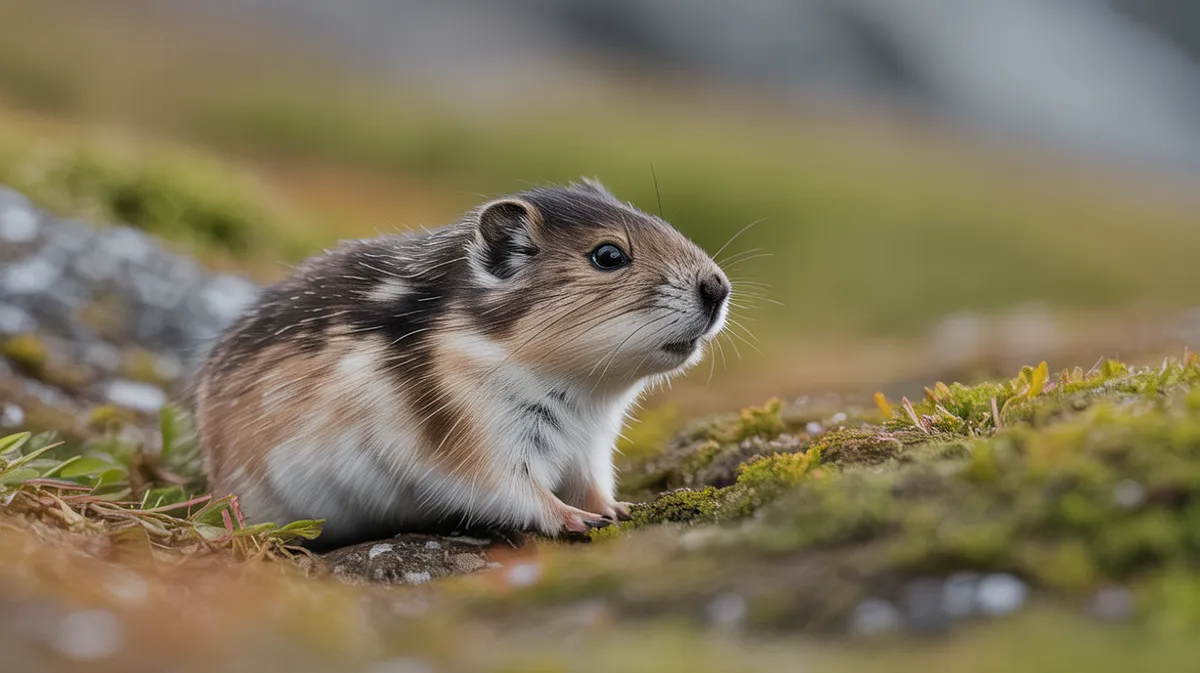
About the Lemming
Lemmings are small, stocky Arctic and subarctic rodents, and they are the subject of one of the most durable pieces of wildlife misinformation ever produced. They do not commit mass suicide. That belief was cemented by the 1958 Disney documentary White Wilderness, which won an Academy Award and which staged the scene: lemmings imported to Alberta, hundreds of kilometres from the sea, were herded onto a snow-covered turntable to create the illusion of a migrating horde and then driven off a riverbank by the film crew. What is true is stranger and better documented. Lemming populations undergo boom-and-bust cycles with a period of roughly three to five years, in some regions swinging by a factor of a hundred or more, and during a boom animals disperse en masse in search of food; some drown crossing water they misjudge. Those cycles drive the entire Arctic food web - snowy owls, Arctic foxes, skuas and stoats breed heavily in lemming years and fail in crash years, and even geese benefit, because in a lemming year predators leave their nests alone. Lemmings stay active all winter under the snow, tunnelling through the subnivean space, and they do not hibernate. Warming winters that produce ice crusts instead of powder are disrupting the cycles.
Fascinating facts
Arctic Adaptations
Lemmings have thick fur and stocky bodies that help them retain heat in freezing tundra environments.
Vegetarian Diet
They feed mainly on grasses, mosses, and roots, often storing food in their burrows for winter.
Population Booms
Every 3-4 years, lemming populations can explode, causing mass migrations as they search for food.
Detailed description
The Norway lemming (Lemmus lemmus) is a small, robust rodent measuring 13–15 cm in length, with a short tail of 1.5–2.5 cm and a body mass typically ranging from 40 to 112 grams. Its dense, woolly fur is patterned in striking patches of black, brown, and yellowish-buff, providing both camouflage and insulation against the harsh Arctic environment. Lemmings possess short limbs, small ears, and a blunt snout, all adaptations to minimize heat loss. Their prominent, continuously growing incisors are specialized for gnawing tough tundra vegetation. Norway lemmings are primarily terrestrial but are capable swimmers, sometimes crossing streams or flooded areas during dispersal. They are known for their dramatic population cycles, with numbers peaking every 3–5 years, followed by rapid declines. During population booms, lemmings may become highly visible and mobile, sometimes forming large migratory groups. Despite their reputation for mass suicides, these movements are natural dispersal events triggered by overcrowding and resource depletion. Lemmings play a vital ecological role as prey for a variety of Arctic predators, including foxes, owls, and stoats.
Did you know?
The myth that lemmings commit mass suicide originated from a misrepresented documentary and is not based in scientific fact.
Research & sources
Wikipedia summary
A lemming is a small rodent, usually found in or near the Arctic in tundra biomes. Lemmings form the subfamily Arvicolinae together with voles and muskrats, which form part of the superfamily Muroidea, which also includes rats, mice, hamsters and gerbils. A longstanding myth holds that they exhibit herd mentality and jump off cliffs, committing mass suicide.
Behaviour & social structure
Norway lemmings are primarily crepuscular, being most active during twilight hours, though activity can occur throughout the day and night, especially during the Arctic summer when daylight is continuous. They are solitary outside the breeding season, aggressively defending small territories. Lemmings construct extensive burrow systems beneath the snow in winter, where they create nests lined with grasses and mosses. These burrows provide protection from predators and insulation from extreme cold. Feeding occurs both above and below ground, with individuals foraging on grasses, sedges, mosses, and occasionally bark or roots. Lemmings exhibit food caching behavior, storing plant material in their burrows for periods of scarcity. During population peaks, increased competition can lead to aggressive encounters and dispersal movements, sometimes resulting in mass migrations across the landscape.
Reproduction & life cycle
Breeding in Lemmus lemmus is highly seasonal, typically commencing in late spring as snow melts and continuing through summer, with some reproduction possible under the snow in mild winters. Females are polyestrous and can produce up to 3–5 litters per year, each consisting of 6–8 young on average, though litters of up to 13 have been recorded. The gestation period is approximately 16–23 days. Newborns are altricial, blind, and hairless, but develop rapidly, becoming fully furred within a week and weaned by 14–21 days. Sexual maturity is reached in as little as 3–4 weeks, enabling rapid population growth during favorable conditions. Both sexes participate in nest building, but maternal care is predominant, with females fiercely defending their young.
Adaptations & survival
Norway lemmings have evolved a suite of adaptations for Arctic survival. Their compact bodies and short extremities reduce surface area, minimizing heat loss. Dense, insulating fur allows them to remain active throughout the winter, even at subzero temperatures. Their incisors grow continuously, enabling them to process tough, fibrous vegetation. Behavioral adaptations include constructing complex tunnel systems beneath snow cover, which provides thermal insulation and protection from predators. Lemmings are capable of rapid reproduction, a strategy that compensates for high predation rates and environmental unpredictability. Their aggressive temperament, especially during population peaks, may deter some predators and competitors.
Cultural significance
Lemmings have held a prominent place in popular culture and folklore, often symbolizing blind conformity due to the persistent myth of mass suicide. This misconception was popularized by early 20th-century nature documentaries and persists in media and language. In some indigenous Arctic cultures, lemmings are recognized as important ecological indicators and are occasionally referenced in traditional stories. There are no significant traditional uses of lemmings as food or material, but their population cycles have long been observed by local peoples as predictors of predator abundance.
Recent research
Recent research has focused on the genetic mechanisms underlying lemming population cycles, with studies suggesting that both intrinsic (hormonal, genetic) and extrinsic (predation, food supply) factors interact to drive these dramatic fluctuations. Advances in remote sensing and field telemetry have allowed for more precise tracking of lemming movements and habitat use. Ongoing studies are examining the impacts of climate change on snow cover dynamics and the subsequent effects on lemming survival and reproduction. There is also growing interest in the role of lemmings as ecosystem engineers, as their burrowing activity influences soil properties and plant community composition.
Videos
Habitat
Arctic tundra


Conservation
The Lemming is currently classified as Least Concern on the IUCN Red List.
Threats & challenges
Currently, Lemmus lemmus is listed as Least Concern by the IUCN due to its wide distribution and large, fluctuating populations. However, climate change poses a significant threat by altering snow cover patterns, which are critical for winter survival and reproduction. Reduced snow insulation increases exposure to cold and predation. Habitat fragmentation and changes in tundra vegetation due to warming may also impact food availability. While lemmings are not directly threatened by human activities, their population cycles make them vulnerable to stochastic events, and their role as a keystone prey species means that declines can have cascading effects on Arctic ecosystems.
Taxonomy
Scientific name
Lemmus lemmus
- Kingdom
- Animalia
- Phylum
- Chordata
- Class
- Mammalia
- Order
- Rodentia
- Family
- Cricetidae
- Genus
- Lemmus
- Species
- lemmus
Community notes
Share your observations about the Lemming.
No community notes yet. Be the first!
Discover more wildlife
More fascinating animals from the encyclopedia.