
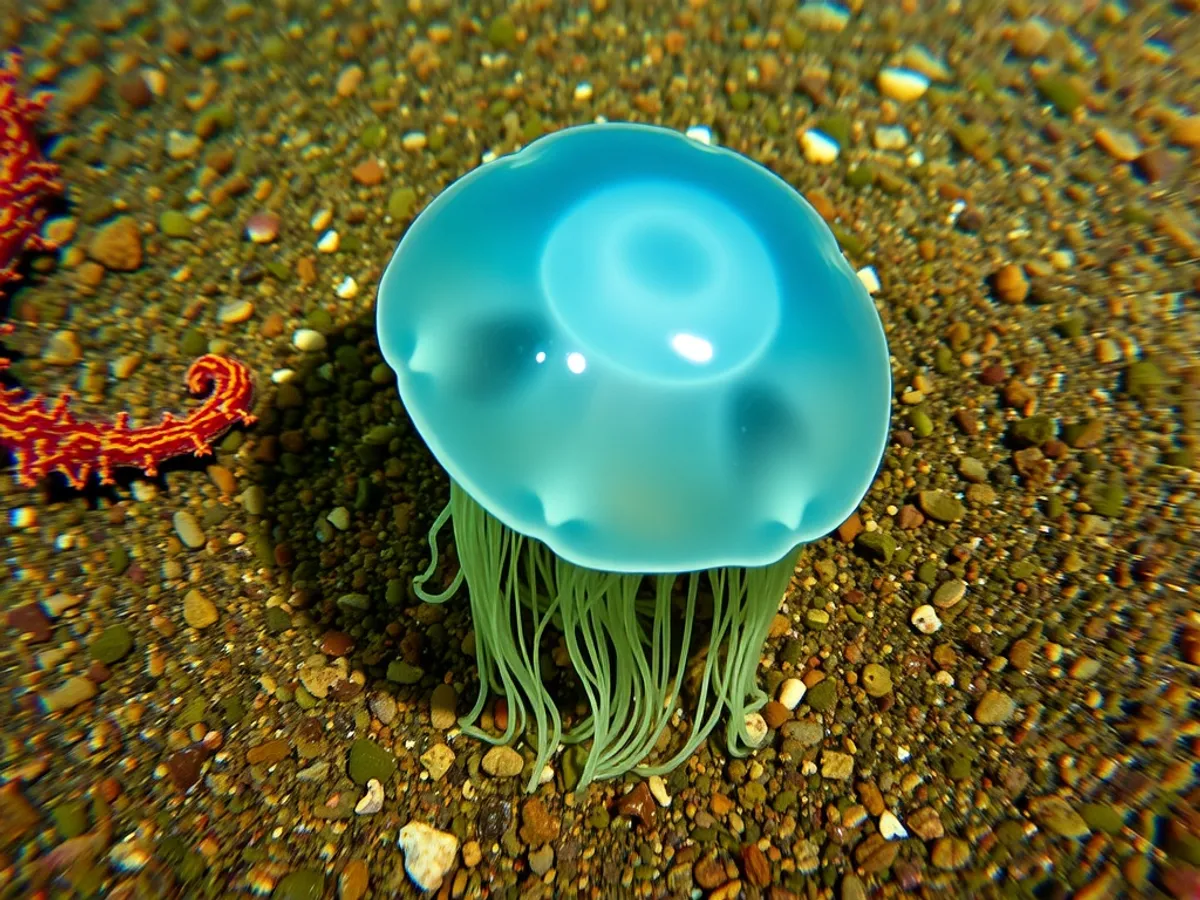
About the Lobed Comb Jelly
The Lobed Comb Jelly is a translucent, gelatinous marine invertebrate known for its beautiful shimmering appearance created by rows of tiny, beating cilia called 'combs.' Native to the western Atlantic Ocean, it is now found in many parts of the world due to accidental introduction via ballast water. The species has distinctive lobes that extend from its body, which help funnel prey towards its mouth. Lobed Comb Jellies are voracious predators, often impacting local ecosystems by consuming large amounts of zooplankton, fish eggs, and larvae. Their soft, delicate bodies are easily damaged, but they are highly resilient and can reproduce rapidly in favorable conditions.
Fascinating facts
Iridescent Combs
The rows of cilia on the Lobed Comb Jelly's body refract light, creating a rainbow-like shimmer as they swim.
Efficient Invader
This species can survive a wide range of salinities and temperatures, making it highly adaptable and invasive.
Zooplankton Eater
Lobed Comb Jellies feed primarily on zooplankton, including copepods, fish eggs, and larvae, impacting local food webs.
Detailed description
The Lobed Comb Jelly (Mnemiopsis leidyi) is a ctenophore distinguished by its oval, laterally compressed, transparent body, typically measuring 2–7.5 cm in length, though individuals can reach up to 12 cm. Its anatomy features two prominent oral lobes extending from either side of the mouth, which are used to funnel prey. Along its body run eight rows of ciliary plates, or 'combs,' which refract light and create a shimmering, rainbow-like effect. Unlike true jellyfish, M. leidyi lacks stinging cells (nematocysts); instead, it captures prey with sticky cells called colloblasts on its tentilla. Internally, it possesses a simple gastrovascular cavity for digestion and a statocyst for balance. The species is bioluminescent, emitting light in response to mechanical stimulation, which may deter predators. M. leidyi is a highly opportunistic feeder, consuming a wide range of zooplankton, fish eggs, and larvae, and is capable of rapid population growth due to its high reproductive output. Its soft, gelatinous body is easily damaged, yet it shows remarkable resilience, often regenerating lost tissues. The species is solitary, with no complex social structure, and is primarily active at night, rising toward the surface to feed.
Did you know?
The Lobed Comb Jelly is considered one of the world's most invasive marine species, having disrupted fisheries in areas like the Black Sea.
Research & sources
Wikipedia summary
Lobata is an order of transparent marine invertebrates belonging to the phylum of Ctenophora in the class Tentaculata, and are commonly referred to as comb jellies or sea gooseberries. There are currently 19 extant known species in the order of Lobata. Members of Lobata exhibit a compressed body in the vertical plane and a pair of oral lobes. They are known to inhabit marine pelagic surfaces and the marine shores.
Behaviour & social structure
Mnemiopsis leidyi is a solitary, free-swimming predator that exhibits diel vertical migration, ascending toward the water surface at night to feed and descending during the day to avoid visual predators. It employs its lobes and ciliated comb rows for gentle propulsion, moving with a characteristic undulating motion. Feeding is non-selective; the lobes and oral cavity trap prey, which are then immobilized by colloblasts and transported to the mouth. M. leidyi can consume prey up to half its own size, including copepods, rotifers, and fish larvae, often outcompeting native species in invaded habitats. It lacks complex social behaviors, interacting with conspecifics primarily through competition for food. The species is capable of rapid feeding, sometimes clearing entire plankton communities in enclosed environments. During periods of high food availability, it can enter a state of continuous feeding and reproduction.
Reproduction & life cycle
Mnemiopsis leidyi is a simultaneous hermaphrodite, possessing both male and female gonads, and is capable of self-fertilization, though cross-fertilization may occur when individuals are in proximity. Spawning is typically continuous during warm months, with peak reproductive output at water temperatures above 15°C. Each adult can release up to 10,000 eggs per day, with fertilization occurring externally in the water column. Embryonic development is rapid; larvae (cydippid stage) hatch within 24 hours and mature into adults in as little as two weeks under optimal conditions. There is no parental care; offspring are planktonic and independent from hatching. This high fecundity and short generation time contribute to the species' invasive potential.
Adaptations & survival
Mnemiopsis leidyi exhibits several key adaptations for survival in variable environments. Its transparent, gelatinous body provides camouflage in open water, while bioluminescence may confuse or deter predators. The ciliated comb rows allow efficient, low-energy locomotion. Colloblasts on the tentilla are specialized for capturing and immobilizing prey without the need for venom. The species tolerates a wide range of salinities (2–38 PSU) and temperatures (2–32°C), enabling colonization of diverse coastal and estuarine habitats. Its ability to self-fertilize ensures reproductive success even at low population densities. Rapid tissue regeneration aids recovery from physical damage. These traits, combined with opportunistic feeding and prolific reproduction, make M. leidyi a highly successful invader.
Cultural significance
Mnemiopsis leidyi has limited direct cultural significance but has become a symbol of invasive species impacts in marine ecosystems, particularly in regions where it has caused fisheries collapses. Its bioluminescence and shimmering appearance have attracted interest from educators and the public, often featuring in marine biology exhibits. There are no known traditional uses or significant roles in mythology.
Recent research
Recent research has focused on the ecological impacts of M. leidyi invasions, particularly in the Black Sea, where it contributed to the collapse of commercial fisheries in the 1980s and 1990s. Genomic studies have revealed a compact genome with unique gene families related to ciliary function and regeneration. Ongoing research investigates its physiological tolerance to environmental stressors, mechanisms of rapid reproduction, and interactions with native and introduced predators such as Beroe ovata. Studies on its microbiome and potential for horizontal gene transfer are also emerging. The species is used as a model organism for studying ctenophore biology, regeneration, and the evolution of nervous systems.
Videos
Habitat
Coastal and estuarine waters

Conservation
The Lobed Comb Jelly is currently classified as Least Concern on the IUCN Red List.
Threats & challenges
Currently, Mnemiopsis leidyi faces few natural predators in many of its introduced ranges, though native predators include the sea turtle (Caretta caretta) and the ctenophore Beroe ovata, which has been used as a biological control agent in the Black Sea. Human impacts, such as ballast water transport, have facilitated its global spread, leading to dramatic ecosystem disruptions, particularly in the Black, Caspian, and Baltic Seas. In these regions, M. leidyi has caused declines in zooplankton and fish populations, notably anchovy and sprat, by consuming eggs and larvae. Climate change and eutrophication may further enhance its invasive potential. Population trends are highly variable, with outbreaks followed by crashes, often regulated by food availability and predation. Conservation status remains 'Least Concern' due to its abundance and adaptability.
Taxonomy
Scientific name
Mnemiopsis leidyi
- Kingdom
- Animalia
- Phylum
- Ctenophora
- Class
- Tentaculata
- Order
- Lobata
- Family
- Mnemiidae
- Genus
- Mnemiopsis
- Species
- leidyi
Where to see a lobed comb jelly
2 zoos and aquariums in 1 country are recorded as keeping this species.

Community notes
Share your observations about the Lobed Comb Jelly.
No community notes yet. Be the first!
Discover more wildlife
More fascinating animals from the encyclopedia.