
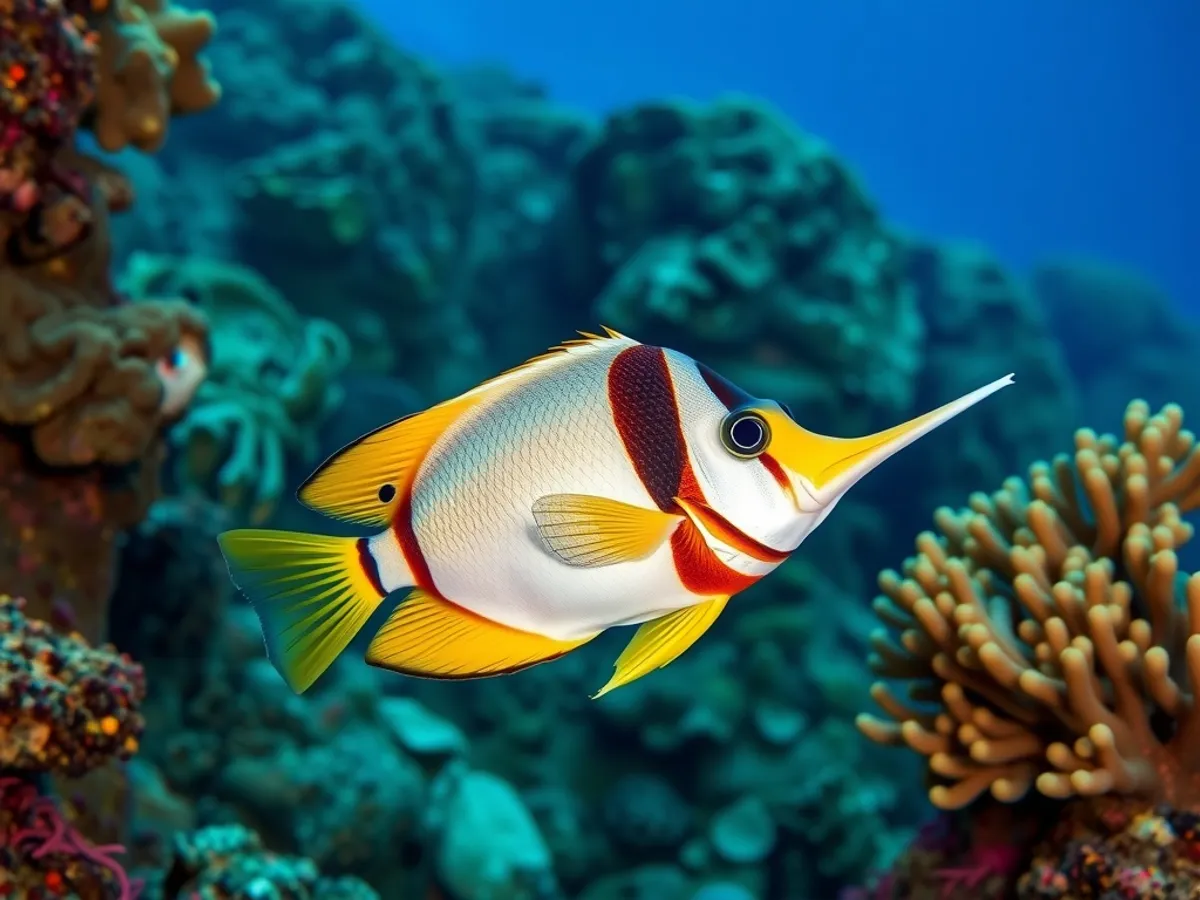
About the Longnose Butterflyfish
The Longnose Butterflyfish is a distinctive marine fish known for its elongated snout and vibrant yellow coloration. It inhabits tropical coral reefs, where its slender snout allows it to feed on small invertebrates hiding in crevices. The species is characterized by a contrasting black patch on its head and a white area near its mouth. Longnose Butterflyfish are often observed singly or in pairs, gracefully maneuvering among coral branches. Their striking appearance and specialized feeding habits make them a popular subject for aquarium enthusiasts and marine biologists alike.
Fascinating facts
Specialized Snout
The elongated snout of the Longnose Butterflyfish allows it to reach prey in narrow coral crevices that most other fish cannot access.
Widespread Distribution
This species is found throughout the Indo-Pacific region, from the eastern coast of Africa to Hawaii and the central Pacific.
Monogamous Behavior
Longnose Butterflyfish often form long-term pairs, exhibiting monogamous behavior and defending territories together.
Detailed description
The Longnose Butterflyfish (Forcipiger flavissimus) is a medium-sized marine fish, typically reaching lengths of 12–22 cm (4.7–8.7 in), with a laterally compressed, disc-shaped body and a strikingly elongated, tubular snout that can comprise up to a third of its total body length. Its body is predominantly bright yellow, with a contrasting black triangular patch covering the eye and upper head, and a white area around the mouth and lower jaw. The dorsal fin is continuous, with 10–11 spines and 21–25 soft rays, while the anal fin has 3 spines and 17–18 soft rays. This species possesses small, bristle-like teeth adapted for extracting prey from narrow crevices within coral reefs. Longnose Butterflyfish are diurnal, exhibiting peak activity during daylight hours as they navigate complex coral structures with remarkable agility. They are often observed singly or in monogamous pairs, maintaining well-defined territories. Their elongated snout and specialized jaws enable them to feed on small crustaceans, polychaete worms, and coral-associated invertebrates inaccessible to many other reef fish. Reproduction involves elaborate courtship displays, with pairs engaging in synchronized swimming and color changes. The species is oviparous, releasing pelagic eggs into the water column. Juveniles are rarely seen and are thought to settle in deeper or more sheltered reef areas. The Longnose Butterflyfish's vivid coloration and unique morphology provide both camouflage among corals and deterrence against predators.
Did you know?
Despite their delicate appearance, Longnose Butterflyfish are highly territorial and will fiercely defend their feeding grounds from intruders.
Research & sources
Wikipedia summary
Longsnout butterflyfish or longnose butterflyfish may refer to:Chelmon rostratus Forcipiger flavissimus Forcipiger longirostris Prognathodes aculeatus
Behaviour & social structure
Forcipiger flavissimus exhibits strong site fidelity, often defending a specific territory against conspecifics and other butterflyfish species. Socially, they are most commonly encountered as solitary individuals or as stable, monogamous pairs, especially during the breeding season. Pair-bonded individuals engage in coordinated foraging and mutual territory defense. Their foraging behavior is highly specialized: they use their elongated snouts and protractile jaws to probe deep into coral crevices, extracting small prey such as amphipods, copepods, polychaete worms, and small crustaceans. Feeding occurs throughout the day, with individuals methodically inspecting coral heads and rubble. At night, they seek shelter within the reef, reducing activity and lowering their metabolic rate. Longnose Butterflyfish communicate through body postures, fin displays, and occasional color changes, particularly during courtship or territorial disputes.
Reproduction & life cycle
Longnose Butterflyfish are oviparous and exhibit seasonal breeding, typically coinciding with warmer water temperatures and increased plankton availability (often spring to early summer, varying by region). Courtship involves intricate displays, including synchronized swimming, circling, and mutual fin erection. Spawning occurs at dusk, with pairs ascending into the water column to release eggs and sperm simultaneously. Fertilized eggs are pelagic, drifting with currents for 24–48 hours before hatching into planktonic larvae. The larval stage, known as the tholichthys stage, lasts several weeks and is characterized by the presence of bony head plates. Juveniles settle onto reefs at a size of 2–3 cm, often in deeper or sheltered microhabitats. There is no parental care post-spawning, and survival rates are influenced by predation and environmental conditions.
Adaptations & survival
The most distinctive adaptation of Forcipiger flavissimus is its elongated, tubular snout and small, fine teeth, which allow it to access prey hidden deep within coral crevices—an ecological niche with reduced competition. Its laterally compressed body and large, rounded pectoral fins facilitate agile maneuvering among complex coral branches. The bright yellow coloration provides camouflage among coral polyps and sponges, while the black facial patch obscures the eye, confusing predators about the fish's orientation. The species' ability to rapidly change coloration during social interactions or when threatened is a form of visual communication and predator deterrence. Its monogamous pair-bonding and territoriality enhance reproductive success and resource defense.
Cultural significance
The Longnose Butterflyfish is a popular species in the marine aquarium trade, prized for its striking appearance and peaceful temperament. In some Pacific cultures, butterflyfish in general are considered symbols of beauty, grace, and fidelity, due to their monogamous pairing. They are frequently featured in underwater photography, marine tourism, and educational materials as iconic representatives of coral reef biodiversity. There are no known traditional medicinal or subsistence uses for this species.
Recent research
Recent studies have focused on the feeding ecology of Forcipiger flavissimus, highlighting its role in controlling populations of coral-associated invertebrates and its potential as an indicator species for reef health. Genetic research has clarified its phylogenetic relationships within the Chaetodontidae family, revealing cryptic speciation and hybridization events with closely related species such as Forcipiger longirostris. Ongoing research is investigating the impact of habitat fragmentation and coral loss on butterflyfish social structure and reproductive success. Additionally, behavioral experiments have explored the mechanisms of pair-bond formation and maintenance in butterflyfish.
Videos
Habitat
Coral reefs in tropical marine waters

Conservation
The Longnose Butterflyfish is currently classified as Least Concern on the IUCN Red List.
Threats & challenges
While Forcipiger flavissimus is currently listed as Least Concern by the IUCN, it faces localized threats from coral reef degradation, primarily due to climate change-induced coral bleaching, ocean acidification, and destructive fishing practices. Collection for the aquarium trade poses additional pressure in some regions, though the species is generally resilient due to its broad distribution and adaptability. Habitat loss and declining coral cover can reduce available foraging and breeding sites, potentially impacting population densities. Long-term monitoring is necessary to assess population trends in the face of accelerating reef decline.
Taxonomy
Scientific name
Forcipiger flavissimus
- Kingdom
- Animalia
- Phylum
- Chordata
- Class
- Actinopterygii
- Order
- Perciformes
- Family
- Chaetodontidae
- Genus
- Forcipiger
- Species
- flavissimus
Community notes
Share your observations about the Longnose Butterflyfish.
No community notes yet. Be the first!
Discover more wildlife
More fascinating animals from the encyclopedia.