
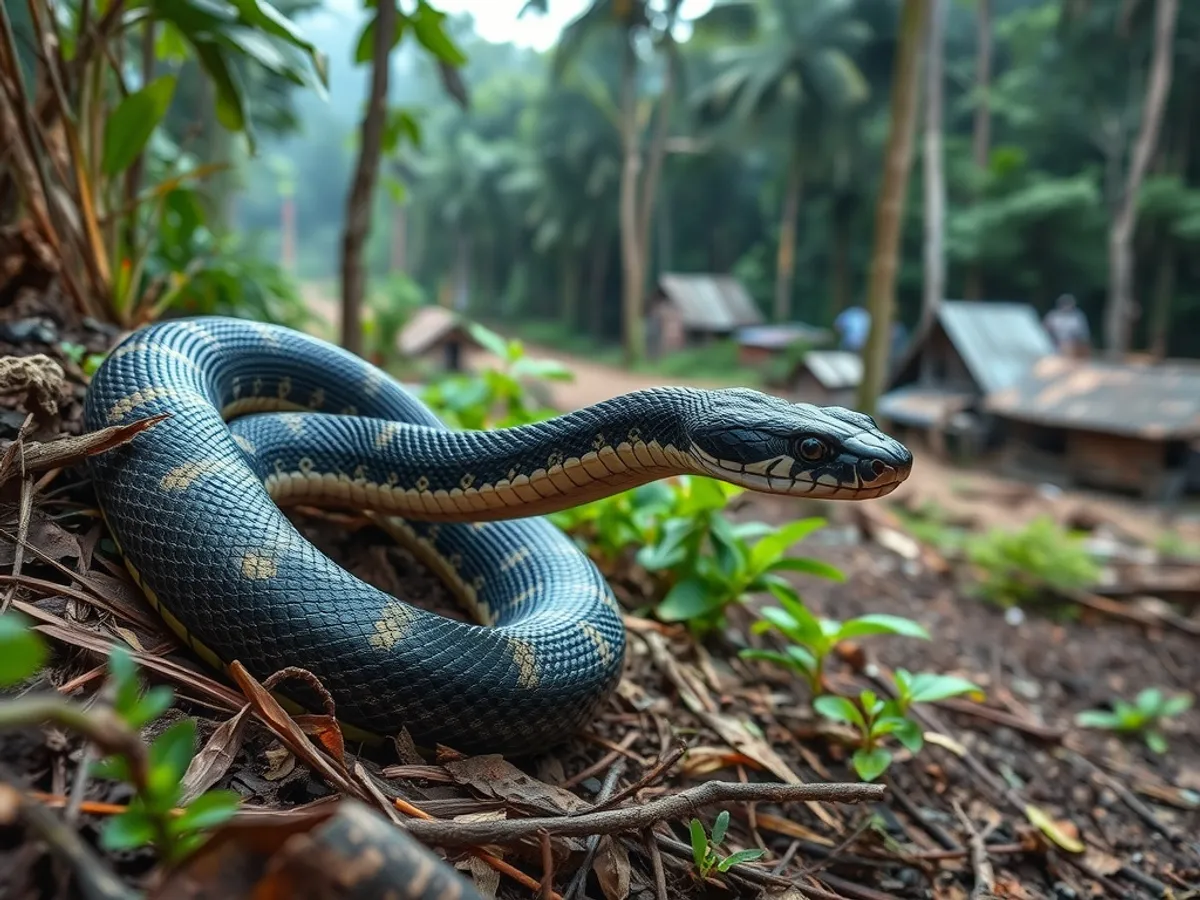
About the Malayan krait
The Malayan krait is a highly venomous snake found throughout Southeast Asia, known for its striking black and white banded pattern. This nocturnal reptile prefers moist habitats and is often encountered near human settlements, especially during the rainy season. Its venom contains potent neurotoxins that can be fatal, making it one of the most dangerous snakes in its range. Despite its lethality, the Malayan krait is generally shy and reclusive, rarely biting unless provoked.
Fascinating facts
Distinctive Bands
Malayan kraits display a striking pattern of alternating black and white bands, which help with camouflage in their native habitat.
Nocturnal Hunter
This snake is most active at night, hunting other snakes, amphibians, and small mammals under the cover of darkness.
Potent Venom
Their venom is highly neurotoxic, capable of causing respiratory failure and death in humans if not treated quickly.
Detailed description
The Malayan krait (Bungarus candidus) is a medium-sized elapid snake, typically measuring 108–130 cm in total length, though some individuals can exceed 150 cm. Its most distinctive feature is its alternating black and white or pale bluish bands, which are broad and sharply defined, running the length of a slender, laterally compressed body. The head is slightly wider than the neck, with smooth, glossy scales and relatively small eyes with round pupils, indicative of its nocturnal habits. The ventral surface is usually white or pale yellow. The Malayan krait is primarily terrestrial but is capable of limited climbing and swimming. It is a secretive and nocturnal species, spending daylight hours hidden under debris, in burrows, or beneath logs, emerging at night to hunt. Its neurotoxic venom is among the most potent of Asian snakes, acting rapidly on the nervous system and causing paralysis. Despite its dangerous reputation, the species is generally docile and reluctant to bite, often relying on its cryptic coloration and reclusive behavior to avoid threats. Malayan kraits are solitary outside the breeding season and display little social interaction. Their distribution spans much of Southeast Asia, including Thailand, Malaysia, Indonesia, Cambodia, Laos, Vietnam, and southern Myanmar, favoring lowland habitats with proximity to water.
Did you know?
A Malayan krait's bite can be almost painless and is sometimes not immediately noticed, yet it can be fatal without prompt medical treatment.
Research & sources
Wikipedia summary
Bungarus candidus, commonly known as the Malayan krait or blue krait, is a highly venomous species of snake. The blue krait is a member of the genus Bungarus and the family Elapidae.
Behaviour & social structure
Malayan kraits are strictly nocturnal, with peak activity occurring between dusk and midnight. During the day, they remain hidden in rodent burrows, under leaf litter, or within crevices to avoid predators and desiccation. Their hunting strategy is primarily ambush-based, relying on stealth and their cryptic coloration to approach prey undetected. The diet consists mainly of other snakes, including venomous and non-venomous species, but they also consume lizards, small mammals, and occasionally amphibians. Feeding is infrequent due to their slow metabolism and the high caloric value of their prey. Malayan kraits are generally solitary and show little tolerance for conspecifics outside of mating periods. When threatened, they may coil and hide their head beneath their body or remain motionless, relying on camouflage rather than aggression. Defensive biting is rare but can occur if the snake is persistently provoked or handled.
Reproduction & life cycle
Bungarus candidus is oviparous, with breeding typically occurring at the onset of the rainy season (May to July in much of its range). Males locate females via pheromonal cues and may engage in combat with rival males. After mating, females lay clutches of 4–15 elongated, leathery eggs in concealed, humid locations such as under logs or within abandoned burrows. Incubation lasts approximately 60–70 days, depending on ambient temperature and humidity. Females do not exhibit parental care beyond egg-laying. Hatchlings measure 25–30 cm at birth and are fully independent, possessing functional venom glands and displaying adult-like coloration and behavior from the outset.
Adaptations & survival
The Malayan krait exhibits several adaptations for survival in its environment. Its potent neurotoxic venom is highly specialized for subduing other snakes, its primary prey, and acts rapidly to immobilize both prey and potential predators. The bold banded coloration provides disruptive camouflage in dappled forest light, while also serving as aposematic (warning) coloration to deter predators. Nocturnality reduces competition with diurnal predators and prey, and helps avoid the heat of the day. The species’ slow, deliberate movements and tendency to remain motionless when threatened further enhance its ability to avoid detection. Its slender, flexible body allows it to access narrow crevices and burrows, both for hunting and shelter.
Cultural significance
The Malayan krait features in local folklore and traditional beliefs throughout Southeast Asia, often regarded with a mixture of fear and respect due to its potent venom and secretive habits. In some cultures, it is associated with omens or supernatural powers, and its appearance near human dwellings is sometimes interpreted as a warning. There are few documented uses in traditional medicine, likely due to the risk involved in handling the species. Its striking appearance has made it a subject of interest among herpetologists and wildlife enthusiasts, but it is generally avoided by local populations.
Recent research
Recent research has focused on the composition and pharmacological effects of Bungarus candidus venom, which contains a complex mixture of alpha-bungarotoxins and other neurotoxins targeting nicotinic acetylcholine receptors. Studies have highlighted the clinical challenges in treating envenomation, as symptoms can develop slowly but progress rapidly to respiratory paralysis. Ongoing ecological studies are examining the species’ adaptability to human-modified landscapes and its role in controlling populations of other snakes and small vertebrates. Genetic analyses have revealed significant geographic variation, suggesting the possibility of cryptic species within the Bungarus candidus complex. Conservation research is monitoring population trends and the impact of habitat fragmentation, with recommendations for public education to reduce unnecessary killing and promote coexistence.
Videos
Habitat
Tropical forests, agricultural fields, and rural human settlements
 Various Continental Regions
Grassland
Open areas dominated by grasses rather than trees, supporting numerous herbivores and their predators.
 Global
Forest
Wooded areas with significant tree cover and diverse plant and animal communities.
 Global
Freshwater
Lakes, rivers, and wetlands with diverse aquatic ecosystems.
Conservation
The Malayan krait is currently classified as Least Concern on the IUCN Red List.
Threats & challenges
Currently classified as Least Concern by the IUCN, the Malayan krait faces localized threats from habitat loss due to agricultural expansion, urbanization, and deforestation. Road mortality is a significant risk, as the species often crosses roads at night. In some areas, it is killed out of fear due to its venomous nature. However, its adaptability to disturbed habitats, including agricultural fields and rural settlements, has allowed it to persist in many regions. There is limited evidence of population decline, but ongoing habitat fragmentation and human encroachment could pose future risks. Collection for the pet trade is minimal, as the species is not commonly kept in captivity due to its dangerous venom and specialized diet.
Taxonomy
Scientific name
Bungarus candidus
- Kingdom
- Animalia
- Phylum
- Chordata
- Class
- Reptilia
- Order
- Squamata
- Family
- Elapidae
- Genus
- Bungarus
- Species
- candidus
Community notes
Share your observations about the Malayan krait.
No community notes yet. Be the first!
Discover more wildlife
More fascinating animals from the encyclopedia.