
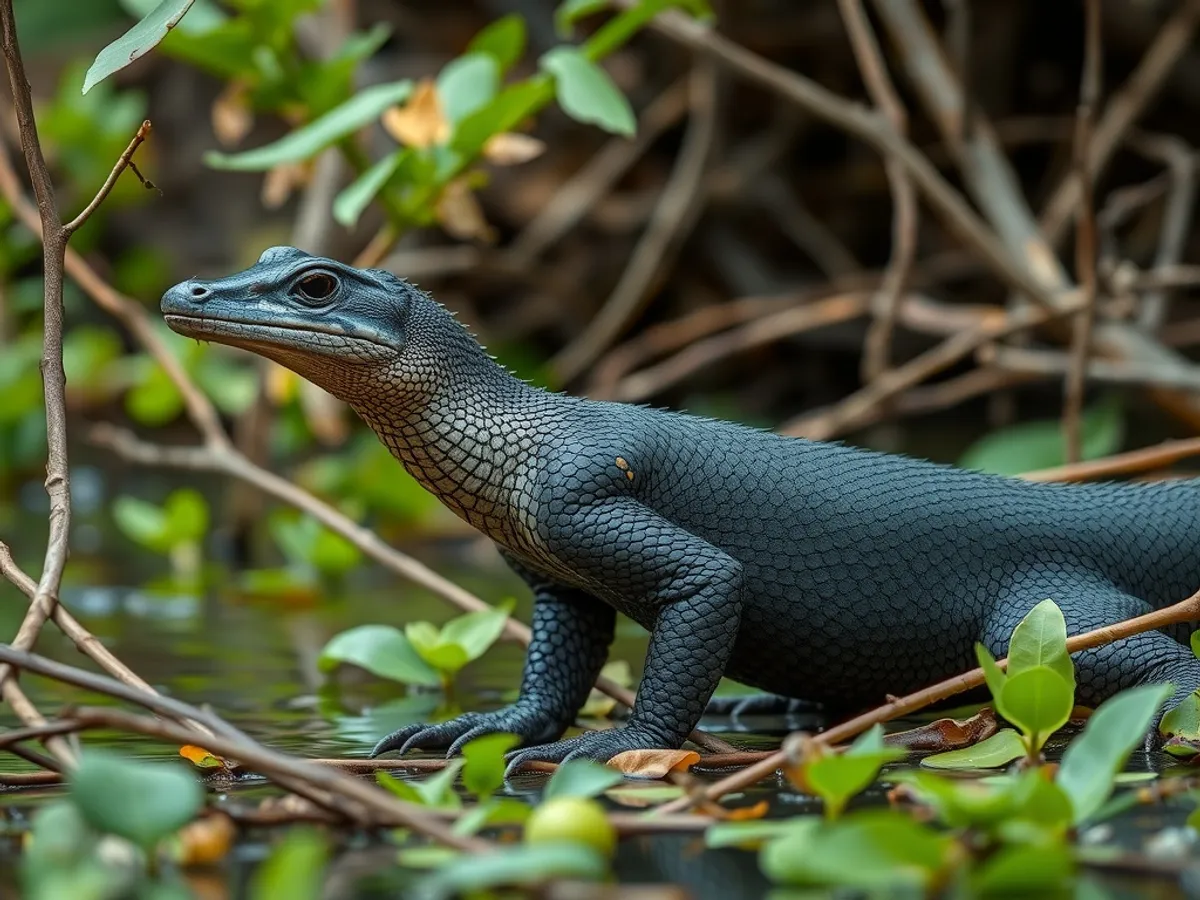
About the Mangrove Monitor
The Mangrove Monitor is a medium-sized monitor lizard native to northern Australia, New Guinea, and many islands throughout the western Pacific. It is characterized by its sleek, muscular body, dark coloration with yellowish spots, and a long, prehensile tail that aids in swimming. Adapted to mangrove swamps and coastal forests, this species is an adept climber and swimmer. The Mangrove Monitor is both a terrestrial and arboreal hunter, preying on a variety of animals such as crabs, insects, fish, and small vertebrates.
Fascinating facts
Expert Swimmers
Mangrove Monitors are highly skilled swimmers, able to stay underwater for up to 45 minutes while hunting or avoiding predators.
Diverse Diet
Their diet is extremely varied, including crabs, mollusks, insects, fish, birds, and even small mammals.
Tree Dwellers
They frequently climb trees in mangrove forests, using their sharp claws and prehensile tails for balance and support.
Detailed description
The Mangrove Monitor (Varanus indicus) is a robust, medium-sized monitor lizard, typically reaching total lengths of 90–120 cm (3–4 ft), though some individuals may exceed this. Its body is slender and muscular, with a laterally compressed, prehensile tail that can comprise up to two-thirds of its total length, aiding both in swimming and balance while climbing. The dorsal coloration is generally dark brown to black, adorned with numerous small yellow or cream-colored ocelli (spots), which provide camouflage among the dappled light of mangrove forests. The ventral surface is lighter, often pale yellow or cream. The head is elongated with a pointed snout, and the jaws house sharp, recurved teeth suited for grasping slippery prey. The tongue is long, forked, and highly sensitive, used for chemoreception. Mangrove Monitors possess well-developed limbs with sharp claws, facilitating both arboreal and terrestrial locomotion. They are highly adaptable, occupying a range of coastal habitats including mangrove swamps, tidal flats, and riverine forests. Their semi-aquatic lifestyle is supported by nostrils positioned close to the tip of the snout, allowing them to breathe while mostly submerged. This species is diurnal, with activity patterns closely tied to tidal cycles in their environment.
Did you know?
Despite their aquatic adaptations, Mangrove Monitors can sometimes be found far inland, utilizing rivers and wetlands away from the coast.
Research & sources
Wikipedia summary
The mangrove monitor, mangrove goanna, or Western Pacific monitor lizard is a member of the monitor lizard family with a large distribution from northern Australia and New Guinea to the Moluccas and Solomon Islands. It grows to lengths of 3.5 to 4 ft. It is also known as wbl yb in the Kalam language of Papua New Guinea.
Behaviour & social structure
Mangrove Monitors are primarily solitary and territorial, with individuals maintaining overlapping home ranges, especially in resource-rich habitats. They are active during the day (diurnal), often seen basking in the morning to regulate body temperature before foraging. Their hunting strategy is opportunistic and highly varied: they use keen vision and an acute sense of smell to locate prey, which includes crustaceans (notably crabs), fish, insects, amphibians, small mammals, birds, eggs, and carrion. They are proficient swimmers, capable of remaining submerged for up to 45 minutes, and can dive to escape predators or pursue aquatic prey. On land, they exhibit agile climbing behavior, ascending trees and mangrove roots to hunt or evade danger. When threatened, they may inflate their bodies, hiss, lash with their tails, or bite. Social interactions are generally limited to breeding, though juveniles may occasionally be seen in loose aggregations in areas of abundant food.
Reproduction & life cycle
Breeding in Varanus indicus is seasonal in some regions (often correlated with the rainy season), but can occur year-round in equatorial populations. Courtship involves males engaging in ritualized combat and scent-trailing to locate receptive females. Females lay clutches of 2–12 eggs, typically in decaying logs, termite mounds, or burrows, where the temperature and humidity are optimal for incubation. The incubation period ranges from 7 to 8 months, depending on environmental conditions. Hatchlings are precocial, measuring about 25–30 cm in length, and are independent from birth, receiving no parental care. Sexual maturity is generally reached at 2–3 years of age. Reproductive output and clutch frequency can vary with resource availability and environmental stability.
Adaptations & survival
The Mangrove Monitor exhibits several key adaptations for its semi-aquatic and arboreal lifestyle. Its laterally compressed tail functions as a powerful rudder during swimming, while strong limbs and sharp claws enable efficient climbing and digging. The skin is tough and resistant to abrasion and saltwater exposure. Salt glands located near the nostrils allow for excretion of excess salt, a crucial adaptation for survival in brackish environments. The species’ cryptic coloration provides camouflage among mangrove roots and leaf litter. Its highly developed Jacobson’s organ and forked tongue facilitate chemical detection of prey and conspecifics. Behavioral plasticity, including the ability to exploit a wide range of food sources and habitats, has enabled V. indicus to colonize numerous islands and coastal regions.
Cultural significance
Mangrove Monitors hold significance in various indigenous cultures across their range. In Papua New Guinea, they are known as 'wbl yb' in the Kalam language and are sometimes hunted for food or their skins. In some Melanesian societies, monitor lizards are featured in folklore and are believed to possess spiritual or totemic qualities. Their presence in mangrove ecosystems is sometimes seen as an indicator of environmental health. In the pet trade, they are valued for their intelligence and striking appearance, though this has led to concerns about overcollection in some regions.
Recent research
Recent research has focused on the species’ salt gland physiology, revealing convergent evolution with marine iguanas and sea snakes. Genetic studies have shown significant population structuring across its range, with evidence of cryptic speciation among island populations. Ecological studies highlight the monitor’s role as a top predator in mangrove ecosystems, influencing prey populations and nutrient cycling. Ongoing research is investigating the impacts of habitat fragmentation and climate change on population viability. Additionally, studies of their reproductive biology in captivity are informing conservation breeding programs.
Videos
Habitat
Mangrove forests and coastal wetlands


Conservation
The Mangrove Monitor is currently classified as Least Concern on the IUCN Red List.
Threats & challenges
While currently listed as Least Concern by the IUCN, Mangrove Monitors face localized threats from habitat destruction (especially mangrove deforestation for aquaculture and development), pollution, and overharvesting for the pet trade and traditional uses. Invasive species, such as feral cats and dogs, may prey on eggs and juveniles. Climate change poses a long-term threat through sea-level rise and increased frequency of extreme weather events, potentially altering or reducing suitable habitat. In some areas, populations are declining due to these pressures, though the species’ broad distribution and adaptability have so far buffered it from widespread risk.
Taxonomy
Scientific name
Varanus indicus
- Kingdom
- Animalia
- Phylum
- Chordata
- Class
- Reptilia
- Order
- Squamata
- Family
- Varanidae
- Genus
- Varanus
- Species
- indicus
Community notes
Share your observations about the Mangrove Monitor.
No community notes yet. Be the first!
Discover more wildlife
More fascinating animals from the encyclopedia.