
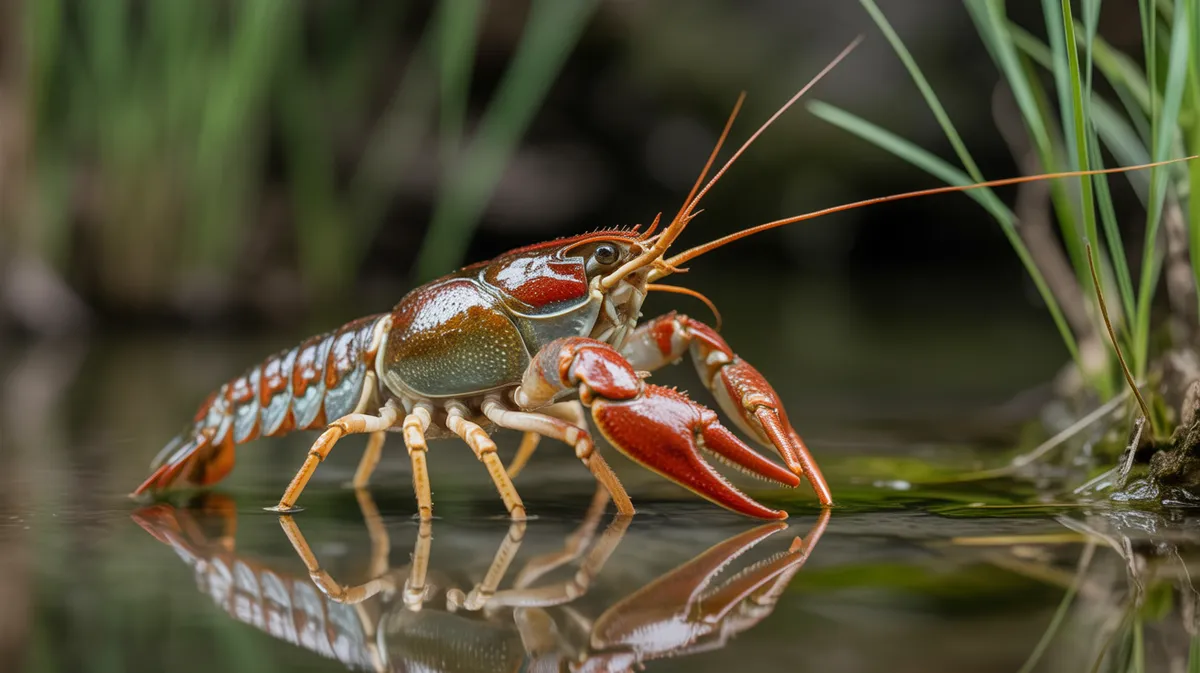
About the Marbled Crayfish
Procambarus virginalis is, as far as anyone can tell, an animal that did not exist before about 1995. It appeared in the German aquarium trade, where hobbyists noticed a crayfish that was reproducing without any males present, and genetic work later showed why: it is triploid, carrying three sets of chromosomes, and it arose from a mating between two slough crayfish, Procambarus fallax, in which one parent contributed an unreduced gamete. The result is an all-female animal that reproduces exclusively by parthenogenesis - every marbled crayfish alive is a clone, and genome sequencing of animals from Germany, Madagascar and the pet trade found them to be effectively genetically identical. It is one of the very few documented cases of a new asexual animal species arising within living memory, and biologists have used it as a natural experiment in how a clonal lineage behaves. It behaves invasively. Released into the wild, a single individual can found a population, and marbled crayfish have exploded across Madagascar - going from a handful of sites to over 100,000 square kilometres in about a decade - threatening endemic crayfish and rice paddies, and they are established in Germany, Slovakia, Ukraine, Japan and elsewhere. The EU has banned them.
Fascinating facts
All-Female Species
Marbled Crayfish populations are entirely female—there are no males in this species, as reproduction occurs through parthenogenesis.
Model for Research
Their unique reproductive biology makes them a valuable model in studies of genetics, development, evolution, and epigenetics.
Invasive Potential
Marbled Crayfish have rapidly spread in the wild, particularly in Madagascar and Europe, raising ecological concerns due to their invasive potential.
Detailed description
The Marbled Crayfish (Procambarus virginalis) is a medium-sized freshwater crustacean, typically reaching lengths of 6–11 cm, with a robust exoskeleton displaying a striking marbled pattern of dark and light patches, which provides camouflage among aquatic vegetation and substrates. Anatomically, it features five pairs of walking legs (pereiopods), the first pair modified into large, chelate claws (chelae) used for defense and food manipulation. Its body is divided into a cephalothorax and abdomen, with a fan-shaped tail (uropods and telson) aiding in rapid backward escape movements. Marbled Crayfish are primarily nocturnal, emerging at dusk to forage and retreating to burrows or under rocks during the day. Socially, they are largely solitary and territorial, displaying aggressive interactions when space or resources are limited. Their most remarkable trait is obligate parthenogenesis: all individuals are female and reproduce without males, producing clonal offspring from unfertilized eggs. This unique reproductive mode has enabled rapid population expansion and colonization of new habitats. Marbled Crayfish are highly adaptable, tolerating a wide range of water temperatures (4–30°C), pH, and oxygen levels, and can survive periods of drought by burrowing into moist substrate. Their omnivorous diet includes detritus, plant matter, algae, invertebrates, and carrion, contributing to their ecological versatility. The species' rapid growth, high fecundity, and resilience have made it a successful invader in non-native regions, raising ecological concerns.
Did you know?
Every marbled crayfish in the world is a clone, sharing identical genetic material with all others.
Research & sources
Behaviour & social structure
Marbled Crayfish are primarily nocturnal, spending daylight hours concealed in self-dug burrows, under rocks, or among dense aquatic vegetation to avoid predation. At night, they become active foragers, using their sensitive antennae and chelae to locate and manipulate food. Their feeding behavior is opportunistic and includes grazing on algae, scavenging dead organic matter, and preying on small aquatic invertebrates. In high-density environments, they exhibit aggressive territoriality, engaging in displays and physical confrontations to defend shelter and food resources. Social interactions are generally limited, with cannibalism observed, especially among juveniles or when food is scarce. Molting occurs periodically as they grow, during which individuals are vulnerable to predation and may isolate themselves. Marbled Crayfish display exploratory behavior and are capable of overland dispersal during wet conditions, facilitating colonization of new habitats.
Reproduction & life cycle
Procambarus virginalis is the only known decapod crustacean to reproduce exclusively by apomictic parthenogenesis, meaning all offspring are genetic clones of the mother. There are no males; reproduction occurs without mating. Females can become gravid multiple times per year, with peak breeding typically in spring and autumn under natural conditions, though reproduction can occur year-round in stable environments. After a gestation period of 3–5 weeks, females lay 50–700 eggs, which are attached to their pleopods (swimmerets) beneath the abdomen. The mother provides brooding care by aerating and cleaning the eggs until hatching. Hatchlings remain attached to the mother for several days to weeks, undergoing two molts before becoming independent. Sexual maturity is reached rapidly, often within 3–7 months, depending on temperature and food availability, enabling explosive population growth.
Adaptations & survival
Key adaptations include obligate parthenogenesis, allowing a single individual to found a new population, and high fecundity, with multiple reproductive cycles per year. Their marbled coloration provides effective camouflage against predators. Physiologically, they tolerate a wide range of environmental conditions, including low oxygen, variable temperatures, and moderate salinity. Behavioral adaptations include burrowing to escape desiccation and predation, and nocturnal activity to reduce exposure to diurnal predators. Their omnivorous, generalist diet allows them to exploit diverse food resources, while rapid growth and early maturity enhance their colonization potential. The ability to disperse overland during wet conditions further facilitates their spread.
Cultural significance
The Marbled Crayfish has limited traditional cultural significance, as it is a recent species of artificial origin. However, it has become a subject of interest in scientific research, particularly in genetics, developmental biology, and invasion ecology. Its unique reproductive biology has made it a model organism for studying clonal evolution, epigenetics, and the consequences of asexuality. In some regions, it is kept as an aquarium pet, but this has contributed to its spread as an invasive species. There are no known roles in mythology or folklore.
Recent research
Recent research has focused on the genomic and epigenetic mechanisms underlying parthenogenesis and clonal reproduction in Procambarus virginalis. The species' triploid genome (resulting from autopolyploidization) has been sequenced, revealing low genetic diversity but high phenotypic plasticity. Studies have examined its rapid adaptability, resistance to disease, and potential as a model for cancer and aging research due to its high regenerative capacity. Ecological studies in Madagascar and Europe have documented its impacts on native biodiversity and ecosystem processes. Ongoing research addresses management strategies for invasive populations and the risks of further spread. The Marbled Crayfish is also being investigated for its potential use in aquaculture and as a bioindicator for environmental monitoring.
Sources
The marbled crayfish as a paradigm for saltational speciation by autopolyploidy and parthenogenesis in animals
Frank Lyko et al. (2017)
scientificThe genome of the marbled crayfish provides insights into evolution and parthenogenesis
Gutekunst, J. et al. (2018)
scientificThe marbled crayfish as a paradigm for saltational speciation by autopolyploidy and parthenogenesis in animals
Frank Lyko et al. (2017)
scientificThe genome of the marbled crayfish provides insights into the evolution of parthenogenesis
Gutekunst, J. et al. (2018)
scientificVideos
Habitat
Freshwater streams, ponds, and lakes


Conservation
The Marbled Crayfish is currently classified as Not Evaluated on the IUCN Red List.
Threats & challenges
In their introduced range, Marbled Crayfish face few natural predators or diseases, contributing to their invasive success. However, in some habitats, predation by fish, birds, and mammals, as well as competition with native crayfish, can exert pressure. Their rapid proliferation poses significant ecological threats, including displacement of native crayfish, alteration of aquatic vegetation, and impacts on food webs. They are vectors for the crayfish plague (Aphanomyces astaci), which can devastate native crayfish populations. Human-mediated spread via the aquarium trade and deliberate releases remains a major challenge. Currently, there are no large-scale eradication efforts, but some countries have banned their import, sale, or possession. Population trends in invaded areas show rapid expansion, while their status in the wild remains unassessed globally.
Taxonomy
Scientific name
Procambarus virginalis
- Kingdom
- Animalia
- Phylum
- Arthropoda
- Class
- Malacostraca
- Order
- Decapoda
- Family
- Cambaridae
- Genus
- Procambarus
- Species
- virginalis
Community notes
Share your observations about the Marbled Crayfish.
No community notes yet. Be the first!
Discover more wildlife
More fascinating animals from the encyclopedia.