
About the Marbled Gecko
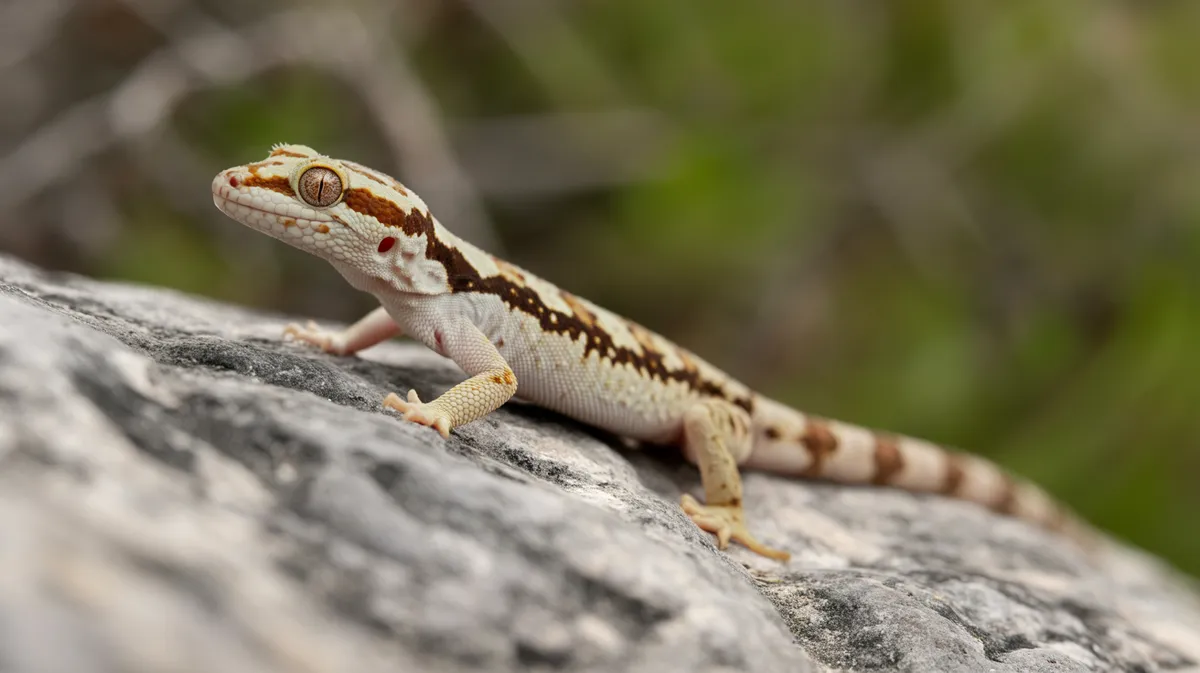
The Marbled Gecko is a small, nocturnal lizard native to southern Australia, known for its distinctive marbled pattern of grey, brown, and white across its body. This gecko is highly adaptable, often found on rocky outcrops, tree trunks, and even in urban gardens and buildings. It has specialized toe pads that enable it to climb smooth vertical surfaces with ease. The Marbled Gecko is primarily active at night, seeking out insects and other small invertebrates for food. Its calm demeanor and striking appearance have made it a popular species among reptile enthusiasts.
Fascinating facts
Tail Autotomy
Marbled Geckos can shed their tails to escape predators, a process known as autotomy. The tail will wriggle to distract the predator while the gecko makes its escape.
Nocturnal Lifestyle
These geckos are active at night, hunting for insects and staying well-hidden during the day to avoid predators and harsh sunlight.
Urban Adaptation
Marbled Geckos are often found in and around human dwellings, taking advantage of artificial structures for shelter and hunting opportunities.
Detailed description
The Marbled Gecko (Christinus marmoratus) is a small, slender lizard typically reaching a snout-vent length of 60–70 mm, with a total length including the tail of up to 120 mm. Its body is soft-skinned and covered in fine granular scales, exhibiting a striking marbled pattern of grey, brown, cream, and sometimes purplish hues, which provides effective camouflage against bark and rocks. The head is relatively broad with large lidless eyes featuring vertical pupils, an adaptation for nocturnal vision. Toes are equipped with expanded pads bearing microscopic setae, enabling adhesion to smooth vertical surfaces and even glass. The tail is prehensile and can be autotomized (shed) as a defense mechanism, regenerating over time. Marbled Geckos are primarily nocturnal, emerging at dusk to forage, and are known for their agility and speed when escaping predators. They are semi-arboreal, favoring tree trunks, rocky outcrops, and human structures for shelter. During the day, they seek refuge in crevices, under bark, or within roof spaces. Their vocalizations include soft clicks and chirps, used in social interactions and territorial displays. The species is highly adaptable, thriving in both natural and urbanized habitats across southern Australia.
Did you know?
The Marbled Gecko sometimes lives communally, with several individuals sharing a single shelter, especially during colder months.
Research & sources
Wikipedia summary
Christinus is a genus of Gekkonidae geckos found in southern regions of Australia. It contains species and subspecies that are regionally termed as marbled geckos. The contrasted patterns of these geckos, marbling, are found in a variety of reddish-brown, grey, silver, white, black and purplish hues. They are frequently found in old knotted trees and sometimes congregate in large numbers in established urban environments.
Behaviour & social structure
Marbled Geckos are solitary for most of the year but may form loose aggregations in favorable shelters, especially during colder months, possibly for thermoregulation. They are territorial, with males displaying aggressive postures and vocalizations to defend prime basking or feeding sites. Nocturnally active, they hunt by ambush and active pursuit, preying on a variety of arthropods such as moths, beetles, spiders, and cockroaches. Their hunting strategy involves slow stalking followed by rapid tongue projection to capture prey. During the day, they remain inactive, conserving energy and avoiding predators. In urban environments, they frequently exploit artificial lighting to ambush insects attracted to light sources. Social interactions are generally limited outside the breeding season, though some communal roosting has been observed.
Reproduction & life cycle
Breeding occurs primarily in the austral spring and summer (September to February). Males establish territories and court females through tactile and vocal signals. After mating, females lay one or two parchment-shelled eggs per clutch, often in communal nesting sites, such as under loose bark or within rock crevices. Incubation lasts approximately 60–90 days, depending on ambient temperature. Females may produce multiple clutches per season. Parental care is absent; hatchlings are independent from birth and resemble miniature adults. Communal nesting is thought to enhance egg survival by stabilizing microclimate and reducing predation risk.
Adaptations & survival
Christinus marmoratus exhibits several adaptations for survival in variable environments. Its cryptic coloration and marbled pattern provide camouflage against predators. The adhesive toe pads, composed of lamellae with microscopic setae, allow efficient climbing on both rough and smooth surfaces. Tail autotomy serves as a predator escape mechanism, with the tail regenerating over several months. Nocturnality reduces competition and predation, while large eyes enhance low-light vision. The species demonstrates behavioral flexibility, readily exploiting urban habitats and artificial structures for shelter and foraging. Communal nesting and occasional group roosting may aid in thermoregulation and reproductive success.
Cultural significance
While not prominent in Aboriginal mythology or Australian folklore, Marbled Geckos are occasionally featured in educational programs and urban wildlife initiatives, highlighting their role as beneficial insectivores in gardens and homes. Their docile nature and striking appearance have made them popular in the pet trade and as subjects for citizen science projects. In some regions, they are regarded as symbols of good luck or household guardians due to their insect-eating habits.
Recent research
Recent research has focused on the biomechanics of gecko adhesion, with Christinus marmoratus serving as a model for understanding setae structure and function. Studies have also examined communal nesting behavior, revealing potential benefits for egg survival and thermal regulation. Ongoing genetic research is clarifying the phylogenetic relationships within the genus Christinus and its divergence from related gecko taxa. Urban ecology studies are investigating the species' adaptability to anthropogenic environments, including dietary shifts and altered activity patterns.
Videos
Habitat
Rocky outcrops, forests, urban areas


Conservation
The Marbled Gecko is currently classified as Least Concern on the IUCN Red List.
Threats & challenges
Currently assessed as Least Concern by the IUCN, the Marbled Gecko faces localized threats from habitat loss due to urban development, removal of old trees, and predation by introduced species such as cats and foxes. Pesticide use in urban and agricultural areas may reduce prey availability and directly impact gecko health. Despite these pressures, the species' adaptability to urban environments and broad distribution have helped maintain stable populations. Climate change poses a potential long-term threat by altering habitat suitability and prey dynamics.
Taxonomy
Scientific name
Christinus marmoratus
- Kingdom
- Animalia
- Phylum
- Chordata
- Class
- Reptilia
- Order
- Squamata
- Family
- Gekkonidae
- Genus
- Christinus
- Species
- marmoratus
Community notes
Share your observations about the Marbled Gecko.
No community notes yet. Be the first!
Discover more wildlife
More fascinating animals from the encyclopedia.