
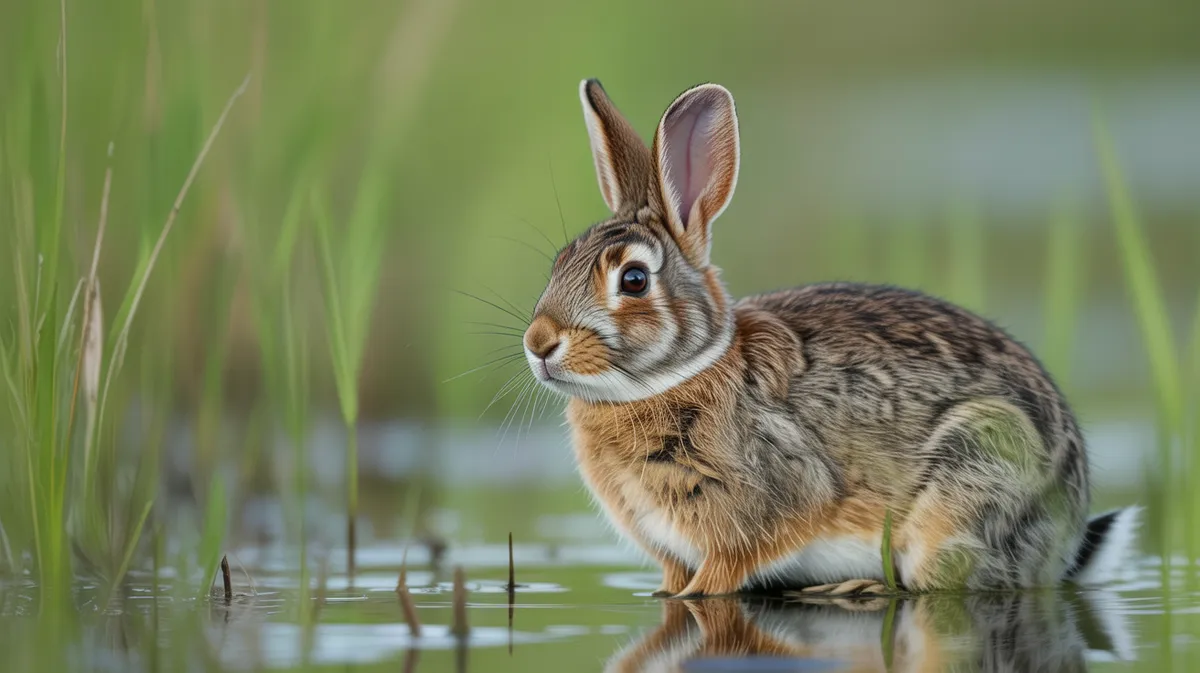
About the Marsh Rabbit
The Marsh Rabbit is a medium-sized, semi-aquatic cottontail native to the southeastern United States. It is well adapted to life in wetlands, with shorter ears and legs compared to other rabbits, and a dark, rusty-brown coat that provides excellent camouflage among marsh vegetation. Marsh Rabbits are strong swimmers and can often be seen taking to the water to escape predators or forage. They are mostly nocturnal, spending their days hidden in dense cover and emerging at dusk to feed. Unlike many other rabbits, they build runways through thick marsh grasses and occasionally create nests above ground.
Fascinating facts
Wetland Specialist
The Marsh Rabbit is specially adapted to wetland habitats, thriving in swamps, marshes, and along riverbanks where few other rabbits can live.
Strong Swimmer
Unlike most rabbits, Marsh Rabbits are adept swimmers and often take to the water to evade predators or move between feeding areas.
Nocturnal Lifestyle
These rabbits are primarily nocturnal, foraging at night and hiding in dense vegetation during the day to avoid detection.
Detailed description
The marsh rabbit (Sylvilagus palustris) is a small, semi-aquatic lagomorph with a compact, robust body adapted for life in wetland environments. Adults typically measure 38–45 cm (15–18 in) in length and weigh between 1.0–1.6 kg (2.2–3.5 lbs). Their pelage is dense and coarse, with a dark brown to rusty-brown dorsal coloration and a grayish or buff ventral side, providing effective camouflage among marsh grasses and reeds. The ears are notably shorter than those of the eastern cottontail, measuring about 4–6 cm (1.6–2.4 in), and the tail is small and inconspicuous, often appearing dark above and white below. The hind legs are relatively short, which, while reducing their speed on land, enhances maneuverability in dense vegetation and water. Marsh rabbits possess partially webbed toes, an adaptation that aids in swimming. They are primarily crepuscular and nocturnal, spending daylight hours concealed in thick cover or in forms—shallow depressions in vegetation. Unlike many terrestrial rabbits, marsh rabbits are solitary outside of the breeding season and maintain overlapping home ranges. Their diet consists mainly of aquatic and semi-aquatic plants, including sedges, grasses, rushes, and occasionally woody browse. They construct above-ground nests for their young, often hidden in dense marsh vegetation. Vocalizations are rare, but they may emit distress calls when threatened. Their strong swimming ability allows them to evade predators by diving into water and navigating through submerged pathways.
Did you know?
Unlike most rabbits, Marsh Rabbits sometimes submerge themselves completely underwater with only their noses exposed to avoid predators.
Research & sources
Wikipedia summary
The marsh rabbit is a small cottontail rabbit found in marshes and swamps of coastal regions of the Eastern and Southern United States. It is a strong swimmer and found only near regions of water. It is similar in appearance to the eastern cottontail but is characterized by smaller ears, legs, and tail.
Behaviour & social structure
Marsh rabbits exhibit solitary and secretive behavior, with individuals maintaining home ranges that can overlap but are not actively defended. They are most active during twilight and nighttime hours, emerging from cover to forage along the edges of marshes and swamps. Feeding behavior is characterized by selective browsing on tender shoots, leaves, and stems of aquatic and emergent plants; they are known to feed on cattails (Typha spp.), pickerelweed (Pontederia cordata), and various grasses. Marsh rabbits create well-worn runways through dense vegetation, which they use for movement and escape. When threatened, they may freeze, relying on camouflage, or flee in a zigzag pattern, often taking to water where they swim with ease—sometimes submerging completely with only their nose exposed. Unlike some other cottontails, they rarely dig burrows, instead using natural cover or constructing simple nests. Social interactions are limited, with aggressive encounters observed mainly during the breeding season.
Reproduction & life cycle
The breeding season for marsh rabbits varies geographically but generally extends from late winter through early fall, with peak activity in spring and summer. Females are induced ovulators and can produce multiple litters per year, typically 3–6 litters annually. Each litter contains 2–4 kits, though litter sizes up to 6 have been recorded. Gestation lasts approximately 30–37 days. Nests are constructed above ground in dense vegetation, lined with fur and grasses. Neonates are altricial, born blind and hairless, and are nursed by the female once or twice daily. Weaning occurs at around 12–15 days, after which the young disperse. There is little to no paternal involvement in rearing the young. High juvenile mortality is common due to predation and environmental hazards.
Adaptations & survival
Marsh rabbits display several adaptations for wetland living. Their short, sturdy legs and partially webbed hind feet facilitate efficient swimming and movement through dense, waterlogged vegetation. The dark, water-resistant fur provides camouflage and protection from the elements. Their small ears and tail reduce heat loss and minimize snagging in thick undergrowth. Behavioral adaptations include nocturnal and crepuscular activity patterns to avoid diurnal predators and heat stress. The ability to use aquatic escape routes and even submerge to evade predators is a unique specialization among North American rabbits. Their diet is highly flexible, allowing them to exploit a wide range of marsh plants, including those less palatable to other herbivores.
Cultural significance
The marsh rabbit has limited direct cultural significance compared to other cottontails, but it plays a role in the folklore and natural history of the southeastern United States. In some regions, it has been hunted for food, though its elusive nature and preference for inaccessible habitats limit its importance as game. The Lower Keys marsh rabbit has gained attention as a symbol of conservation efforts in the Florida Keys, particularly due to its endangered status and the involvement of local communities in habitat restoration. The species is occasionally referenced in regional literature and environmental education programs as an indicator of wetland health.
Recent research
Recent research on marsh rabbits has focused on their population genetics, habitat use, and responses to environmental change. Studies using radio telemetry and camera traps have provided insights into home range size, movement patterns, and habitat preferences. Genetic analyses have clarified the relationships among subspecies, particularly the distinctiveness of S. p. hefneri. Research on the impacts of sea-level rise and saltwater intrusion in the Florida Keys is ongoing, with implications for the conservation of endangered populations. Disease ecology, including susceptibility to parasites and pathogens, is an emerging area of study, especially in fragmented habitats. Conservation biologists are also investigating the effectiveness of predator management and habitat restoration in supporting population recovery.
Sources
Sylvilagus palustris (Marsh Rabbit) Species Account
James D. Lazell, Jr. and others, Mammalian Species, American Society of Mammalogists (1974)
scientificSylvilagus palustris: The IUCN Red List of Threatened Species 2019
McCleery, R. & Lanier, H.C. (2019)
conservationVideos
Habitat
Freshwater marshes, swamps, and wetland edges

Conservation
The Marsh Rabbit is currently classified as Least Concern on the IUCN Red List.
Threats & challenges
While the overall species is classified as Least Concern by the IUCN, marsh rabbits face several localized threats. Habitat loss and fragmentation due to wetland drainage, urban development, and agriculture are significant challenges, especially in Florida and along the Gulf Coast. Predation by native species (e.g., bobcats, foxes, raptors, alligators) and introduced predators (e.g., domestic cats, dogs) also impacts populations. The Lower Keys marsh rabbit (S. p. hefneri) is federally listed as Endangered, with threats including habitat destruction, sea-level rise, and predation by invasive species. Road mortality and exposure to pesticides and pollutants further threaten some populations. Conservation efforts focus on habitat protection, restoration, and predator control.
Taxonomy
Scientific name
Sylvilagus palustris
- Kingdom
- Animalia
- Phylum
- Chordata
- Class
- Mammalia
- Order
- Lagomorpha
- Family
- Leporidae
- Genus
- Sylvilagus
- Species
- palustris
Community notes
Share your observations about the Marsh Rabbit.
No community notes yet. Be the first!
Discover more wildlife
More fascinating animals from the encyclopedia.