
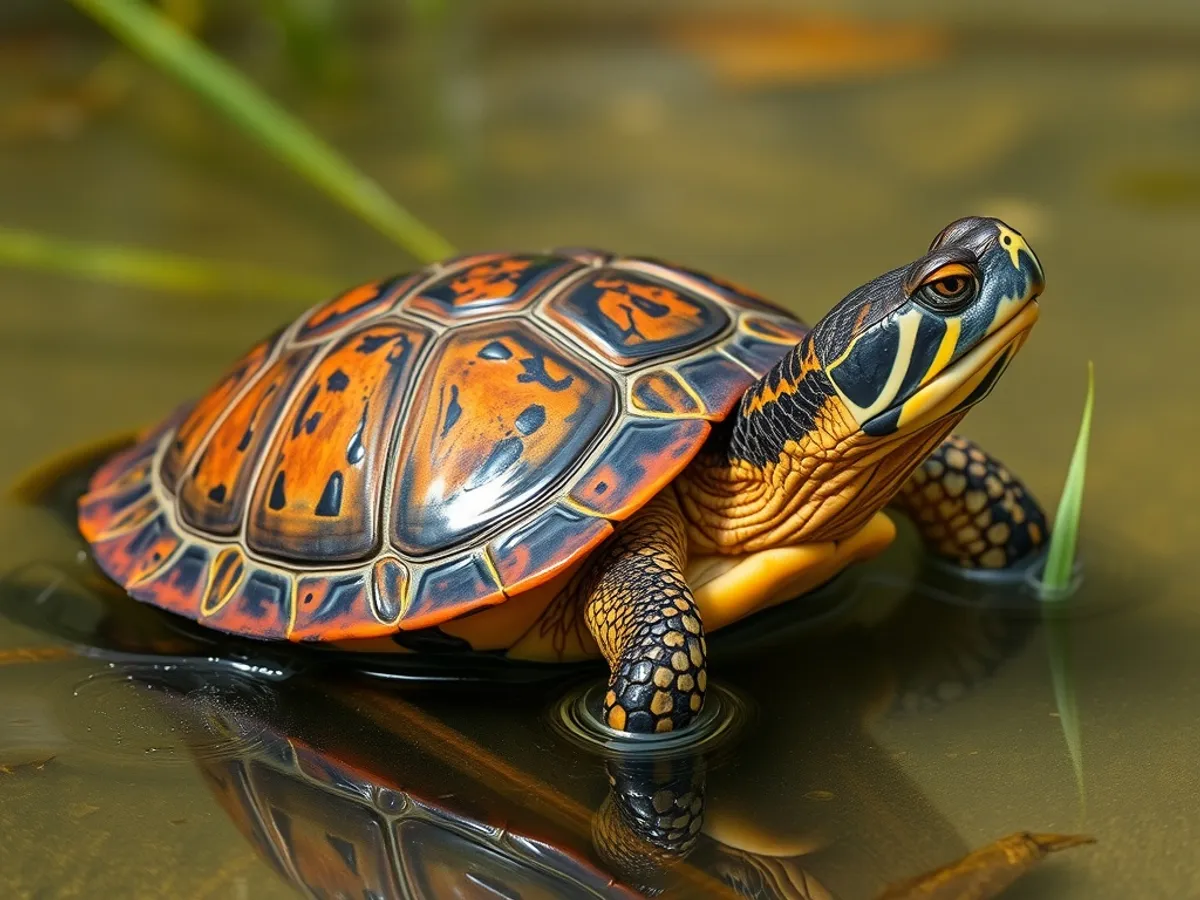
About the Mary River Turtle
Elusor macrurus is confined to a single river system in Queensland, and it has two claims to fame. The first is respiratory: it has specialised gill-like structures in the cloaca that extract dissolved oxygen from water, so the turtle can remain submerged for up to 72 hours without surfacing - a form of cloacal respiration, popularly and inevitably called "bum-breathing". That capacity lets juveniles stay hidden on the riverbed for days at a time. The second is its appearance: individuals frequently grow a thick mat of green algae over the head and shell, which in some animals stands up in a mohican, and this, plus the fleshy barbels under the chin, has earned it the nickname punk turtle. It also has a long muscular tail, unusual in a turtle, up to two-thirds the length of its shell. It was not described by science until 1994, which is remarkable given that for decades it was one of the most common pets in Australia - tens of thousands of hatchlings were collected from the wild and sold in pet shops as "penny turtles" through the 1960s and 70s, with nobody recording where they came from or what species they were. That harvest, plus dams and cattle trampling nests, has left it Endangered, and the animals now alive are mostly old; it takes about 25 years to mature.
Fascinating facts
Underwater Breather
This turtle can stay underwater for up to 72 hours by absorbing oxygen through its cloaca, a rare adaptation among turtles.
Exclusive Range
The Mary River Turtle is found only in a single river system—the Mary River in southeastern Queensland, Australia.
Punk Hairstyle
Algae often grows on the turtle’s head and shell, giving some individuals a distinctive 'punk' look.
Detailed description
The Mary River turtle (Elusor macrurus) is a large, highly aquatic freshwater turtle endemic to the Mary River system in southeast Queensland, Australia. Adults typically reach a carapace length of 40–50 cm, with females generally larger than males. One of its most distinctive features is its exceptionally long tail, which can be up to 70% the length of the carapace, a trait unique among Australian turtles. The carapace is streamlined and oval, colored olive to dark brown, while the plastron is lighter, often cream or yellowish. The head is relatively small with a blunt snout, and the skin is gray-green. Juveniles and some adults are often observed with filamentous green algae growing on their shells and heads, a result of their sedentary aquatic lifestyle. The Mary River turtle possesses specialized cloacal bursae, allowing it to extract up to two-thirds of its oxygen requirements directly from the water, enabling prolonged submergence. This species is primarily herbivorous, feeding on aquatic macrophytes, filamentous algae, and occasionally detritus. Its limbs are strongly webbed, adapted for powerful swimming in fast-flowing river habitats. The species is long-lived, with individuals estimated to reach sexual maturity at 20–25 years and potentially living for over 50 years.
Did you know?
The Mary River Turtle was only scientifically described in 1994, despite being kept as a pet for decades prior, and is the sole species in its genus.
Research & sources
Wikipedia summary
The Mary River turtle is an endangered species of short-necked turtle in the family Chelidae. The species is endemic to the Mary River in south-east Queensland, Australia. Although this turtle was known to inhabit the Mary River for nearly 30 years, it was not until 1994 that it was recognised as a new species. There has been a dramatic decrease in its population due to low reproduction rates and an increase of depredation on nests.
Behaviour & social structure
Mary River turtles are diurnal and spend nearly all their time submerged, rarely basking except occasionally on submerged logs or rocks. They are solitary and non-territorial, with minimal social interaction outside of the breeding season. Their feeding behavior involves grazing on submerged vegetation, using their sharp beaks to crop aquatic plants and algae. Juveniles may be more opportunistic, sometimes consuming small invertebrates. The species is highly adapted to riverine environments, favoring deep pools with abundant aquatic vegetation and sandy or gravelly substrates. When threatened, they may bury themselves in sediment or wedge into submerged crevices. Their cryptic coloration and algae-covered shells provide effective camouflage from predators.
Reproduction & life cycle
Breeding occurs during the austral spring and early summer (October to January). Courtship and mating take place underwater, with males displaying to females by nuzzling and circling. Females lay a single clutch per year, typically depositing 12–25 eggs in sandy banks above the flood line. Nesting sites are carefully selected for optimal temperature and moisture, as incubation temperature influences hatchling sex (temperature-dependent sex determination). The incubation period ranges from 50 to 70 days, depending on environmental conditions. There is no parental care after oviposition; hatchlings emerge independently and make their way to the water. Low recruitment rates are a major concern, as nest predation by introduced foxes, goannas, and flooding events can destroy a significant proportion of eggs each year.
Adaptations & survival
The Mary River turtle exhibits several remarkable adaptations. Its cloacal bursae allow for efficient aquatic respiration, a rare trait among turtles, enabling it to remain submerged for extended periods and reducing the need to surface for air. The long, muscular tail may aid in maneuverability and stability in fast-flowing waters. Its herbivorous diet is supported by a sharp, serrated beak for cropping tough aquatic plants. The tendency to grow algae on the shell and head enhances camouflage, making the turtle less visible to predators. Hatchlings possess a more streamlined shell, improving their swimming ability and predator evasion. The species’ delayed sexual maturity and longevity are evolutionary strategies for survival in a stable, but vulnerable, riverine environment.
Cultural significance
The Mary River turtle has become an emblematic species for river conservation in Queensland, often featured in local environmental campaigns. Its unique appearance, especially the 'punk' algae hairstyle, has garnered international attention and made it a symbol of Australia’s unique biodiversity. While there is no evidence of traditional use or significant role in Aboriginal mythology, the species is now a flagship for community-led conservation efforts, including nest protection and habitat restoration.
Recent research
Recent research has focused on the turtle’s unique respiratory physiology, genetic diversity, and population dynamics. Studies have confirmed the critical role of cloacal respiration in its ecology and highlighted the genetic bottleneck resulting from historic over-collection. Ongoing research includes radio telemetry to track movements, nest temperature monitoring to assess climate change impacts on sex ratios, and captive breeding trials. Conservation programs led by the Tiaro & District Landcare Group and academic institutions have implemented nest protection, predator control, and community education, with some success in increasing hatchling survival. The species is listed as Endangered under both IUCN and Australian federal legislation, and its recovery is a priority for regional biodiversity strategies.
Videos
Habitat
Freshwater rivers

Conservation
The Mary River Turtle is currently classified as Endangered on the IUCN Red List.
Threats & challenges
The Mary River turtle faces numerous threats, primarily from habitat degradation due to water extraction, dam construction, and sedimentation, which alter river flow and nesting sites. Historic over-collection for the pet trade in the 1960s and 1970s severely depleted populations before the species was formally described. Nest predation by invasive species (foxes, feral pigs), trampling by livestock, and flooding events further reduce recruitment. Pollution from agricultural runoff and urbanization degrades water quality, impacting food resources and health. The species’ slow maturation and low reproductive output exacerbate its vulnerability. Current population estimates suggest fewer than 1,000 mature individuals remain, with fragmented subpopulations and limited gene flow.
Taxonomy
Scientific name
Elusor macrurus
- Kingdom
- Animalia
- Phylum
- Chordata
- Class
- Reptilia
- Order
- Testudines
- Family
- Chelidae
- Genus
- Elusor
- Species
- macrurus
Community notes
Share your observations about the Mary River Turtle.
No community notes yet. Be the first!
Discover more wildlife
More fascinating animals from the encyclopedia.