
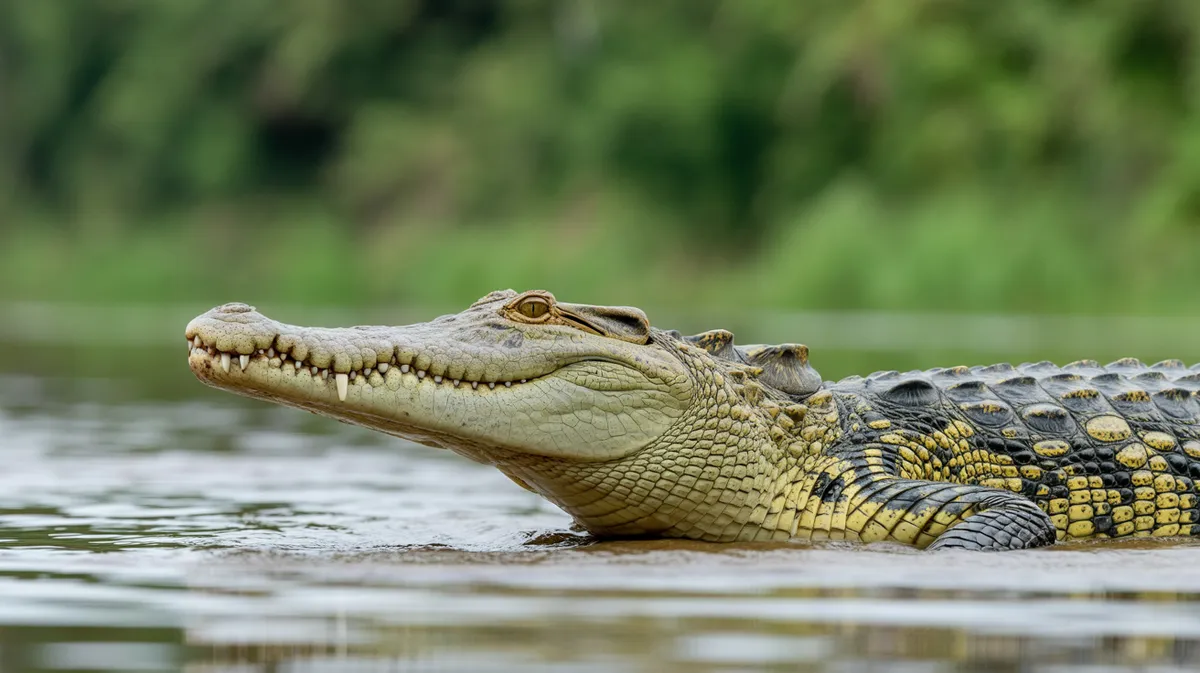
About the Nile Crocodile
The Nile crocodile (Crocodylus niloticus) is one of the largest and most widely distributed crocodilian species in Africa, found in 26 countries across sub-Saharan regions. This formidable reptile thrives in a variety of freshwater habitats, including rivers, lakes, and marshlands, and can occasionally be found in brackish water and deltas, though it rarely ventures into saltwater. Notably, Lake Turkana in Kenya hosts one of the largest undisturbed populations of Nile crocodiles. These apex predators can grow up to 6 meters in length and weigh over 1,000 kilograms, making them second only to the saltwater crocodile in size. Their robust physique and powerful jaws enable them to tackle large prey, including antelope and even young hippos. Unlike some crocodilian relatives, the Nile crocodile has a highly developed sense of hearing and sight, crucial for hunting in murky waters. Their ability to slow their metabolism allows them to survive long periods without food, an adaptive trait that suits their often unpredictable environment.
Fascinating facts
Powerful Bite
The Nile crocodile's bite is measured at over 5,000 psi, making it the most powerful bite of any living animal.
Maternal Care
Female Nile crocodiles guard their nests and help hatchlings reach water, a rare behavior among reptiles.
Diverse Diet
Their diet includes fish, birds, mammals, and even other crocodiles, showcasing their adaptability as apex predators.
Detailed description
The Nile crocodile (Crocodylus niloticus) is Africa’s largest freshwater predator, with adult males typically measuring 3.5–5 meters (11–16 feet) in length, though exceptional individuals can reach up to 6 meters (20 feet) and weigh over 1,000 kg (2,200 lbs). Its robust body is covered in thick, osteoderm-reinforced scales, providing formidable protection. The head is broad and powerful, with a set of conical teeth (64–68 in total) designed for gripping and tearing flesh. The eyes and nostrils are positioned dorsally, allowing the crocodile to see and breathe while mostly submerged. Nile crocodiles are ectothermic, relying on basking to regulate body temperature. Their cardiovascular system is highly efficient, with a four-chambered heart and the ability to shunt blood, enabling prolonged dives of up to 30 minutes. Sensory pits on the jaws detect minute vibrations in water, aiding in prey detection. These crocodiles are highly adaptable, occupying a range of aquatic environments from fast-flowing rivers to stagnant marshes, and even tolerating some brackish conditions. Socially, they are semi-gregarious, often congregating at basking sites or during feeding, but can be fiercely territorial, especially during the breeding season. Their ecological role as apex predators and scavengers is critical for maintaining the balance of aquatic ecosystems.
Did you know?
Nile crocodiles can go for months without eating by slowing their metabolism, especially during dry seasons.
Research & sources
Wikipedia summary
The Nile crocodile is a large crocodilian native to freshwater habitats in Africa, where it is present in 26 countries. It is widely distributed in sub-Saharan Africa, occurring mostly in the eastern, southern, and central regions of the continent, and lives in different types of aquatic environments such as lakes, rivers, swamps and marshlands. It occasionally inhabits deltas, brackish lakes and rarely also saltwater. Its range once stretched from the Nile Delta throughout the Nile River. Lake Turkana in Kenya has one of the largest undisturbed Nile crocodile populations.
Behaviour & social structure
Nile crocodiles are primarily crepuscular and nocturnal hunters, though basking and social interactions occur during daylight. They exhibit a sit-and-wait predation strategy, remaining motionless near the water’s edge before launching rapid ambush attacks. Their diet is highly opportunistic: juveniles feed on insects, amphibians, and small fish, while adults consume fish, birds, reptiles, and large mammals such as antelope, zebra, and even buffalo. Cooperative hunting has been observed, particularly during fish migrations, where groups may herd fish into shallow waters. Social hierarchies are established at basking and feeding sites, with dominant individuals gaining priority access. Vocalizations, body postures, and jaw clapping serve as communication signals, especially during territorial disputes or courtship. Nile crocodiles are known for their intelligence, exhibiting problem-solving abilities and learning from experience. During the dry season, they may aestivate in burrows to survive drought conditions.
Reproduction & life cycle
Breeding occurs during the dry season, typically from November to December in southern Africa, though timing varies regionally. Males establish territories and engage in ritualized displays, including vocalizations, water slapping, and head lifts, to attract females and deter rivals. After mating, females lay 25–80 eggs in carefully excavated nests on sandy banks, usually at night. Incubation lasts 80–90 days, with temperature-dependent sex determination: higher nest temperatures favor males, while lower produce females. Females guard the nest vigilantly against predators such as monitor lizards, hyenas, and humans. Upon hatching, the mother assists by gently rolling the eggs in her mouth and carrying hatchlings to the water. Parental care extends for several weeks, with the female remaining nearby to protect the young from predation. Juvenile mortality is high, with less than 10% surviving to adulthood.
Adaptations & survival
Nile crocodiles possess several key adaptations for survival. Their semi-aquatic lifestyle is supported by webbed feet and a muscular, laterally compressed tail for powerful swimming. The palatal valve in the throat prevents water from entering the lungs while capturing prey underwater. Their integument is reinforced with bony scutes (osteoderms) for defense. The tapetum lucidum in the eyes enhances night vision, while pressure-sensitive dome receptors on the jaws detect water movement. They can tolerate extended fasting, surviving months without food during lean periods. Behavioral adaptations include basking to regulate body temperature and burrow digging for shelter during extreme conditions. Evolutionarily, their lineage dates back over 80 million years, with physiological and behavioral traits finely tuned for ambush predation and environmental resilience.
Cultural significance
The Nile crocodile has played a prominent role in African cultures for millennia. In ancient Egypt, it was both feared and revered, symbolized by the god Sobek, who was associated with fertility, military prowess, and the Nile’s life-giving power. Crocodile mummies and temples attest to their religious significance. In modern times, they feature in folklore, proverbs, and as symbols of strength and cunning. Traditional uses include the harvesting of skins for leather and, in some communities, the use of body parts in medicine or ritual. The crocodile’s reputation as a man-eater has also contributed to its mythic status, shaping local attitudes and conservation challenges.
Recent research
Recent genetic studies have clarified the taxonomy of African crocodiles, distinguishing the Nile crocodile from the West African crocodile (Crocodylus suchus), which was previously considered a subspecies. Ongoing research focuses on population genetics, movement ecology using satellite telemetry, and the impact of environmental changes on nesting success. Studies on crocodile intelligence have revealed advanced learning and problem-solving abilities, challenging previous assumptions about reptilian cognition. Conservation research is increasingly community-oriented, exploring ways to reduce human-crocodile conflict and promote coexistence. Notably, Lake Turkana in Kenya remains a key site for long-term ecological studies due to its large, relatively undisturbed crocodile population.
Videos
Habitat
Freshwater rivers, lakes, and marshes

Conservation
The Nile Crocodile is currently classified as Least Concern on the IUCN Red List.
Threats & challenges
Despite being listed as Least Concern by the IUCN, Nile crocodile populations face significant threats from habitat loss, water pollution, and illegal hunting for skins and meat. Human-crocodile conflict is a major issue, particularly in areas where expanding agriculture and settlements encroach on crocodile habitats, leading to attacks on livestock and, occasionally, humans. Dams and water management projects disrupt breeding sites and migration routes. In some regions, overexploitation for the leather trade has caused local declines. Climate change, resulting in altered rainfall patterns and drought, poses additional challenges by affecting nesting success and prey availability. Conservation efforts focus on habitat protection, regulated hunting, and community-based management to mitigate conflict and ensure sustainable populations.
Taxonomy
Scientific name
Crocodylus niloticus
- Kingdom
- Animalia
- Phylum
- Chordata
- Class
- Reptilia
- Order
- Crocodylia
- Family
- Crocodylidae
- Genus
- Crocodylus
- Species
- niloticus
Where to see a nile crocodile
6 zoos and aquariums in 3 countries are recorded as keeping this species.
 Bronx Zoo🇺🇸 Bronx, United States
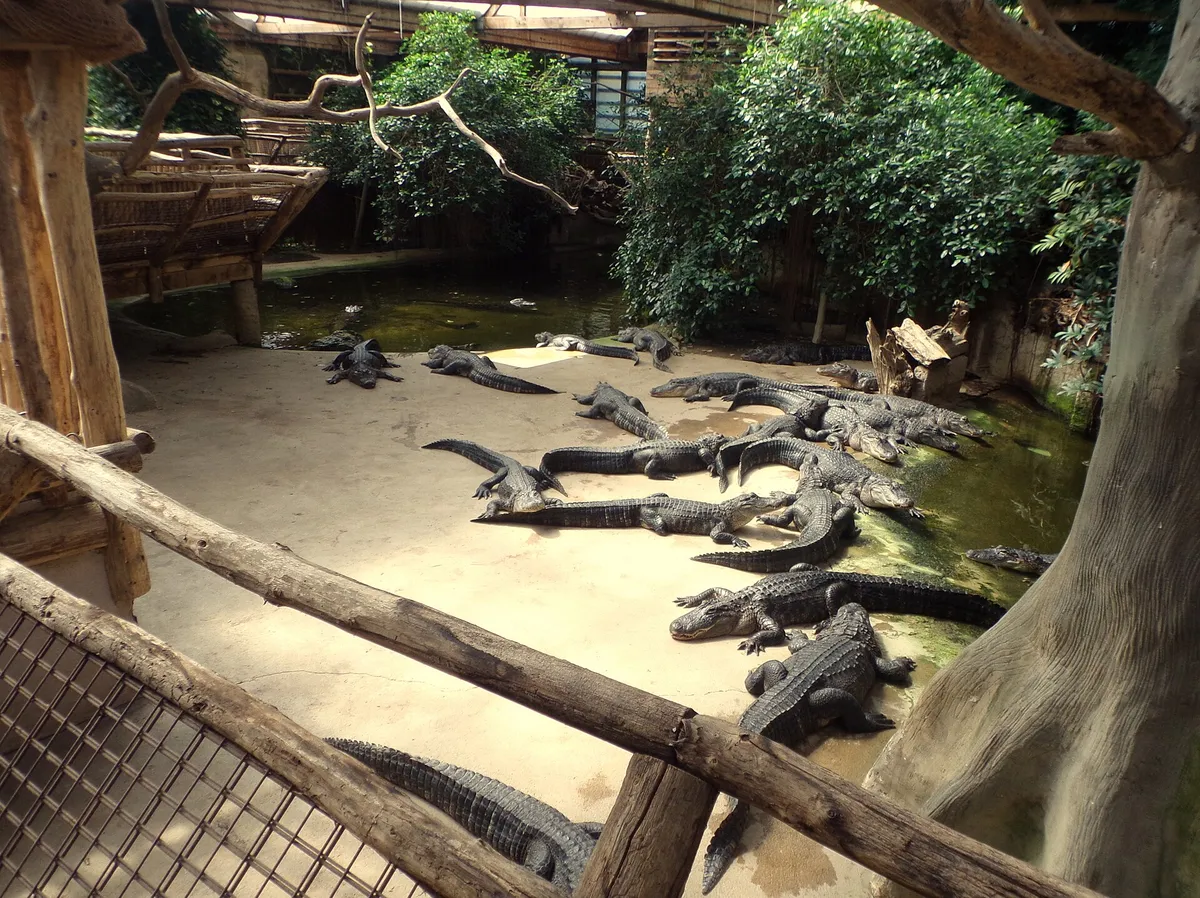 Alligator Bay🇫🇷 Beauvoir, France
 Dublin Zoo🇮🇪 Ireland
 Memphis Zoo🇺🇸 Memphis, United States
- 🦁Jacksonville Zoo and Gardens🇺🇸 Jacksonville, United States
Community notes
Share your observations about the Nile Crocodile.
No community notes yet. Be the first!
Discover more wildlife
More fascinating animals from the encyclopedia.