
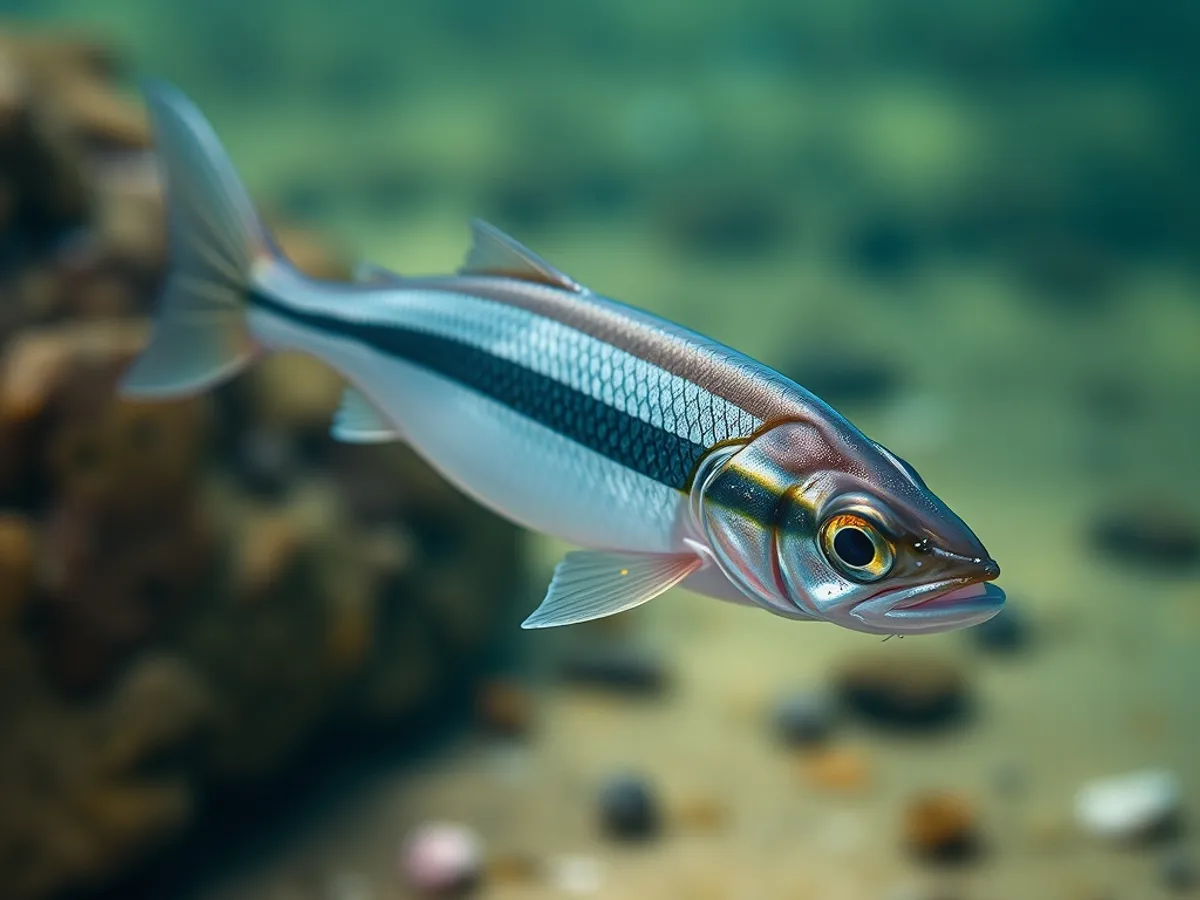
About the Northern Anchovy
The Northern Anchovy is a small, schooling fish found along the Pacific coast of North America, ranging from British Columbia to Baja California. It has a slender, silver body with a bluish-green back and a large mouth extending behind the eyes. Northern Anchovies play a vital ecological role as a significant food source for larger fish, marine mammals, and seabirds. They typically form dense schools near the surface, especially in coastal upwelling zones where plankton is abundant.
Fascinating facts
Vital Forage Fish
Northern Anchovies are a primary food source for many marine predators, including salmon, sea lions, and seabirds.
Plankton Feeders
They feed by filtering plankton from the water using specialized gill rakers while swimming with their mouths open.
Culinary Use
Anchovies are used in sauces, dressings, and as a savory ingredient in many cuisines around the world.
Detailed description
The Northern Anchovy (Engraulis mordax) is a small, pelagic fish typically reaching 10–18 cm in length, with a maximum recorded length of about 23 cm. Its body is elongated and laterally compressed, covered in cycloid scales that easily shed when handled. The species is characterized by a large, terminal mouth that extends well behind the eye, equipped with fine gill rakers adapted for filter feeding. The dorsal surface is bluish-green, fading to silvery flanks and a white belly, providing effective countershading against predators. Northern Anchovies are highly social, forming dense schools that can number in the millions, a behavior that confers protection from predators and enhances foraging efficiency. They are primarily found in the upper 50 meters of the water column, especially in nutrient-rich upwelling zones along the eastern Pacific. Their diet shifts ontogenetically: larvae and juveniles feed mainly on phytoplankton and microzooplankton, while adults consume a mix of zooplankton, small crustaceans, and fish larvae. Northern Anchovies are a key forage species, supporting a wide array of predators, including commercially important fish, seabirds, and marine mammals. Their rapid growth and high reproductive output allow populations to respond quickly to environmental changes, making them a classic example of an r-selected species.
Did you know?
Despite their small size, Northern Anchovies are one of the most important forage fish in the Pacific Ocean, supporting entire ecosystems and commercial fisheries.
Research & sources
Behaviour & social structure
Northern Anchovies exhibit diel vertical migration, rising to the surface at night to feed and descending during the day to avoid predators. Their schooling behavior is highly coordinated, with individuals responding to changes in light, water movement, and the presence of predators. Feeding occurs both by particulate feeding and filter feeding, depending on prey size and abundance. Schools often break apart and reform in response to predation pressure or changes in environmental conditions. During feeding, anchovies swim with their mouths open, filtering plankton-rich water through their gill rakers. Social interactions are primarily mediated by vision and lateral line sensing, allowing rapid collective responses to threats. They are known to aggregate in areas of high plankton productivity, such as coastal upwelling zones, and may undertake local migrations in response to seasonal changes in water temperature and food availability.
Reproduction & life cycle
Northern Anchovies are batch spawners, with females releasing multiple batches of eggs during the spawning season, which typically extends from late winter through early summer, peaking between February and April off California. Spawning occurs in open water, usually at night, with external fertilization. Females can produce between 1,000 and 29,000 eggs per spawning event, depending on size and condition. The eggs are pelagic, spherical, and buoyant, hatching within 2–4 days depending on water temperature. Larvae are planktonic and undergo rapid growth, reaching juvenile stage within a few weeks. There is no parental care; survival of offspring is highly dependent on environmental conditions and predation rates. Sexual maturity is reached at about one year of age, and individuals rarely live beyond four years in the wild.
Adaptations & survival
Northern Anchovies possess several adaptations for survival in dynamic coastal environments. Their streamlined, laterally compressed bodies reduce drag and facilitate rapid schooling maneuvers. The large mouth and fine gill rakers are specialized for efficient filter feeding on small planktonic organisms. Countershading provides camouflage from both aerial and aquatic predators. Their highly developed lateral line system enables detection of water movements and coordination within schools. High fecundity and rapid growth rates allow populations to recover quickly from declines, an adaptation to variable oceanic conditions. Additionally, their ability to exploit a wide range of planktonic prey allows them to persist through fluctuations in food availability.
Cultural significance
Northern Anchovies have been an important resource for indigenous peoples along the Pacific coast, used as food and bait. Commercially, they have been harvested for reduction into fish meal and oil, as well as for use as live bait in recreational fisheries. While not a major food fish in North America, they are occasionally consumed fresh, salted, or canned. Their ecological importance as a forage species is widely recognized, and they are often cited in discussions of sustainable fisheries management and ecosystem-based approaches. In some regions, anchovies have symbolic significance as indicators of ocean health and productivity.
Recent research
Recent research on Northern Anchovies has focused on their role as a keystone forage species and their responses to climate variability. Studies using otolith microchemistry have provided insights into larval dispersal and population connectivity. Advances in acoustic survey techniques have improved estimates of school biomass and distribution. Ongoing research is examining the impacts of ocean acidification and warming on anchovy physiology and reproductive success. Genetic studies have revealed population structure and potential subpopulations along the Pacific coast, informing management strategies. Additionally, ecosystem modeling efforts are quantifying the anchovy's role in supporting higher trophic levels and the potential consequences of population fluctuations.
Videos
Habitat
Coastal ocean waters

Conservation
The Northern Anchovy is currently classified as Least Concern on the IUCN Red List.
Threats & challenges
While currently listed as Least Concern, Northern Anchovies face several threats, including overfishing, habitat degradation, and climate-driven changes in ocean productivity. Historical overexploitation in the mid-20th century led to population declines, but improved management has allowed partial recovery. Coastal pollution, eutrophication, and hypoxic events can impact spawning and nursery habitats. Climate change poses a significant challenge by altering upwelling patterns and plankton communities, potentially reducing food availability. Population abundance is highly variable, with natural boom-and-bust cycles driven by oceanographic conditions such as El Niño and La Niña events. Bycatch in other fisheries and competition with other forage fish species also pose ongoing challenges.
Taxonomy
Scientific name
Engraulis mordax
- Kingdom
- Animalia
- Phylum
- Chordata
- Class
- Actinopterygii
- Order
- Clupeiformes
- Family
- Engraulidae
- Genus
- Engraulis
- Species
- mordax
Community notes
Share your observations about the Northern Anchovy.
No community notes yet. Be the first!
Discover more wildlife
More fascinating animals from the encyclopedia.