
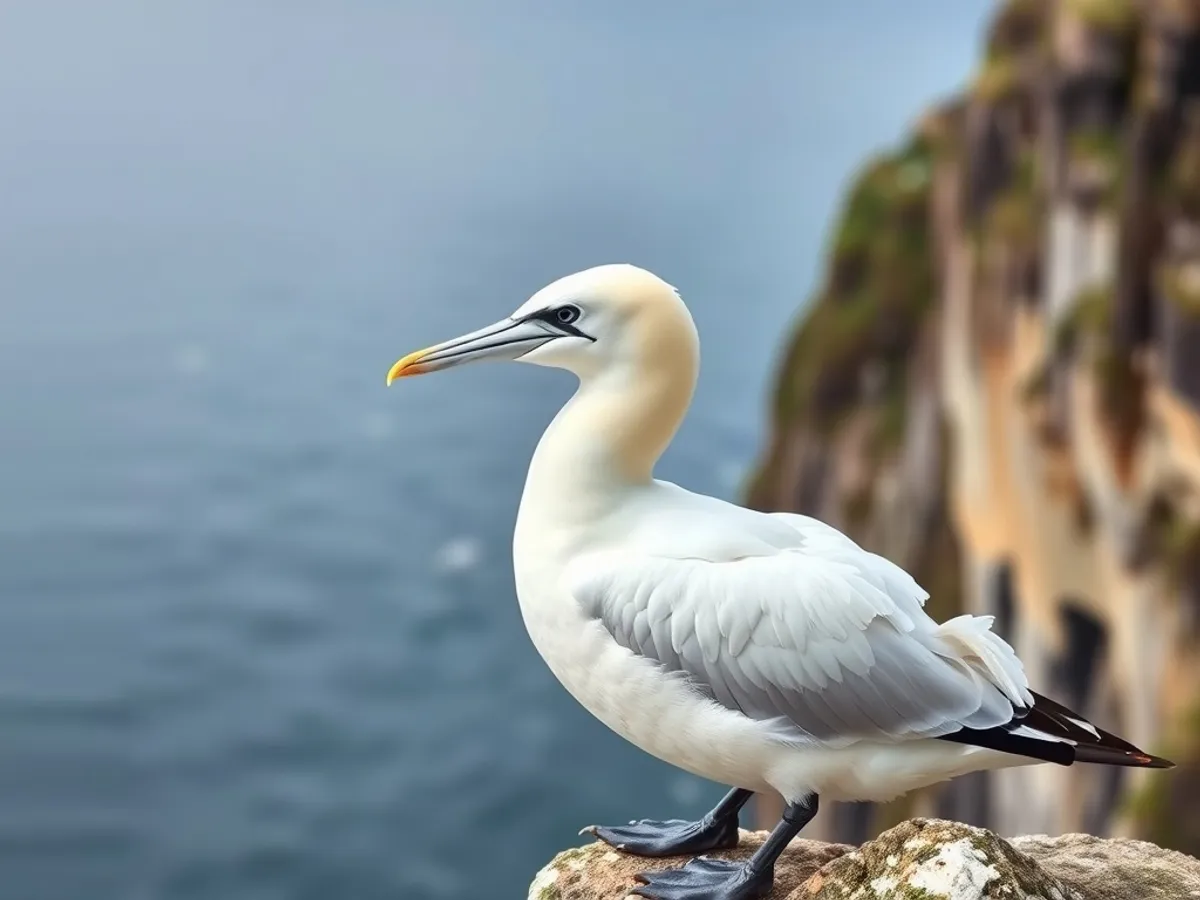
About the Northern Gannet
Morus bassanus hunts by turning itself into a javelin. From 30 to 40 m up it folds its 1.8 m wings straight back against the body and enters the water at around 90 km/h, penetrating 3 to 5 m on impact and then swimming deeper, to 20 m or more, with wing and foot strokes. Every part of the bird is built for that impact: the nostrils are sealed shut and it breathes through the mouth, a network of air sacs under the skin of the face, neck and chest inflates to cushion the blow, and the skull is reinforced with no true nasal opening. Gannets have binocular vision, unusual in birds, which lets them judge distance to a moving fish from height. They are colonial to an extreme degree — Bass Rock in the Firth of Forth, which gives the species its name, holds well over 100,000 birds and is the largest northern gannet colony on Earth. Pairs are long-term, greet each other with a mutual bill-fencing display each time one returns, and raise a single chick. In 2022, highly pathogenic avian influenza tore through North Atlantic colonies and killed tens of thousands of birds; survivors were later found with black irises instead of the normal pale blue, apparently a marker of infection.
Fascinating facts
Expert Divers
Northern Gannets can dive from heights of up to 40 meters (130 feet), hitting the water at speeds up to 100 km/h to catch fish.
Colony Nesters
They nest in some of the largest seabird colonies in the North Atlantic, with sites like Bass Rock and St. Kilda hosting tens of thousands of pairs.
Ocean Travelers
Northern Gannets travel vast distances outside the breeding season, wintering as far south as the Gulf of Mexico and the west coast of Africa.
Detailed description
The Northern Gannet (Morus bassanus) is a large, robust seabird, measuring 87–100 cm in length and boasting an impressive wingspan of 170–180 cm, making it the largest seabird in the North Atlantic. Adults display a striking appearance with predominantly white plumage, a subtle buff-yellow wash on the head and nape during the breeding season, and sharply contrasting black wingtips. Their long, slender wings and streamlined body are highly adapted for dynamic soaring and plunge-diving. The bill is long, conical, and blue-grey, with black bare skin around the mouth and eyes, giving them a distinctive facial expression. Juveniles are initially dark brown with white speckling, gradually acquiring adult plumage over five years. Northern Gannets are highly social, nesting in dense colonies on steep coastal cliffs and remote islands. Their vocalizations are loud and raucous, particularly at breeding sites. These birds are renowned for their spectacular hunting technique, plunging from heights of up to 40 meters into the ocean to capture fish, often reaching speeds of 100 km/h upon impact. Their eyes are positioned forward, providing binocular vision crucial for accurate depth perception during dives.
Did you know?
Despite their size and dramatic dives, Northern Gannets can fly up to 65 km/h and migrate thousands of kilometers each year between breeding and wintering grounds.
Research & sources
Wikipedia summary
The northern gannet is a seabird, the largest species of the gannet family, Sulidae. It is native to the coasts of the Atlantic Ocean, breeding in Western Europe and Northeastern North America. It is the largest seabird in the northern Atlantic. The sexes are similar in appearance. The adult northern gannet has a mainly white streamlined body with a long neck, and long and slender wings. It is 87–100 cm long with a 170–180 cm (67–71 in) wingspan. The head and nape have a buff tinge that is more prominent in breeding season, and the wings are edged with dark brown-black feathers. The long, pointed bill is blue-grey, contrasting with black, bare skin around the mouth and eyes. Juveniles are mostly grey-brown, becoming increasingly white in the five years it takes them to reach maturity.
Behaviour & social structure
Northern Gannets are diurnal and spend most of their lives at sea, only coming ashore to breed. They are highly gregarious, forming large colonies that can number tens of thousands of pairs. Social interactions include ritualized greeting displays, bill fencing, and mutual preening, which reinforce pair bonds and reduce aggression in crowded colonies. Foraging is typically solitary or in small groups, though large feeding flocks may form over abundant prey. Their primary hunting method is plunge-diving, where they fold their wings and streamline their bodies before hitting the water at high speed, sometimes diving to depths of 10–20 meters. They may pursue prey underwater using their wings for propulsion. Daily routines involve alternating periods of foraging at sea with resting and socializing at the colony during the breeding season.
Reproduction & life cycle
Northern Gannets are monogamous, with pairs often reuniting at the same nest site each year. Breeding occurs from late March to September, depending on location. Nests are constructed from seaweed, grass, and debris, cemented together with guano. Females lay a single chalky-blue egg, which both parents incubate for 42–46 days using their webbed feet to transfer heat. After hatching, the chick is brooded and fed by regurgitation. Parental care is intensive, with both adults alternating feeding trips and nest defense. Fledging occurs at 11–13 weeks, after which juveniles leave the colony and spend several years at sea before returning to breed. Sexual maturity is reached at 4–5 years.
Adaptations & survival
Northern Gannets possess several remarkable adaptations for their pelagic lifestyle. Their streamlined bodies and long, narrow wings enable efficient gliding and dynamic soaring over the ocean. Air sacs beneath the skin of the face and chest cushion the impact of high-speed dives, protecting internal organs. Their nostrils are located inside the mouth to prevent water ingress during plunges. Binocular vision and specialized nictitating membranes protect the eyes and enhance underwater vision. Strong, webbed feet aid in swimming and nest construction. Social adaptations include complex vocalizations and displays to maintain order in crowded colonies.
Cultural significance
Northern Gannets have featured in the folklore and traditions of coastal communities, particularly in the British Isles and Atlantic Canada. In Scotland, the species is known as the 'Solan goose,' and its eggs and young were historically harvested as food. The gannet's spectacular diving has inspired admiration and metaphor in literature and art. The term 'gannet' is sometimes used colloquially to describe a person with a voracious appetite, reflecting the bird's feeding behavior.
Recent research
Recent research has focused on the foraging ecology of Northern Gannets, using GPS and biologging devices to track movements and dive profiles. Studies have revealed remarkable foraging ranges, with individuals traveling over 500 km from breeding colonies. Investigations into the effects of climate change have highlighted shifts in prey availability and distribution. Genetic studies have explored population structure and connectivity across the Atlantic. Ongoing monitoring of colonies is providing valuable data on the impacts of disease outbreaks, such as highly pathogenic avian influenza, and the accumulation of marine plastics in nest materials.
Videos
Habitat
Coastal cliffs and islands in the North Atlantic

Conservation
The Northern Gannet is currently classified as Least Concern on the IUCN Red List.
Threats & challenges
While currently listed as Least Concern by the IUCN, Northern Gannets face several threats. Overfishing can reduce prey availability, particularly of key species like mackerel and herring. Bycatch in fishing gear, oil spills, and pollution (especially plastic ingestion) pose significant risks. Disturbance at breeding colonies from tourism or development can reduce reproductive success. Emerging threats include avian influenza outbreaks and the impacts of climate change, such as shifting prey distributions and increased storm frequency. Despite these challenges, global populations have been stable or increasing in recent decades, though localized declines have been noted.
Taxonomy
Scientific name
Morus bassanus
- Kingdom
- Animalia
- Phylum
- Chordata
- Class
- Aves
- Order
- Suliformes
- Family
- Sulidae
- Genus
- Morus
- Species
- bassanus
Where to see a northern gannet
1 zoo and aquarium in 1 country are recorded as keeping this species.

Community notes
Share your observations about the Northern Gannet.
No community notes yet. Be the first!
Discover more wildlife
More fascinating animals from the encyclopedia.