
About the Northern Snakehead
Channa argus arrived in the American public imagination in 2002, when a Maryland angler pulled one from a pond in Crofton and the press christened it Frankenfish. The reality is less lurid than the tabloids but genuinely serious. The northern snakehead is a large, torpedo-shaped predator native to China, Russia and Korea that reaches over 1 m, breeds prolifically, guards its young aggressively, and eats fish, frogs, crayfish and anything else it can fit in its jaws. It has a suprabranchial chamber above the gills that lets it breathe atmospheric air, so it survives in stagnant, hypoxic water where native predators cannot, and it can persist out of water for days in damp conditions. The wriggling-across-land claim is real but overstated for the adults: juveniles can squirm over wet ground for short distances, while a large adult does so clumsily and only over short, wet stretches. It is established in the Potomac basin, in Arkansas, and elsewhere, and it is illegal to possess a live one in most US states. Wildlife agencies have largely given up on eradication and now push "eat them" campaigns — the flesh is firm, white and good, and Maryland actively markets it.
Fascinating facts
Air Breather
Northern Snakeheads possess a unique organ that allows them to breathe air, enabling survival in low-oxygen waters and even on land for limited periods.
Land Migration
They have been observed moving short distances over moist land, especially when seeking new habitats or escaping unsuitable conditions.
Invasive Species
Outside their native range, snakeheads are regarded as a serious invasive threat, often outcompeting native fish and altering aquatic ecosystems.
Detailed description
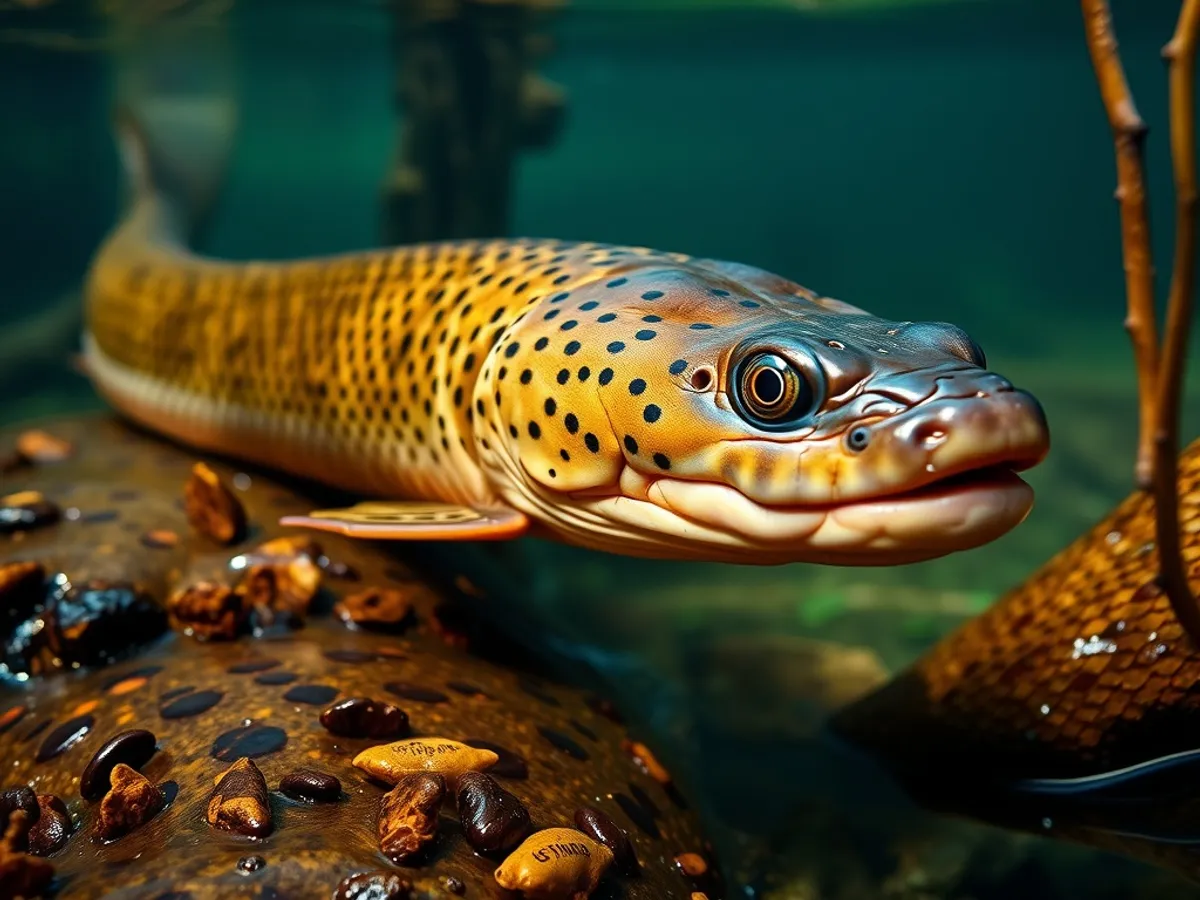
The Northern Snakehead (Channa argus) is a robust, elongated freshwater fish reaching up to 150 cm (59 in) in length and weighing as much as 7 kg (15 lbs), though most individuals are smaller. Its body is cylindrical, covered in large cycloid scales, and marked with a series of dark, irregular blotches along a brownish to olive background, providing camouflage in vegetated waters. The head is flattened and snake-like, with a large mouth equipped with sharp, canine-like teeth adapted for grasping prey. The dorsal fin is notably long, running along most of the back, and is paired with a similarly extended anal fin, both aiding in powerful, undulating swimming. Northern Snakeheads possess a suprabranchial (labyrinth) organ, enabling them to breathe atmospheric air and survive in oxygen-poor environments or even out of water for up to four days if kept moist. Behaviorally, they are solitary and highly territorial, aggressively defending their home ranges. They are apex predators in their native and introduced habitats, preying on fish, amphibians, crustaceans, and occasionally small birds or mammals. Reproduction is prolific, with pairs forming monogamous bonds during the breeding season and both parents guarding the nest and fry. Juveniles exhibit rapid growth, reaching sexual maturity within two to three years. This species is highly adaptable, tolerating a wide range of temperatures (0–30°C), pH, and water conditions, contributing to its invasive potential.
Did you know?
A female Northern Snakehead can lay up to 100,000 eggs per year, making it highly capable of establishing new populations rapidly.
Research & sources
Wikipedia summary
The northern snakehead is a species of snakehead fish native to temperate East Asia, in China, Russia, North Korea, and South Korea. Their natural range goes from the Amur River watershed in Siberia and Manchuria down to Hainan. It is an important food fish and one of the most cultivated in its native region, with an estimated 500 short tons (450 t) produced every year in China and Korea alone. Due to this, the northern snakehead has been exported throughout the world and has managed to establish non-native populations in Central Asia and North America. In the United States, it is found in Pennsylvania, Virginia, West Virginia, Delaware, Maryland, North Carolina, Arkansas, Missouri, and Mississippi.
Behaviour & social structure
Northern Snakeheads are primarily ambush predators, lying motionless among submerged vegetation before launching rapid, targeted strikes at passing prey. They are most active during dawn and dusk (crepuscular), although activity can extend into daylight hours in turbid or shaded waters. Adults are solitary and territorial, often displaying aggressive behaviors such as lateral displays, biting, and chasing to deter intruders. During the breeding season, pairs cooperate in nest building and defense. Feeding is opportunistic; juveniles consume zooplankton and insect larvae, while adults shift to piscivory, consuming fish up to half their own body length. They exhibit seasonal movement patterns, seeking deeper waters in winter and shallow, vegetated areas for spawning in spring and summer. Air-breathing allows them to survive in hypoxic conditions and even migrate short distances over land to colonize new habitats.
Reproduction & life cycle
Breeding occurs from late spring to early summer when water temperatures reach 18–28°C. Northern Snakeheads are oviparous, with females laying up to 100,000 eggs per season in several batches. Spawning typically takes place in shallow, vegetated areas where the pair constructs a floating nest from plant material. Fertilization is external, and both parents actively guard the nest, fanning the eggs and defending against predators. Eggs hatch within 24–48 hours, depending on temperature, and the fry remain under parental protection for up to a month, forming dense schools. Parental care is highly developed and includes aggressive defense of the young. Sexual maturity is reached at 2–3 years, with high fecundity contributing to rapid population growth in suitable environments.
Adaptations & survival
Key adaptations include the labyrinth organ for air-breathing, enabling survival in low-oxygen or even terrestrial conditions. Their cryptic coloration and elongated body facilitate camouflage and stealth in dense aquatic vegetation. The long dorsal and anal fins provide stability and maneuverability for ambush predation. Strong jaws and recurved teeth allow them to capture and subdue large, slippery prey. High reproductive output and parental care increase offspring survival. Physiological tolerance to a wide range of temperatures and water qualities allows colonization of diverse habitats. Their ability to move over land (by undulating their bodies) enables dispersal between isolated water bodies.
Cultural significance
Northern Snakeheads are highly valued in East Asian cuisine, particularly in China and Korea, where they are farmed for their firm, white flesh and believed medicinal properties. The fish features in traditional Chinese medicine as a tonic for wound healing and recovery. In folklore, snakeheads are sometimes associated with resilience and adaptability due to their survival skills. In the United States, their notoriety as an invasive species has led to widespread media coverage and public concern, earning them nicknames such as 'Frankenfish.'
Recent research
Recent research has focused on the ecological impact of snakehead invasions, including studies on their diet, competition with native species, and potential for disease transmission. Genetic studies have clarified population structure and invasion pathways, aiding management efforts. Ongoing research explores the physiological mechanisms underlying their air-breathing and terrestrial locomotion. Advances in eDNA (environmental DNA) techniques are being used to monitor their spread in non-native regions. There is also active investigation into control methods, including targeted removal, chemical treatments, and public education campaigns.
Videos
Habitat
Freshwater rivers, lakes, and ponds

Conservation
The Northern Snakehead is currently classified as Least Concern on the IUCN Red List.
Threats & challenges
In their native range, Northern Snakeheads face few natural predators as adults, but eggs and juveniles are vulnerable to birds, larger fish, and aquatic mammals. Overfishing and habitat degradation in parts of Asia may locally impact populations, but overall, the species remains abundant. In introduced regions, especially North America, they pose significant ecological threats by preying on native fish and amphibians, competing with indigenous predators, and altering food webs. Control and eradication are challenging due to their resilience, high fecundity, and ability to survive adverse conditions. Human-mediated dispersal (e.g., aquarium releases, live food trade) remains a key vector for invasions.
Taxonomy
Scientific name
Channa argus
- Kingdom
- Animalia
- Phylum
- Chordata
- Class
- Actinopterygii
- Order
- Anabantiformes
- Family
- Channidae
- Genus
- Channa
- Species
- argus
Community notes
Share your observations about the Northern Snakehead.
No community notes yet. Be the first!
Discover more wildlife
More fascinating animals from the encyclopedia.