
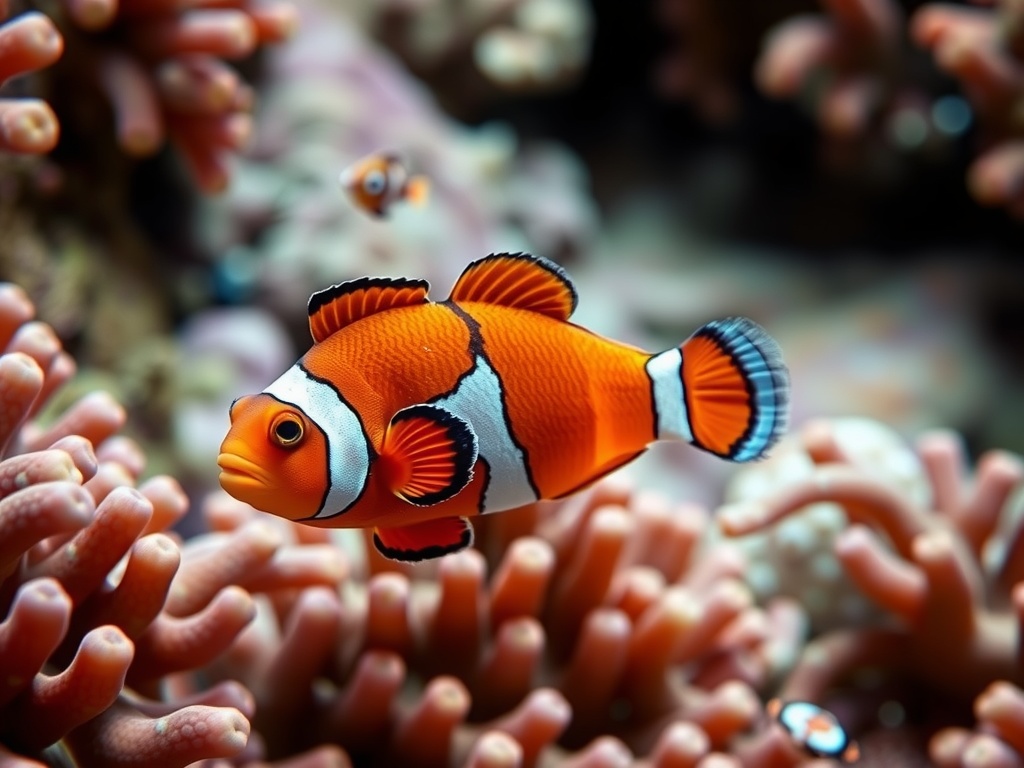
About the Ocellaris clownfish
Amphiprion ocellaris is a protandrous sequential hermaphrodite: every fish is born male, and each anemone holds a strict size-based hierarchy with one large breeding female at the top, a smaller breeding male below her, and a queue of sexually suppressed non-breeders. When the female dies, the breeding male changes sex and becomes the female, and the largest juvenile matures into the new breeding male. This makes the plot of Finding Nemo biologically backwards — after Nemo's mother is eaten, his father Marlin should have become his mother. The immunity to anemone stings is not innate; a clownfish acclimates over hours by brushing the tentacles in gradually increasing contact, apparently altering its mucus coat so that the anemone's nematocysts do not recognise it as prey. The relationship is genuinely mutual: the fish gets shelter from predators and the anemone gets defended from butterflyfish that eat tentacles, plus improved water circulation from the fish's constant fanning, and nitrogen from its waste. Ocellaris is the smaller, gentler species usually sold as a "false percula"; the three white bars are edged in a thin black line, and it is distinguished from the true percula by having 11 dorsal spines and a thinner black margin.
Fascinating facts
Vivid Colors
Ocellaris clownfish display bright orange coloration with three distinctive white bands, making them popular in the aquarium trade.
Anemone Alliance
These fish form a symbiotic relationship with sea anemones, gaining protection from predators while providing food scraps to their hosts.
Sex Change
Ocellaris clownfish are protandrous hermaphrodites, meaning they can change sex from male to female as needed within their social group.
Detailed description
The Ocellaris clownfish (Amphiprion ocellaris) is a small, laterally compressed marine fish reaching up to 11 cm in length, with females typically larger than males. Its body is characterized by a vibrant orange coloration interspersed with three distinct white bands edged in black, though color morphs such as black or red-brown exist in certain geographic regions. The species can be distinguished from similar clownfish by its 11 dorsal spines and 17 pectoral rays. Ocellaris clownfish possess a rounded caudal fin and a continuous dorsal fin, contributing to their agile swimming among coral reefs. Their skin is coated with a specialized mucus layer, which provides immunity to the stings of host sea anemones. Socially, they form small, hierarchical groups within a single anemone, led by a dominant female, her mate, and several non-breeding males. All individuals are born male and exhibit protandrous hermaphroditism, allowing the largest male to become female if the dominant female dies. Their diet is omnivorous, consisting of zooplankton, algae, and small crustaceans, and they often feed on food scraps from their host anemone. Ocellaris clownfish exhibit site fidelity, rarely straying far from their host anemone, which provides both protection from predators and a stable microhabitat. Their bright coloration serves as a warning to potential predators of their association with the stinging anemone.
Did you know?
Every Ocellaris clownfish group has a strict social hierarchy, and when the female dies, the dominant male transforms into a female to take her place.
Research & sources
Wikipedia summary
The ocellaris clownfish, also known as the false percula clownfish or common clownfish, is a marine fish belonging to the family Pomacentridae, which includes clownfishes and damselfishes. Amphiprion ocellaris are found in different colors, depending on where they are located. For example, black Amphiprion ocellaris with white bands can be found near northern Hawaii, USA, North America, Australia, Southeast Asia, and Japan. Orange or red-brown Amphiprion ocellaris also exist with three similar white bands on the body and head. Amphiprion ocellaris can be distinguished from other Amphiprion species based on the number of pectoral rays and dorsal spines. Amphiprion ocellaris are known to grow about 11 cm long. Like many other fish species, females are, however, larger than males. The life cycle of Amphiprion ocellaris varies in whether they reside at the surface or bottom of the ocean. When they initially hatch, they reside near the surface. However, when Amphiprion ocellaris enter into the juvenile stage of life, they travel down to the bottom to find shelter in a host anemone. Once they find their anemone, they form a symbiotic relationship with them.
Behaviour & social structure
Ocellaris clownfish display complex social behaviors, including strict dominance hierarchies enforced by aggression and ritualized displays. The dominant female is the largest and most aggressive, followed by her mate, with subordinate males forming a linear pecking order. Feeding occurs throughout the day, with individuals foraging for plankton and detritus near their host anemone, occasionally venturing out to snatch passing prey. They exhibit a symbiotic cleaning behavior, removing parasites from their host anemone, which in turn provides them with protection. Clownfish communicate through a series of popping and clicking sounds produced by jaw and fin movements, especially during territorial disputes or courtship. At night, they retreat deep into the anemone's tentacles for safety. Juvenile clownfish exhibit exploratory behavior before settling into a host anemone, guided by olfactory and auditory cues.
Reproduction & life cycle
Ocellaris clownfish are monogamous within their social group, with only the dominant female and her mate breeding. Spawning typically coincides with the lunar cycle and occurs year-round in tropical regions, peaking during warmer months. The female lays between 100 and 1,000 adhesive eggs on a flat surface near the base of the host anemone. The male fertilizes and then guards the eggs, fanning them with his fins and removing debris or unfertilized eggs. Incubation lasts 6–10 days, depending on water temperature. Upon hatching, larvae are planktonic and drift near the ocean surface for 8–12 days before settling to the reef and seeking a host anemone. Parental care is limited to the egg stage; after hatching, larvae receive no further care.
Adaptations & survival
Key adaptations include a thick mucus coating that prevents nematocyst discharge from anemone tentacles, allowing the fish to live unharmed among the stinging arms. Their bright coloration provides aposematic signaling, warning predators of their toxic association. Ocellaris clownfish have evolved acute olfactory and auditory senses to locate suitable host anemones and avoid unsuitable habitats. Their protandrous hermaphroditism ensures reproductive flexibility and rapid replacement of lost breeding females, maintaining group stability. Morphologically, their compact, rounded bodies and continuous fins allow for agile maneuvering among anemone tentacles.
Cultural significance
Ocellaris clownfish have significant cultural and economic importance, especially following their popularization by the film 'Finding Nemo.' They are among the most recognized marine aquarium species, driving demand for captive-bred individuals. In some Indo-Pacific cultures, clownfish are considered symbols of good luck or harmony due to their symbiotic relationships. They are also used in educational programs to illustrate mutualism and marine biodiversity.
Recent research
Recent studies have focused on the genetic basis of color morphs, the molecular mechanisms of anemone immunity, and the impacts of ocean acidification on larval development and sensory abilities. Ongoing research investigates the effects of climate change on host anemone availability and clownfish reproductive success. Notably, studies have shown that clownfish larvae use reef sounds and chemical cues to locate suitable settlement sites, highlighting the importance of healthy reef soundscapes. Captive breeding and reintroduction efforts are being explored as conservation tools.
Videos
Habitat
Shallow coral reefs

Conservation
The Ocellaris clownfish is currently classified as Least Concern on the IUCN Red List.
Threats & challenges
While currently listed as Least Concern by the IUCN, Ocellaris clownfish face threats from habitat degradation, particularly the loss of coral reefs and host anemones due to climate change, ocean acidification, and destructive fishing practices. Overcollection for the aquarium trade has caused localized population declines, though captive breeding programs have mitigated some pressure. Pollution and coastal development also pose risks to their shallow reef habitats. Population trends are stable in most regions, but continued monitoring is necessary, especially in areas with heavy tourism or reef damage.
Taxonomy
Scientific name
Amphiprion ocellaris
- Kingdom
- Animalia
- Phylum
- Chordata
- Class
- Actinopterygii
- Order
- Perciformes
- Family
- Pomacentridae
- Genus
- Amphiprion
- Species
- ocellaris
Where to see an ocellaris clownfish
1 zoo and aquarium in 1 country are recorded as keeping this species.

Community notes
Share your observations about the Ocellaris clownfish.
No community notes yet. Be the first!
Discover more wildlife
More fascinating animals from the encyclopedia.