
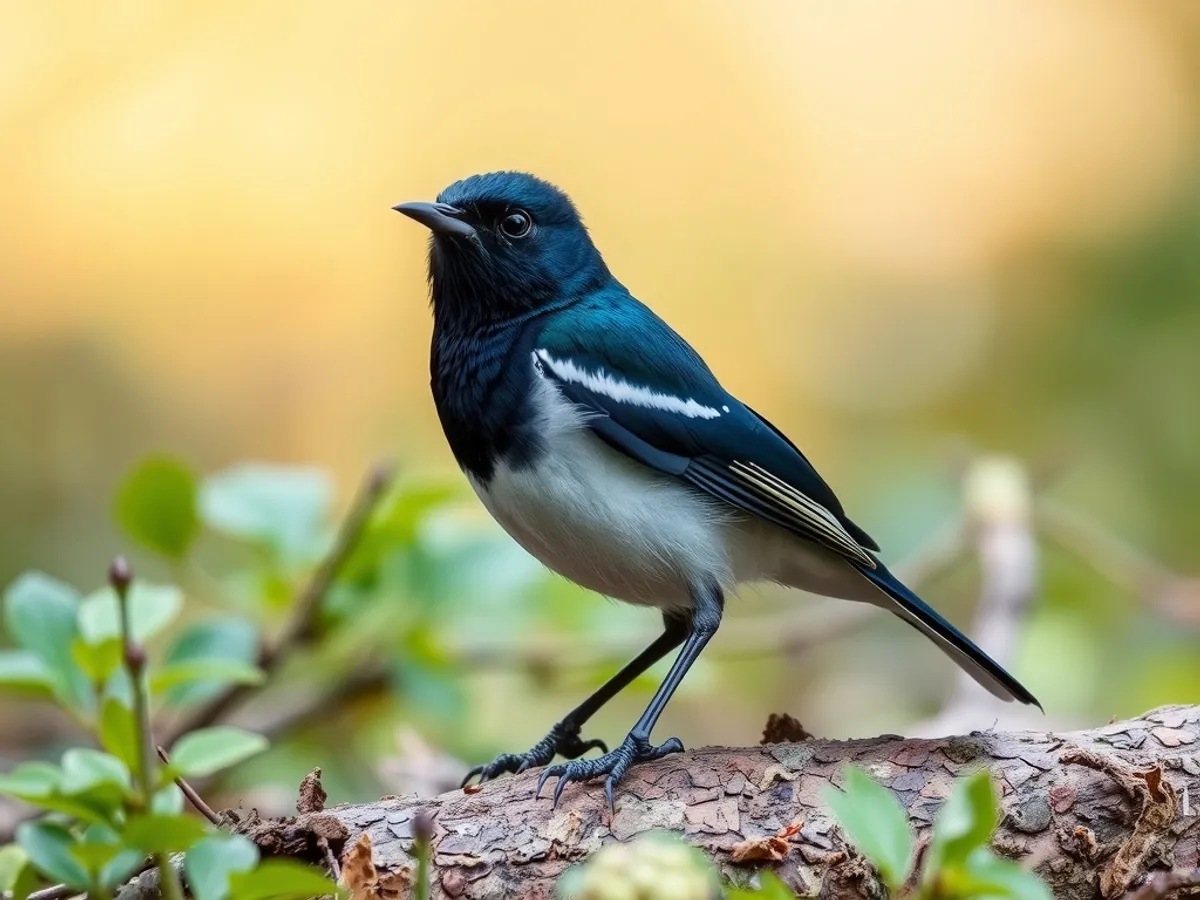
About the Oriental Magpie-robin
The Oriental Magpie-robin is a small, active passerine bird known for its striking black-and-white plumage and melodious song. Native to South and Southeast Asia, it inhabits a variety of habitats, including gardens, forests, and urban areas. Males are easily recognized by their glossy black upperparts and white underparts, while females are more greyish. This bird is often seen perching conspicuously and flicking its tail, and is highly regarded for its vocal mimicry and varied calls.
Fascinating facts
Talented Singer
Male Oriental Magpie-robins are known for their intricate and melodious songs, often performed during the breeding season to attract mates.
Urban Adaptability
This species readily adapts to urban environments and can often be found in city gardens and parks, as well as natural forests.
Unique Nesting Habits
They commonly nest in tree holes, crevices, or even man-made structures, using twigs, roots, and leaves to build their nests.
Detailed description
The Oriental Magpie-robin (Copsychus saularis) is a small passerine bird, measuring 19–21 cm in length, with a wingspan of about 25–30 cm and weighing between 27–42 grams. Males display a striking contrast of glossy black upperparts, head, and throat, with white underparts and prominent white wing patches, while females and juveniles are more subdued, exhibiting slate-grey upperparts and paler underparts. The long, graduated tail is characteristically held upright and flicked frequently, a behavior often used in territorial displays. The species has a slender, slightly decurved bill adapted for insectivory, and strong legs suited for terrestrial foraging. Its vocal repertoire is highly complex, with melodious whistles, trills, and mimicry of other species, especially pronounced during the breeding season. Oriental Magpie-robins are generally solitary or found in pairs, exhibiting strong territoriality, particularly among males. They are diurnal, active from dawn to dusk, and are known for their conspicuous perching and bold behavior in both natural and urban environments. Their adaptability to diverse habitats, from dense forests to city gardens, underscores their ecological versatility. The species is sexually dimorphic, and age-related plumage variation is evident, with juveniles showing mottled brown and grey patterns.
Did you know?
Once popular as cage birds for their singing, their populations in some regions have rebounded after strict protection measures.
Research & sources
Wikipedia summary
The Oriental magpie-robin is a small passerine bird that was formerly classed as a member of the thrush family Turdidae, but now considered an Old World flycatcher. They are distinctive black and white birds with a long tail that is held upright as they forage on the ground or perch conspicuously. Occurring across most of the Indian subcontinent and parts of Southeast Asia, they are common birds in urban gardens as well as forests. They are particularly well known for their songs and were once popular as cagebirds.
Behaviour & social structure
Oriental Magpie-robins are primarily insectivorous, foraging on the ground for insects, spiders, and other arthropods, but their diet also includes small vertebrates, fruits, and nectar, especially during the non-breeding season. They employ a 'perch-and-sally' hunting strategy, scanning for prey from low perches before making short flights to capture it. These birds are highly territorial, with males singing from prominent perches to defend their territory and attract mates. Aggressive encounters, involving chasing and vocal duels, are common during the breeding season. Outside of breeding, they may tolerate conspecifics at feeding sites but generally remain solitary or in pairs. Daily routines include early morning and late afternoon singing, interspersed with periods of foraging and preening. Roosting occurs in dense foliage or sheltered spots, often within their territory. They are known for their curiosity and can become habituated to human presence in urban settings.
Reproduction & life cycle
Breeding typically occurs from March to July, varying regionally with rainfall and temperature. Oriental Magpie-robins are monogamous, forming stable pair bonds for the duration of the breeding season. Courtship involves elaborate singing and display flights by the male. The nest is a cup-shaped structure built by the female, using twigs, roots, and grass, often placed in tree cavities, crevices, or even man-made structures such as eaves and pipes. Clutch size ranges from 3 to 5 eggs, which are pale greenish or bluish with brown speckles. The female incubates the eggs for 8–14 days, while the male provides food and guards the territory. Both parents participate in feeding the chicks, which fledge after 10–13 days. Multiple broods per season are common in favorable conditions. Parental care continues for several days post-fledging, with juveniles remaining within the natal territory.
Adaptations & survival
Oriental Magpie-robins exhibit several adaptations for survival in diverse environments. Their strong legs and elongated tail facilitate agile ground foraging and rapid escape from predators. The species' complex vocalizations serve both territorial and mate-attraction functions, and their ability to mimic other birds may help deter rivals or confuse predators. Their omnivorous diet allows flexibility in resource-poor conditions, and their tolerance of human-altered landscapes has enabled them to thrive in urban areas. The use of a wide range of nesting sites, including artificial structures, further enhances their reproductive success. Seasonal changes in plumage and behavior, such as reduced singing outside the breeding season, reflect adaptive responses to environmental pressures.
Cultural significance
The Oriental Magpie-robin holds significant cultural value in many parts of South and Southeast Asia. Its melodious song has made it a popular cagebird, especially in the 19th and early 20th centuries, and it features in local folklore and poetry as a symbol of joy and vitality. In Bangladesh, it is the national bird and is known locally as 'Doyel' or 'Doel,' celebrated for its beauty and song. The bird is often depicted in art and literature, and its presence in gardens is considered auspicious in some cultures. Conservation campaigns have leveraged its popularity to promote awareness of urban biodiversity.
Recent research
Recent research has focused on the Oriental Magpie-robin's vocal learning abilities, revealing complex song structures and regional dialects, which are of interest in studies of avian communication and neurobiology. Genetic studies have clarified its taxonomic placement within the Muscicapidae family, resolving previous confusion with thrushes. Ongoing ecological research examines its role in urban ecosystems, including its adaptability to anthropogenic change and its interactions with other urban wildlife. Studies on reproductive biology have documented flexible breeding strategies and high parental investment. The species is also used as a model for investigating the impacts of environmental pollutants on avian physiology and behavior.
Videos
Habitat
Open woodland, gardens, and urban areas
 Various Continental Regions
Grassland
Open areas dominated by grasses rather than trees, supporting numerous herbivores and their predators.
 Global
Forest
Wooded areas with significant tree cover and diverse plant and animal communities.
 Global
Freshwater
Lakes, rivers, and wetlands with diverse aquatic ecosystems.
Conservation
The Oriental Magpie-robin is currently classified as Least Concern on the IUCN Red List.
Threats & challenges
Currently assessed as Least Concern by the IUCN, the Oriental Magpie-robin maintains stable populations across much of its range. However, localized declines have been reported due to habitat loss, urbanization, and the use of pesticides that reduce insect prey availability. In some regions, illegal trapping for the cagebird trade remains a threat, although this has diminished compared to historical levels. Predation by domestic cats and competition with invasive species can also impact local populations. Despite these challenges, the species' adaptability and broad ecological niche have allowed it to persist in both rural and urban landscapes. Continued monitoring is necessary to detect emerging threats, particularly in rapidly urbanizing areas.
Taxonomy
Scientific name
Copsychus saularis
- Kingdom
- Animalia
- Phylum
- Chordata
- Class
- Aves
- Order
- Passeriformes
- Family
- Muscicapidae
- Genus
- Copsychus
- Species
- saularis
Community notes
Share your observations about the Oriental Magpie-robin.
No community notes yet. Be the first!
Discover more wildlife
More fascinating animals from the encyclopedia.