
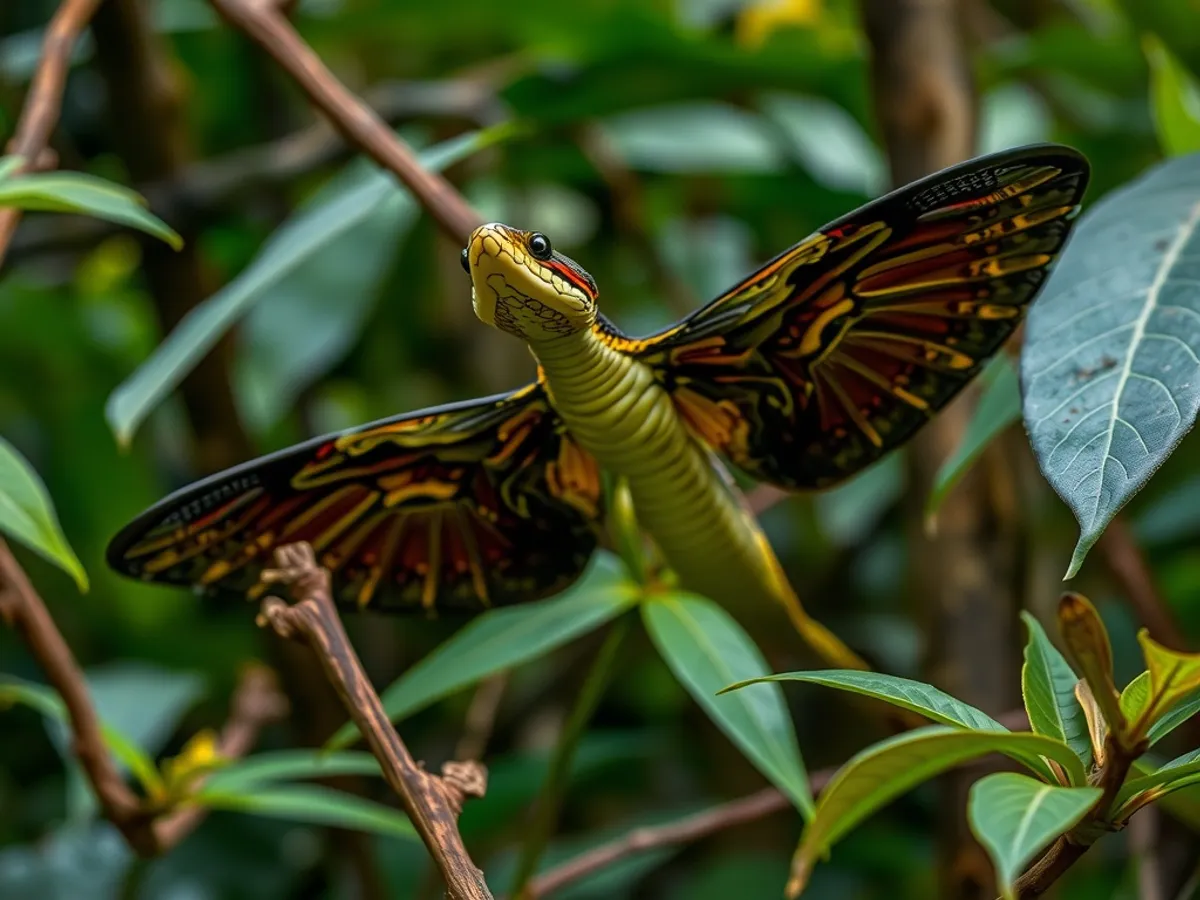
About the Ornate Flying Snake
The Ornate Flying Snake is a slender, mildly venomous tree-dwelling snake known for its remarkable ability to glide between trees. Native to Southeast and South Asia, it has a striking coloration with green, yellow, and black patterns that provide excellent camouflage in the forest canopy. This species can flatten its body and launch itself from branches, using lateral undulation to glide distances of up to 100 meters. The Ornate Flying Snake is agile, primarily arboreal, and preys on lizards, frogs, birds, and bats. It is non-aggressive and poses little threat to humans.
Fascinating facts
Expert Gliders
Ornate Flying Snakes can glide between trees by launching themselves from branches and flattening their bodies to create lift.
Arboreal Lifestyle
They spend most of their lives in the forest canopy, rarely descending to the ground except to lay eggs or hunt.
Diverse Diet
Their diet includes lizards, frogs, small birds, and bats, which they hunt in the treetops using stealth and agility.
Detailed description
The Ornate Flying Snake (Chrysopelea ornata) is a medium-sized, slender colubrid snake, typically ranging from 1.0 to 1.3 meters in length, with females generally larger than males. Its body is laterally compressed, allowing it to flatten its ribs and form a concave surface for gliding. The dorsal coloration is highly variable but usually consists of a bright green, yellow, or gold background with black crossbars and intricate patterns, providing effective camouflage among leaves and branches. The ventral side is lighter, often yellowish or cream. The head is distinct from the neck, with large eyes and round pupils adapted for arboreal life. Chrysopelea ornata is diurnal and highly agile, moving swiftly through the canopy using both lateral undulation and concertina locomotion. Its gliding ability is achieved by launching from elevated perches, flattening the body, and undulating midair to control direction and speed, with recorded glides of up to 100 meters. The species is mildly venomous, possessing rear-fanged (opisthoglyphous) dentition, but its venom is not dangerous to humans. It is solitary outside of the breeding season and exhibits territorial behavior, especially among males. Reproduction is oviparous, with females laying clutches of 6–15 eggs in concealed, humid locations. The Ornate Flying Snake occupies a wide range of habitats, from primary and secondary forests to agricultural edges and urban parks, demonstrating remarkable ecological flexibility.
Did you know?
The Ornate Flying Snake can glide distances of up to 100 meters in a single leap, making it one of the best gliding snakes in the world.
Research & sources
Behaviour & social structure
Ornate Flying Snakes are primarily arboreal and spend most of their lives in the forest canopy, rarely descending to the ground except to lay eggs or occasionally hunt. They are active during the day (diurnal), with peak activity in the early morning and late afternoon. Their hunting strategy involves slow, deliberate movement through branches, using their keen eyesight to locate prey such as lizards (notably geckos and agamids), tree frogs, small birds, and occasionally bats. Upon spotting prey, they employ a rapid strike, using mild venom to subdue smaller animals. Feeding is infrequent, with individuals often going days or weeks between meals. Social interactions are minimal; individuals are solitary and avoid each other except during the breeding season. When threatened, they may display defensive behaviors such as flattening the body, hissing, and rapid escape by gliding to another tree. They are known for their exceptional spatial memory and ability to navigate complex three-dimensional environments.
Reproduction & life cycle
Chrysopelea ornata is oviparous, with breeding typically occurring at the onset of the rainy season (April to June) in most of its range. Courtship involves males actively searching for receptive females, often engaging in brief combat with rival males. Copulation is followed by a gestation period of 4–6 weeks, after which females lay clutches of 6–15 elongated, leathery eggs in concealed, moist microhabitats such as tree hollows, leaf litter, or under bark. Incubation lasts 60–80 days, depending on ambient temperature and humidity. There is no parental care after egg-laying; hatchlings are fully independent and capable of gliding and hunting from birth. Sexual maturity is reached at 2–3 years of age.
Adaptations & survival
The most remarkable adaptation of the Ornate Flying Snake is its ability to glide. By flattening its ribs and expanding the body up to twice its normal width, it creates a pseudo-airfoil shape, generating lift and enabling controlled gliding. The snake launches itself from high perches, undulating its body laterally in midair to steer and stabilize the glide. Its prehensile tail and strong ventral scales aid in climbing and anchoring to branches. The cryptic coloration provides camouflage against predators and prey. Mild venom, delivered via enlarged rear fangs, helps subdue small vertebrates. Its large eyes and acute vision are crucial for detecting prey and navigating the complex canopy. Behavioral flexibility allows it to exploit a range of habitats, including disturbed and urban environments.
Cultural significance
In parts of Southeast Asia and India, flying snakes are featured in folklore and are sometimes regarded with awe or superstition due to their unusual locomotion. They are occasionally referenced in local myths as magical or supernatural beings capable of flight. In some cultures, they are believed to bring good luck or serve as omens. The species has also attracted scientific and popular interest due to its unique gliding ability, inspiring biomimetic research in robotics and aerodynamics. There is no known significant use in traditional medicine or trade.
Recent research
Recent research has focused on the biomechanics of gliding in Chrysopelea ornata, revealing that the snake’s body forms a cross-sectional shape that maximizes lift-to-drag ratio, comparable to engineered airfoils. High-speed videography and computational fluid dynamics have been used to model its aerial undulation and control mechanisms. Studies have also examined its ecological role as a predator of arboreal vertebrates and its adaptability to fragmented landscapes. Ongoing research includes the genetic basis of its gliding adaptations and the potential impacts of climate change on its distribution. The species is also used as a model organism in studies of vertebrate locomotion and evolutionary innovation.
Videos
Habitat
Tropical forests


Conservation
The Ornate Flying Snake is currently classified as Least Concern on the IUCN Red List.
Threats & challenges
Currently assessed as Least Concern by the IUCN, the Ornate Flying Snake faces localized threats from habitat loss due to deforestation, agricultural expansion, and urbanization. In some regions, road mortality and persecution by humans (due to fear or mistaken identity) are minor threats. The species’ adaptability to secondary forests and even urban parks has mitigated some impacts of habitat fragmentation. There is no evidence of significant population decline, and the species remains widespread and locally common throughout its range. However, ongoing habitat degradation and climate change could pose future risks, especially in areas with rapid land-use change.
Taxonomy
Scientific name
Chrysopelea ornata
- Kingdom
- Animalia
- Phylum
- Chordata
- Class
- Reptilia
- Order
- Squamata
- Family
- Colubridae
- Genus
- Chrysopelea
- Species
- ornata
Community notes
Share your observations about the Ornate Flying Snake.
No community notes yet. Be the first!
Discover more wildlife
More fascinating animals from the encyclopedia.