
About the Pacific mole crab
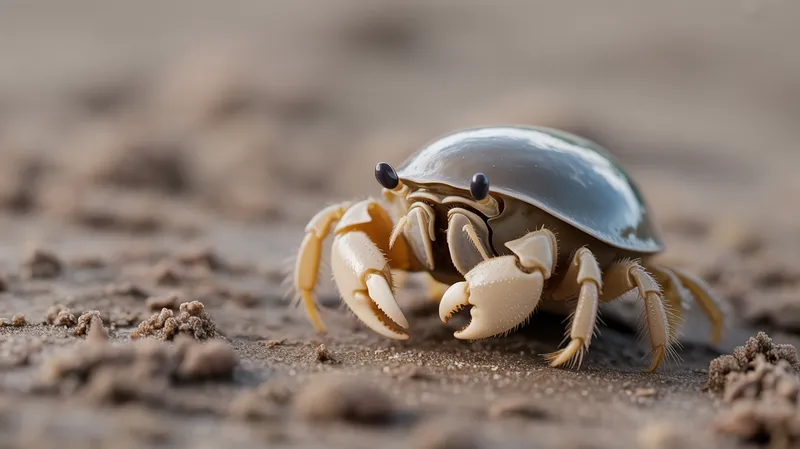
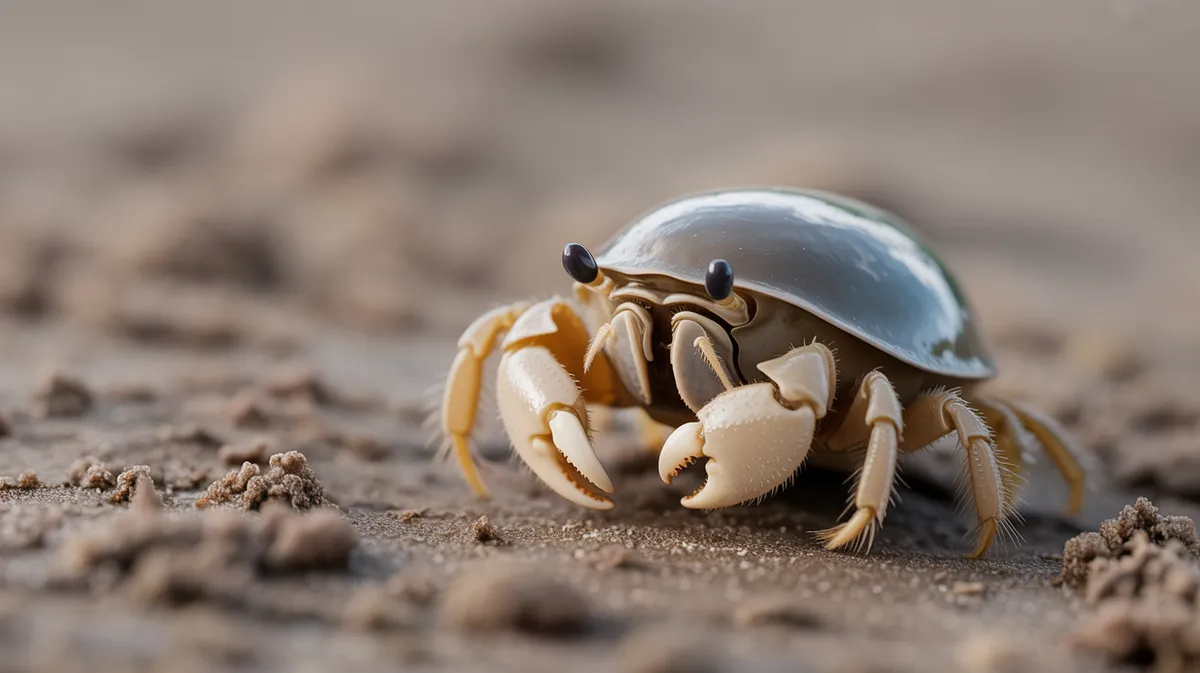
The Pacific mole crab is a small, barrel-shaped crustacean found along the sandy beaches of the eastern Pacific Ocean. Adapted for burrowing, it uses its streamlined body and powerful legs to quickly dig backward into the sand, especially in the swash zone where waves break. These crabs are filter feeders, capturing plankton and organic particles with their feathery antennae as the tides wash over them. Despite their small size, they play a crucial role in coastal food webs, serving as prey for shorebirds, fish, and other marine animals.
Fascinating facts
Beach Specialist
Pacific mole crabs are highly specialized for life in the surf zone, where they are constantly exposed to breaking waves and shifting sands.
Unique Antennae
They use long, feathery antennae to filter tiny plankton and detritus from the water as waves rush over them.
Egg Carriers
Female Pacific mole crabs can carry hundreds of bright orange eggs under their abdomen at a time, ensuring the next generation can thrive.
Detailed description
Emerita analoga, commonly known as the Pacific mole crab, is a small, barrel-shaped crustacean typically measuring 1.5–3.5 cm in length, with females generally larger than males. Its body is highly streamlined and covered by a smooth, convex carapace, which aids in rapid backward burrowing into sandy substrates. The coloration ranges from pale gray to tan, often matching the sand for camouflage. The crab possesses five pairs of legs, with the first pair modified into small, chelate claws and the remaining adapted for digging. Its most distinctive feature is a pair of long, feathery antennae, which are used for filter feeding in the turbulent swash zone. Unlike many crabs, E. analoga lacks prominent eyes on stalks, instead having small, simple eyes positioned dorsally. The species is adapted for a semi-infaunal lifestyle, spending most of its life buried in the sand, emerging only to feed or during reproductive activities. It exhibits sexual dimorphism, with females carrying bright orange egg masses under their abdomen during breeding season. The Pacific mole crab is a key prey item for shorebirds, surf fishes, and other coastal predators, and plays an important role in nutrient cycling within sandy beach ecosystems.
Did you know?
Unlike most crabs, Pacific mole crabs can only move backward and never sideways or forward.
Research & sources
Wikipedia summary
Emerita analoga, the Pacific sand crab, Pacific mole crab or coldwater mole crab, is a species of small, sand-burrowing decapod crustacean found living in the sand along the temperate western coasts of North and South America. It is found on exposed sandy beaches in the swash region of the intertidal zone.
Behaviour & social structure
Pacific mole crabs are highly specialized for life in the dynamic swash zone, where waves continually reshape the sandy substrate. They exhibit a unique backward burrowing behavior, using their legs in a coordinated paddling motion to quickly disappear beneath the surface within seconds. Feeding occurs during periods of wave wash, when the crabs extend their feathery antennae above the sand to filter plankton, detritus, and organic particles from the water. They are non-aggressive and solitary, with little evidence of social interaction outside of breeding aggregations. Activity is closely tied to tidal rhythms, with crabs repositioning themselves up and down the beach in response to changing water levels. They do not actively hunt, relying entirely on suspension feeding. During periods of high predation risk, such as low tide, they remain buried and motionless to avoid detection.
Reproduction & life cycle
Reproduction in E. analoga is seasonal, typically peaking in spring and summer when water temperatures rise. Mating occurs in the swash zone, where males locate receptive females by chemical cues. Fertilization is internal, and females carry fertilized eggs attached to their pleopods (swimmerets) beneath the abdomen. The incubation period lasts approximately 2–4 weeks, depending on temperature. Females can produce several broods per season, each containing thousands of eggs. After hatching, larvae are released into the plankton as zoeae, undergoing multiple molts over 4–5 weeks before settling back into the sand as juveniles. There is no parental care beyond egg brooding, and larval survival is highly dependent on ocean currents and food availability.
Adaptations & survival
E. analoga exhibits several remarkable adaptations for its environment. Its streamlined, convex carapace reduces drag during rapid burrowing and helps resist wave action. The backward digging behavior is unique among crabs and allows for quick escape from predators and shifting sands. The feathery antennae are highly sensitive and efficient at filtering microscopic food particles from turbulent water. The crab's coloration provides effective camouflage against sandy backgrounds, reducing predation risk. Its ability to tolerate rapid changes in salinity and temperature enables survival in the highly variable intertidal zone. Additionally, the reproductive strategy of producing large numbers of planktonic larvae increases the likelihood of successful recruitment despite high mortality rates.
Cultural significance
While not widely utilized in human culture, Pacific mole crabs are occasionally collected as bait for surf fishing, particularly in California and Baja California. They are not consumed by humans due to their small size and sandy habitat. In some coastal communities, their presence is considered an indicator of healthy beach ecosystems. The species also features in educational programs and beach ecology studies, symbolizing the intricate adaptations of intertidal life.
Recent research
Recent research on E. analoga has focused on its role as a bioindicator for sandy beach health, responses to beach nourishment and erosion, and the effects of climate-driven changes in ocean currents on larval dispersal. Molecular studies have examined population connectivity along the Pacific coast, revealing high gene flow facilitated by planktonic larvae. Ongoing studies are investigating the impacts of microplastic pollution on feeding efficiency and health. The species is also used in studies of intertidal community dynamics and predator-prey interactions, particularly with migratory shorebirds and surf zone fishes.
Sources
Emerita analoga (Stimpson, 1857): Taxonomy, Biology, and Ecology
DecaNet, World Register of Marine Species (WoRMS) (2023)
scientificPopulation connectivity and larval dispersal of the sand crab Emerita analoga along the Pacific coast
Morgan, S.G. & Fisher, J.L. (2010)
scientificVideos
Habitat
Sandy intertidal zones of the Pacific Ocean coastline

Conservation
The Pacific mole crab is currently classified as Least Concern on the IUCN Red List.
Threats & challenges
Currently, E. analoga is not considered threatened and is classified as Least Concern. However, populations can be impacted by coastal development, beach nourishment projects, pollution, and trampling by beachgoers. Oil spills and runoff can degrade habitat quality and reduce food availability. Climate change poses potential long-term risks by altering ocean currents, temperature regimes, and the frequency of extreme weather events, which may affect larval dispersal and survival. Despite these challenges, the species remains abundant along much of its range, thanks to its high reproductive output and adaptability.
Taxonomy
Scientific name
Emerita analoga
- Kingdom
- Animalia
- Phylum
- Arthropoda
- Class
- Malacostraca
- Order
- Decapoda
- Family
- Hippidae
- Genus
- Emerita
- Species
- analoga
Community notes
Share your observations about the Pacific mole crab.
No community notes yet. Be the first!
Discover more wildlife
More fascinating animals from the encyclopedia.