
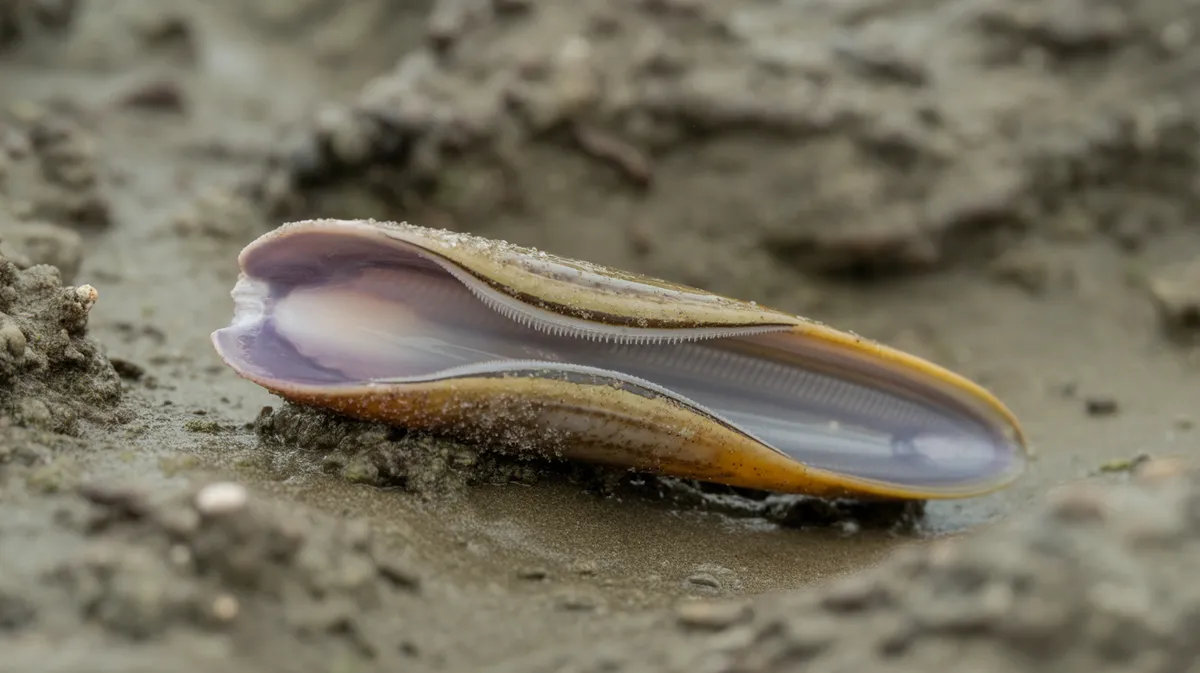
About the Pacific razor clam
The Pacific razor clam is a large, elongated bivalve mollusk found along the sandy beaches of the North American Pacific coast. Its smooth, thin, and fragile shell can reach up to 15 centimeters in length, and is well-adapted for rapid burrowing. Razor clams are renowned for their remarkable speed and agility in the sand, quickly disappearing from predators and harvesters. They are a popular species for recreational and commercial digging, prized for their sweet, tender meat. Their populations are closely monitored due to their ecological importance and popularity as seafood.
Fascinating facts
Shell Shape
The razor clam's shell is long, narrow, and delicate, perfectly adapted for slicing through wet sand.
Rapid Burrowers
Pacific razor clams can burrow out of sight in just seconds, using a strong and muscular foot to propel themselves deep below the sand.
Tidal Dwellers
They thrive in the dynamic environment of the intertidal zone, enduring both submerged and exposed conditions as tides change.
Detailed description
The Pacific razor clam (Siliqua patula) is a large, elongated bivalve mollusk characterized by its thin, fragile, and highly streamlined shell, which can reach lengths of 10–15 cm (4–6 inches), though exceptional specimens may approach 20 cm (8 inches). The shell is laterally compressed, with a smooth surface and a straight dorsal margin, facilitating rapid burrowing in sandy substrates. Coloration changes with age, typically starting as a light brown in juveniles, shifting to yellowish hues, and returning to darker brown as the clam matures. The siphons are long and fused except at the tips, allowing the animal to remain deeply buried while extending to the surface for feeding and respiration. Internally, the muscular foot is highly developed, enabling swift vertical movement within the sand. Pacific razor clams are filter feeders, drawing in seawater through their siphons to extract phytoplankton and suspended organic particles. They are primarily solitary but can occur in dense aggregations, especially in optimal habitats. Their rapid burrowing ability is a key anti-predator adaptation, allowing them to evade threats from birds, fish, and human diggers. The species is dioecious (separate sexes), but external sexual dimorphism is absent, requiring microscopic examination for sex determination. Razor clams play a significant ecological role in coastal food webs, serving as prey for a variety of marine and terrestrial predators.
Did you know?
Pacific razor clams can rebury themselves in as little as 7 seconds if exposed, making them one of the fastest-burrowing clams in the world.
Research & sources
Wikipedia summary
The Pacific razor clam, Siliqua patula, is a large mollusc native to North America belonging to the family Pharidae. Pacific razor clams are sexually dimorphic, but as with all clams, there is no way to tell the difference between sexes without dissecting them or evaluating them under a microscope. The shell ranges in colours as the clams grow, starting out brown, and turning to a more yellow colour as the clam matures, eventually turning brown once more as the clam reaches a larger size. It ranges from around 4-12 inches, and eats minuscule life in the ocean, such as plankton or plants. The Pacific razor clam is famously known for its delicious flavour, which makes it a largely hunted and coveted organism.
Behaviour & social structure
Pacific razor clams exhibit a largely sedentary lifestyle, spending most of their lives buried 15–30 cm (6–12 inches) beneath the sand in the intertidal and shallow subtidal zones. They are most active during periods of tidal flux, particularly at low tide when they may adjust their depth in response to environmental cues or predation risk. Feeding occurs primarily during immersion, with clams extending their siphons to filter feed on plankton and detritus. They are highly sensitive to vibrations and changes in pressure, rapidly retracting their siphons and burrowing deeper when disturbed. Social interactions are minimal, though high-density populations can lead to localized competition for space and resources. Razor clams do not exhibit parental care or complex social structures. Their daily routines are dictated by tidal cycles, with periods of feeding alternating with inactivity during exposure or disturbance.
Reproduction & life cycle
Reproduction in Siliqua patula is sexual and occurs via external fertilization. Spawning typically takes place in late spring to early summer (May to July), triggered by rising water temperatures and increased food availability. Males and females release gametes into the water column, where fertilization occurs. Each female can produce several million eggs per spawning event. The fertilized eggs develop into free-swimming planktonic larvae (veligers) within 2–3 days, which remain in the water column for 4–6 weeks before settling into suitable sandy substrates and undergoing metamorphosis into juvenile clams. There is no parental care; survival rates are low due to high predation and environmental hazards during the larval stage. Sexual maturity is typically reached at 2–3 years of age, with individuals capable of living up to 18 years under favorable conditions.
Adaptations & survival
Pacific razor clams possess several specialized adaptations for life in dynamic sandy environments. Their streamlined, laterally compressed shells minimize resistance during rapid burrowing, while the powerful, wedge-shaped foot enables them to dig at rates exceeding 30 cm (12 inches) per minute. The long, fused siphons allow them to remain deeply buried while still accessing surface water for feeding and respiration. Their sensitivity to vibrations and pressure changes helps them detect and escape predators, including humans. The ability to rapidly rebury after disturbance is a key survival trait. Physiologically, they can tolerate fluctuations in salinity and temperature typical of intertidal zones. Their high fecundity and planktonic larval stage facilitate wide dispersal and colonization of new habitats.
Cultural significance
Pacific razor clams have long held cultural and economic importance for Indigenous peoples and coastal communities of the Pacific Northwest. Traditionally, they have been harvested for food and used in trade, with shell fragments occasionally found in archaeological sites. Today, razor clamming is a popular recreational activity, drawing thousands of participants each year to beaches in Washington, Oregon, and Alaska. The species is celebrated for its sweet, tender meat and features prominently in local cuisine. Razor clam festivals and community digs are common, reflecting the clam’s enduring role in regional identity and heritage.
Recent research
Recent research on Siliqua patula has focused on population dynamics, larval dispersal, and the impacts of environmental stressors such as ocean acidification and harmful algal blooms. Genetic studies have revealed significant population structure along the Pacific coast, informing management strategies. Ongoing monitoring programs track population health, recruitment rates, and the prevalence of biotoxins. Advances in non-lethal sex determination and age estimation techniques are improving understanding of life history traits. Studies on burrowing mechanics and predator-prey interactions continue to shed light on the species’ unique adaptations and ecological role.
Videos
Habitat
Sandy intertidal and subtidal zones along the Pacific coast

Conservation
The Pacific razor clam is currently classified as Least Concern on the IUCN Red List.
Threats & challenges
While the Pacific razor clam is currently considered a species of Least Concern, it faces several localized threats. Overharvesting, particularly in regions with high recreational and commercial demand, can lead to population declines if not carefully managed. Habitat degradation from coastal development, pollution, and sedimentation can negatively impact spawning and juvenile recruitment. Harmful algal blooms (such as those producing domoic acid) can result in mass mortalities and render clams unsafe for human consumption, leading to fishery closures. Climate change poses emerging challenges, including ocean acidification and altered coastal dynamics, which may affect larval survival and habitat suitability. Effective management and monitoring are essential to ensure long-term population stability.
Taxonomy
Scientific name
Siliqua patula
- Kingdom
- Animalia
- Phylum
- Mollusca
- Class
- Bivalvia
- Order
- Adapedonta
- Family
- Pharidae
- Genus
- Siliqua
- Species
- patula
Community notes
Share your observations about the Pacific razor clam.
No community notes yet. Be the first!
Discover more wildlife
More fascinating animals from the encyclopedia.