
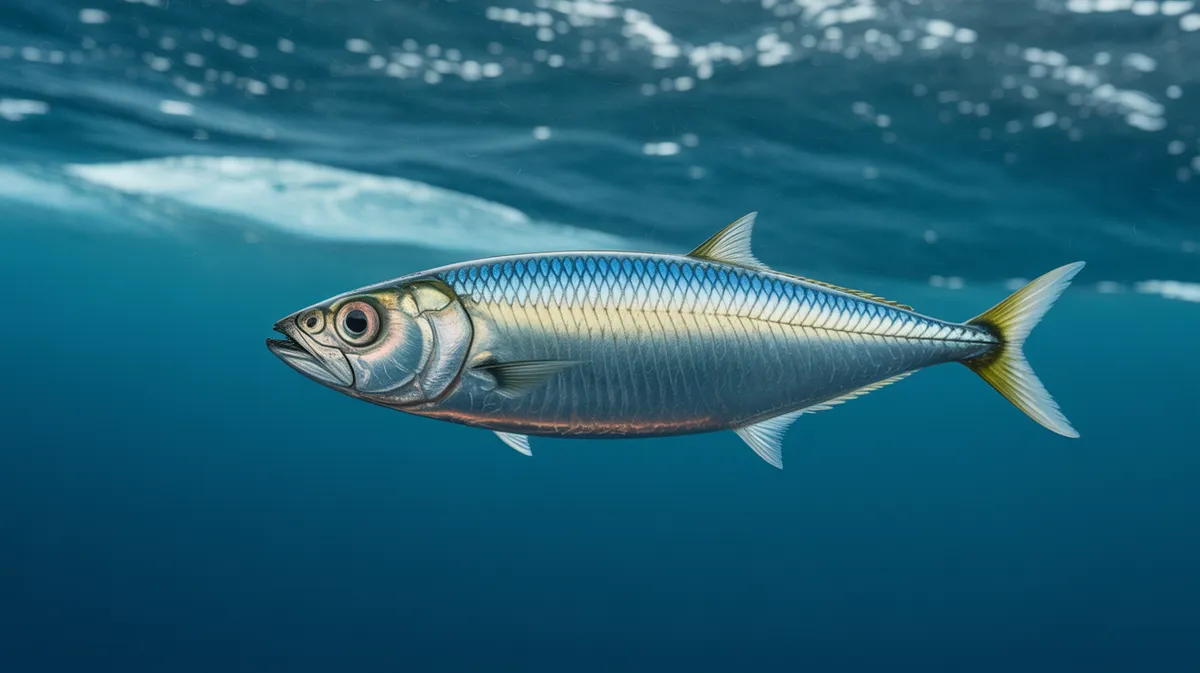
About the Pacific Sardine
The Pacific sardine is a small, schooling fish found abundantly throughout the northeastern Pacific Ocean. Recognizable by its streamlined, silver body and faint dark spots along the sides, this fish often forms massive, dense schools near the ocean surface. Pacific sardines play a vital ecological role as prey for numerous marine predators, including whales, sea lions, and large fish. They are also an important species for commercial fisheries, valued for their nutritional content and use in both human consumption and animal feed.
Fascinating facts
Schooling Behavior
Pacific sardines form some of the largest schools in the ocean, which can sometimes be visible from the air as shimmering silver bands.
Habitat Range
They inhabit the temperate waters of the Pacific, ranging from the Gulf of Alaska down to the coasts of Peru, including the waters off California and Mexico.
Economic Importance
This species is commercially harvested for canned sardines, fishmeal, and bait, contributing significantly to regional fisheries.
Detailed description
The Pacific sardine (Sardinops sagax) is a small, pelagic fish typically measuring 15–25 cm in length, with some individuals reaching up to 30 cm. It is characterized by a slender, laterally compressed body, a single dorsal fin, and a forked caudal fin, which together facilitate agile swimming in large schools. Its coloration is predominantly silver with a bluish-green dorsal surface and a series of faint dark spots along the flanks, providing camouflage from both aerial and aquatic predators. The scales are large and easily shed, a possible anti-predator adaptation. Pacific sardines are highly social, forming schools that can number in the millions, which enhances foraging efficiency and predator avoidance. They are filter feeders, using specialized gill rakers to strain plankton, their primary food source, from the water column. Spawning occurs in open water, where females release thousands of buoyant eggs that are fertilized externally. The species exhibits rapid growth and early maturation, with individuals capable of reproducing within their first year. Pacific sardines are a keystone forage species, supporting a diverse array of marine predators and playing a crucial role in nutrient cycling within coastal ecosystems.
Did you know?
Pacific sardine populations can boom or crash dramatically due to oceanic climate cycles like El Niño and La Niña.
Research & sources
Behaviour & social structure
Pacific sardines display pronounced schooling behavior, forming dense, synchronized aggregations that can stretch for kilometers. This collective movement is a defense mechanism against predators and also aids in efficient foraging. They are primarily crepuscular feeders, rising to the surface at dusk and dawn to feed on phytoplankton, zooplankton, and occasionally small crustaceans. During the day, schools may descend to deeper waters to avoid visual predators. Sardines communicate and coordinate movements through subtle changes in body orientation and lateral line sensing. Their feeding behavior involves swimming with mouths open to filter plankton-rich water, and they can adjust their depth and location in response to plankton availability and water temperature. Social hierarchies are minimal, with little evidence of dominance structures, but school cohesion is maintained through constant sensory feedback.
Reproduction & life cycle
Pacific sardines are highly fecund, with females capable of producing between 20,000 and 100,000 eggs per spawning event, depending on size and age. Spawning occurs in coastal and offshore waters, typically between late winter and early summer, though timing can vary with oceanographic conditions. Eggs are pelagic and buoyant, hatching within 2–4 days depending on water temperature. There is no parental care; larvae are left to drift in the plankton, where they feed on microzooplankton and are subject to high mortality rates. Sexual maturity is reached at 1–2 years of age, and individuals may spawn multiple times within a season. Recruitment success is closely linked to ocean temperature, upwelling, and food availability, leading to pronounced population fluctuations.
Adaptations & survival
Pacific sardines possess several adaptations for survival in dynamic marine environments. Their streamlined bodies and forked tails enable rapid, sustained swimming, essential for both migration and predator evasion. The large, deciduous scales may help confuse predators during attacks. Specialized gill rakers allow efficient filter feeding on small planktonic organisms. Sardines exhibit remarkable sensory adaptations, including a well-developed lateral line system for detecting water movements and maintaining school cohesion. Their reproductive strategy of high fecundity and pelagic eggs increases the likelihood of survival in variable conditions. Physiologically, they are tolerant of a wide range of temperatures and salinities, enabling them to exploit diverse habitats and migrate extensively in response to oceanographic changes.
Cultural significance
Pacific sardines have played a significant role in the economies and cultures of coastal communities, particularly in California, Mexico, and Japan. In the early 20th century, sardine fisheries were central to the development of cities like Monterey, California, famously depicted in John Steinbeck's 'Cannery Row.' Sardines are consumed fresh, canned, smoked, or processed into fish meal and oil, and have been a staple in traditional diets. They also feature in local festivals and folklore, symbolizing abundance and resilience. The rise and fall of sardine fisheries have shaped regional histories and inspired conservation efforts.
Recent research
Recent research on Pacific sardines has focused on the effects of climate change and oceanographic variability on population dynamics, using advanced modeling and genetic tools to track migration and recruitment. Studies have highlighted the importance of the Pacific Decadal Oscillation and El Niño-Southern Oscillation in driving sardine abundance. Ongoing research is examining the impacts of microplastic ingestion and ocean acidification on sardine health and reproduction. Genetic studies have revealed significant population structure across the Pacific, informing international management. Acoustic and satellite tagging are providing new insights into migration routes and habitat use.
Videos
Habitat
Coastal and open ocean waters of the Pacific Ocean

Conservation
The Pacific Sardine is currently classified as Least Concern on the IUCN Red List.
Threats & challenges
While currently listed as Least Concern, Pacific sardines face several threats, including overfishing, habitat degradation, and climate variability. Historical overexploitation led to major fishery collapses in the 20th century, with populations only recovering after strict management measures. Climate-driven changes in ocean temperature and productivity can cause dramatic fluctuations in sardine abundance, affecting both the species and its predators. Bycatch in other fisheries and pollution (e.g., microplastics, oil spills) also pose risks. Effective management is challenged by the species' natural population variability and the need for international cooperation, as sardines migrate across national boundaries.
Taxonomy
Scientific name
Sardinops sagax
- Kingdom
- Animalia
- Phylum
- Chordata
- Class
- Actinopterygii
- Order
- Clupeiformes
- Family
- Clupeidae
- Genus
- Sardinops
- Species
- sagax
Where to see a pacific sardine
1 zoo and aquarium in 1 country are recorded as keeping this species.

Community notes
Share your observations about the Pacific Sardine.
No community notes yet. Be the first!
Discover more wildlife
More fascinating animals from the encyclopedia.