
About the Painted Turtle
Chrysemys picta is the most widespread native turtle in North America, and its hatchlings do something no other turtle in the region can: they stay in the nest chamber through their first winter, only a few centimetres below the soil surface, and survive being frozen. The hatchling supercools, holding its body fluids liquid below 0 C, and can also tolerate a limited amount of actual ice formation in its tissues, with high blood glucose and specialised proteins protecting the cells. Adults have a different and equally extreme trick: they overwinter at the bottom of ponds under ice with no access to air, and when the oxygen runs out they switch to anaerobic metabolism, dumping lactic acid into the blood. The turtle then buffers that acid by dissolving calcium and magnesium carbonate out of its own shell and bones, and by sequestering lactate into the shell — effectively using its skeleton as an antacid. It can survive over four months of total anoxia at 3 C, which no other air-breathing vertebrate comes close to. Sex is determined by nest temperature: cooler nests produce males, warmer nests females, with no sex chromosomes at all, and this makes the species a subject of intense concern in a warming climate. Painted turtles bask constantly and stack up on logs by the dozen.
Fascinating facts
Colorful Shell Patterns
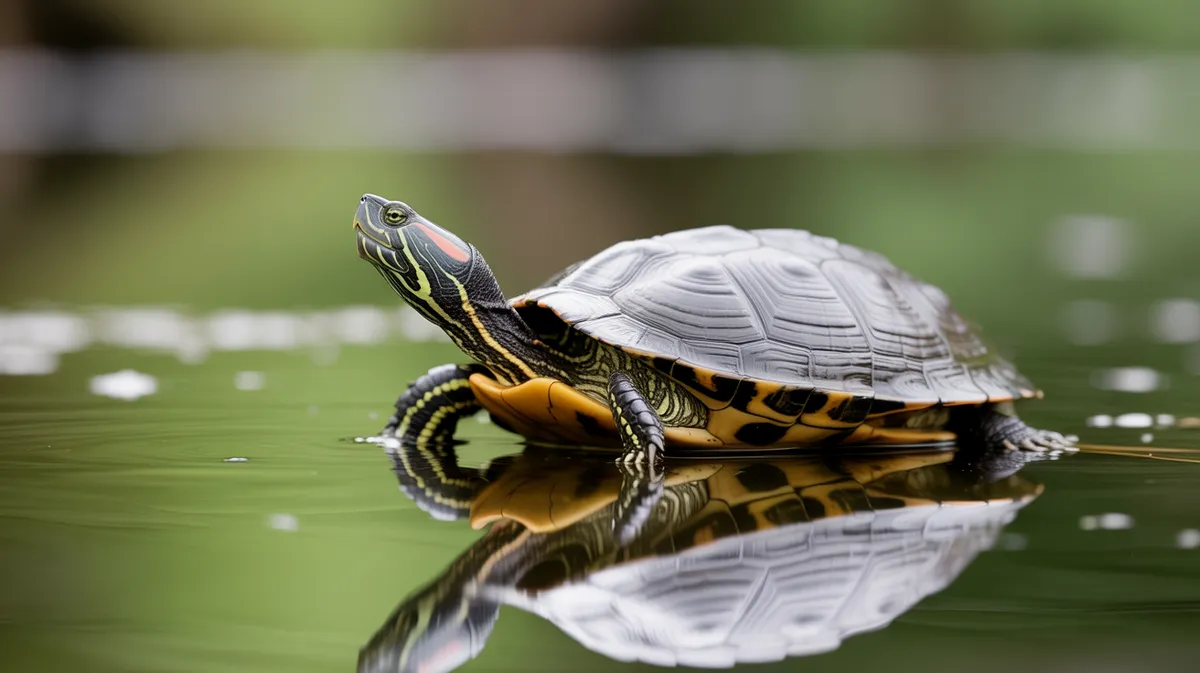
The Painted Turtle's carapace features vivid red and yellow stripes along its edges and on its limbs, making it one of the most visually striking North American turtles.
Temperature-Dependent Sex
The gender of Painted Turtle hatchlings is determined by the temperature at which the eggs are incubated, with warmer temperatures producing females and cooler ones yielding males.
Underwater Hibernation
During winter, Painted Turtles hibernate at the bottom of ponds or lakes, where they can absorb oxygen through their skin and lining of their throat and cloaca.
Detailed description
The painted turtle (Chrysemys picta) is a medium-sized freshwater turtle, with adults typically measuring 10–25 cm (4–10 in) in carapace length and weighing 300–500 g (10–18 oz). Its carapace is smooth, oval, and relatively flat, displaying olive to black coloration with distinctive red and yellow markings along the edges and plastron. The plastron itself is usually yellow or orange, sometimes with a central dark blotch. The head, neck, and limbs are marked with vivid yellow stripes, aiding in camouflage among aquatic vegetation. Painted turtles exhibit sexual dimorphism: females are generally larger with shorter claws, while males possess elongated foreclaws used in courtship displays. This species is diurnal, spending much of the day basking on logs or rocks to regulate body temperature. They are highly aquatic, rarely venturing far from water except during nesting. Painted turtles have a lifespan of 20–40 years in the wild, with some individuals documented to exceed 50 years. Their sensory adaptations include acute vision and olfaction, facilitating efficient foraging and predator avoidance. The species is tolerant of a wide range of environmental conditions, including low-oxygen waters during winter hibernation.
Did you know?
Painted Turtle hatchlings can survive winter in frozen mud, enduring body temperatures below freezing without lasting harm.
Research & sources
Wikipedia summary
The painted turtle is the most widespread native turtle of North America. It lives in relatively slow-moving fresh waters, from southern Canada to northern Mexico, and from the Atlantic to the Pacific. They have been shown to prefer large wetlands with long periods of inundation and emergent vegetation. This species is one of the few that is specially adapted to tolerate freezing temperatures for extended periods of time due to an antifreeze-like substance in their blood that keeps their cells from freezing. This turtle is a member of the genus Chrysemys, which is part of the pond turtle family Emydidae. Fossils show that the painted turtle existed 15 million years ago. Three regionally based subspecies evolved during the last ice age. The southern painted turtle (C. dorsalis) is alternately considered the only other species in Chrysemys, or another subspecies of C. picta.
Behaviour & social structure
Painted turtles are generally solitary but may aggregate in large numbers at preferred basking sites, especially during cooler months. Basking is critical for thermoregulation, digestion, and parasite control. They are omnivorous, with juveniles favoring animal prey such as aquatic insects, crustaceans, and small fish, while adults consume more aquatic vegetation and algae. Foraging occurs primarily in the morning and late afternoon. Painted turtles are known for their cautious behavior; they quickly dive into water at the slightest disturbance. They communicate through tactile and visual signals, particularly during courtship, where males use their long foreclaws to stroke the female's face. Activity levels decrease significantly during cold weather, and in northern populations, turtles may enter a state of brumation (a form of hibernation) underwater, relying on cutaneous respiration to survive months beneath ice.
Reproduction & life cycle
Breeding occurs in spring and autumn, with most nesting taking place from late May to early July. Males initiate courtship by fluttering their elongated foreclaws in front of the female's head. After mating, females may store sperm for several years, allowing multiple clutches from a single mating event. Females select sunny, well-drained sites up to several hundred meters from water to lay eggs, typically at dusk. Clutch size ranges from 4 to 20 eggs, depending on female size and subspecies. Incubation lasts 72–80 days, with temperature-dependent sex determination: warmer nest temperatures produce females, cooler temperatures yield males. Hatchlings may overwinter in the nest, surviving subfreezing temperatures due to physiological adaptations. There is no parental care post-oviposition; hatchlings are independent upon emergence.
Adaptations & survival
Painted turtles possess several remarkable adaptations. Their blood contains cryoprotectants (glucose and lactate) that prevent ice crystal formation, allowing hatchlings and sometimes adults to survive partial freezing during overwintering. They can tolerate prolonged anoxia (lack of oxygen) by switching to anaerobic metabolism and buffering lactic acid with shell and bone minerals. Their streamlined shell and webbed feet facilitate efficient swimming. The vivid coloration may serve as a warning to predators or play a role in mate recognition. Painted turtles also exhibit temperature-dependent sex determination, an evolutionary strategy linked to environmental variability. Their ability to exploit a wide range of aquatic habitats, including human-modified environments, underpins their broad distribution.
Cultural significance
Painted turtles hold cultural significance for many Indigenous peoples of North America, often featuring in creation stories and folklore as symbols of endurance and adaptability. In some traditions, turtles represent the Earth or serve as totems. The species is also a popular subject in environmental education and wildlife observation, valued for its striking appearance and visibility in natural habitats. However, there is little evidence of widespread traditional use for food or medicine, likely due to their small size and protected status in many regions.
Recent research
Recent research has focused on the painted turtle's extraordinary freeze tolerance and mechanisms of anoxia survival, providing insights into vertebrate physiology and potential medical applications. Genomic studies have revealed adaptations related to longevity, immune function, and metabolic regulation. Ongoing studies are examining the impacts of climate change on sex ratios and population dynamics, as well as the effects of environmental contaminants on development and reproduction. Painted turtles are also used as model organisms in studies of reptilian behavior, ecology, and evolutionary biology.
Videos
Habitat
Freshwater ponds, lakes, and marshes

Conservation
The Painted Turtle is currently classified as Least Concern on the IUCN Red List.
Threats & challenges
While classified as Least Concern by the IUCN, painted turtles face several threats. Habitat loss and fragmentation due to wetland drainage, urbanization, and road construction are significant concerns. Road mortality, especially of nesting females, can impact local populations. Pollution, invasive species (such as predatory fish and red-eared sliders), and collection for the pet trade also pose risks. Climate change may alter sex ratios and nesting success due to shifts in temperature regimes. Despite these challenges, the species' adaptability and wide range have helped maintain stable overall populations, though localized declines are documented.
Taxonomy
Scientific name
Chrysemys picta
- Kingdom
- Animalia
- Phylum
- Chordata
- Class
- Reptilia
- Order
- Testudines
- Family
- Emydidae
- Genus
- Chrysemys
- Species
- picta
Where to see a painted turtle
3 zoos and aquariums in 1 country are recorded as keeping this species.
 National Aquarium🇺🇸 Baltimore, United States
- 🦁Topeka Zoo🇺🇸 Topeka, United States
- 🦁Lake Superior Zoo🇺🇸 Duluth, United States
Community notes
Share your observations about the Painted Turtle.
No community notes yet. Be the first!
Discover more wildlife
More fascinating animals from the encyclopedia.