
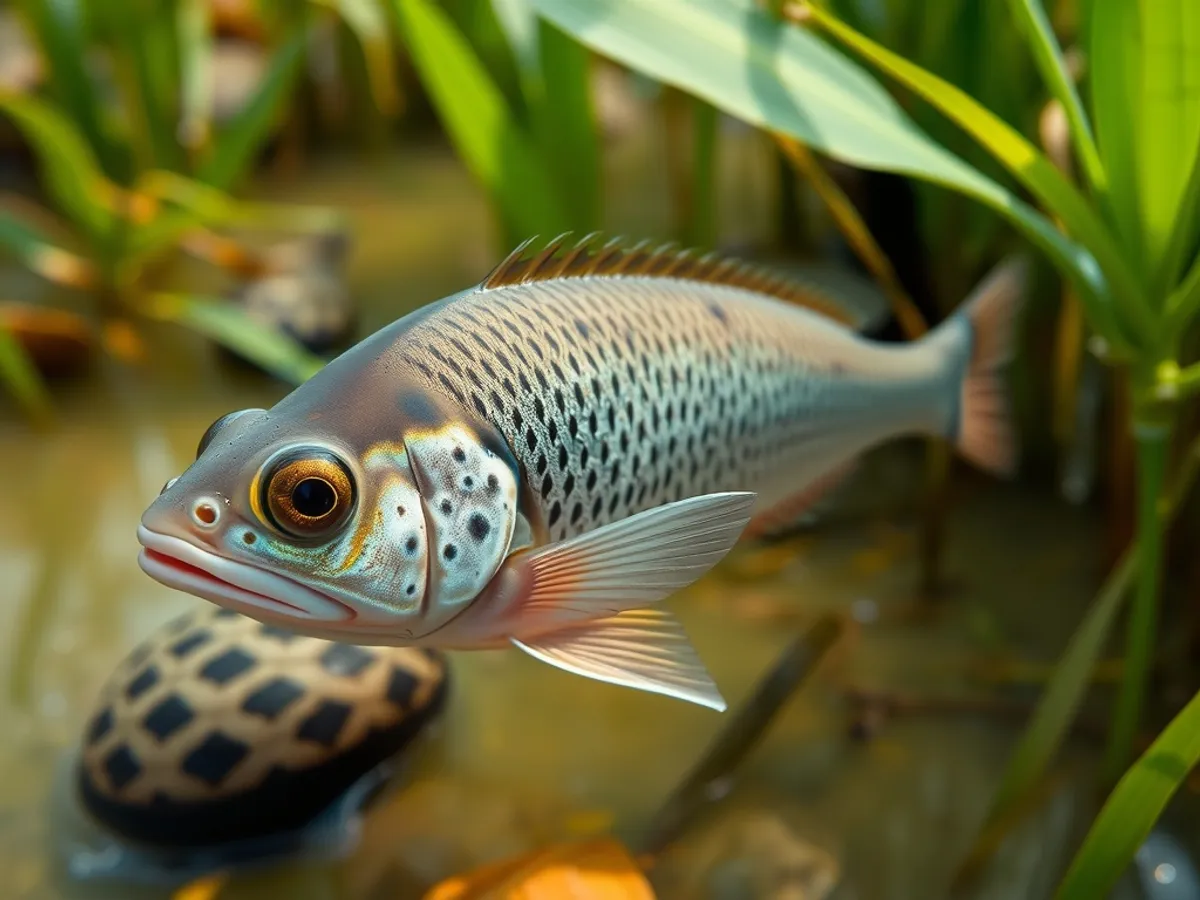
About the Paradise fish
The paradise fish is a strikingly colorful freshwater fish native to East Asia, known for its elongated fins and vibrant blue, red, and orange stripes. It is a labyrinth fish, meaning it can breathe air directly from the surface due to a specialized organ called the labyrinth organ. Males are especially ornate and become highly territorial, often displaying aggressive behavior towards other males. Paradise fish were among the earliest ornamental fish introduced to Europe in the 19th century and are popular in aquariums for their beauty and hardy nature.
Fascinating facts
Labyrinth Organ
Paradise fish possess a labyrinth organ, enabling them to breathe atmospheric air and survive in stagnant or low-oxygen water.
Brightly Colored
Males exhibit vivid blue, red, and orange coloration, especially during breeding or territorial disputes.
Bubble Nest Builder
Males construct intricate bubble nests at the water's surface to house and protect developing eggs.
Detailed description
The paradise fish (Macropodus opercularis) is a medium-sized freshwater labyrinth fish, reaching up to 6.7 cm in standard length, although most individuals are closer to 5.5 cm. It is renowned for its striking coloration: males display iridescent blue and red vertical stripes along the body, with elongated, filamentous dorsal, anal, and caudal fins that can be forked or pointed. Females are generally less vividly colored and have shorter fins. The species possesses a laterally compressed body and a small, upturned mouth adapted for surface feeding. Paradise fish exhibit pronounced sexual dimorphism, especially during breeding periods when males intensify in color and fin extension. Their labyrinth organ, an evolutionary adaptation, allows them to breathe atmospheric oxygen, enabling survival in hypoxic or stagnant waters. The species is highly territorial, especially males, which will display and fight rivals through fin flaring, lateral displays, and occasional biting. Paradise fish are omnivorous, consuming a varied diet of insects, zooplankton, plant material, and detritus. In the wild, they inhabit slow-moving or still waters such as rice paddies, ditches, ponds, and streams across East Asia, from the Yangtze River basin in China south to northern Vietnam. Their adaptability and tolerance for a range of water conditions have contributed to their success both in the wild and as ornamental aquarium fish.
Did you know?
Paradise fish can recognize their owners and display interactive behaviors, making them engaging pets.
Research & sources
Wikipedia summary
The fork tailed paradisefish, or paradise gourami is a species of gourami found in most types of fresh water in East Asia, ranging from the China to northern Vietnam. This species can reach a standard length of 6.7 cm, though most are only about 5.5 cm . Paradise gouramis was the second Chinese ornamental fish introduced to the West after the Goldfish, and the first freshwater tropical fish successfully bred in captivity in Europe, having been imported 1869 to France by the French aquarium fish importer Pierre Carbonnier in Paris. The paradise fish is one of the more aggressive members of its family. It is more aggressive than the three spot gourami, yet less pugnacious in nature than the less commonly kept combtail.
Behaviour & social structure
Paradise fish are diurnal, with peak activity during daylight hours. Males are highly territorial, especially during the breeding season, and will aggressively defend their territory from other males and sometimes even from other species. They use visual displays, such as fin spreading and color intensification, to intimidate rivals and attract mates. Feeding behavior is opportunistic; they hunt at the water's surface for insects and larvae, but will also graze on algae and detritus. Socially, they are best kept singly or in carefully managed groups in captivity, as male-male aggression can lead to injury. In the wild, they maintain loosely defined territories, with dominant males occupying the best spawning sites. Paradise fish are also known for their intelligence and can recognize their keepers in captivity, sometimes responding to feeding cues.
Reproduction & life cycle
Paradise fish are bubble nest builders, with males constructing floating nests from air bubbles coated in saliva, often anchored to floating vegetation. Courtship begins with the male displaying vibrant colors and performing a series of ritualized movements to entice the female. Once receptive, the female is embraced by the male, who fertilizes the eggs as they are released. The eggs, numbering several hundred per spawning event, float up into the bubble nest, where the male guards and tends them, repairing the nest as needed. Incubation lasts 24–36 hours at typical tropical temperatures (24–28°C), after which the larvae hatch and remain in the nest for several days until they become free-swimming. The male continues to guard the fry for a short period, after which parental care ceases. Breeding can occur year-round in tropical climates but is often triggered by seasonal rains or temperature changes in the wild.
Adaptations & survival
The labyrinth organ is the most notable adaptation, allowing paradise fish to extract oxygen directly from air, which is vital for survival in stagnant, oxygen-poor waters. Their upturned mouth is adapted for surface feeding, enabling them to exploit a niche unavailable to many other fish. The species' aggressive territoriality ensures access to optimal breeding sites and food resources. Their vivid coloration and elaborate fins play a role in sexual selection, with females preferring more colorful and vigorous males. Paradise fish also exhibit remarkable tolerance to a wide range of water conditions, including temperature fluctuations (15–30°C), pH (6.0–8.0), and low dissolved oxygen, making them resilient in both wild and captive environments.
Cultural significance
Paradise fish hold a unique place in the history of ornamental fishkeeping, being the first tropical freshwater species bred in captivity in Europe (introduced in 1869 by Pierre Carbonnier). In East Asia, they have been kept for centuries, admired for their beauty and hardiness. In Chinese culture, their vibrant colors and combative nature have made them symbols of vitality and perseverance. While not as prominent in mythology as koi or goldfish, they are sometimes featured in traditional art and literature as emblems of elegance and resilience.
Recent research
Recent studies have focused on the genetic diversity of wild and captive populations, revealing significant variation across their range. Research into the labyrinth organ has provided insights into the evolution of air-breathing in fishes. Behavioral studies have examined aggression modulation, with findings that environmental enrichment and visual barriers can reduce male-male conflict in captivity. There is ongoing interest in the species as a model for studying sexual selection, parental care, and adaptation to hypoxic environments. Additionally, their role as a potential invasive species in non-native habitats is being monitored, particularly in parts of Southeast Asia and Europe.
Videos
Habitat
Freshwater streams, ponds, and rice paddies


Conservation
The Paradise fish is currently classified as Least Concern on the IUCN Red List.
Threats & challenges
Currently, Macropodus opercularis is classified as Least Concern by the IUCN, with stable populations across its native range. However, localized threats include habitat degradation from agricultural expansion, pollution, and waterway modification. Invasive species and hybridization with introduced congeners may also pose risks in some regions. Over-collection for the aquarium trade is not considered a major threat due to the species' ease of captive breeding. Climate change and increasing urbanization could impact habitat quality in the future, but the species' adaptability offers some resilience.
Taxonomy
Scientific name
Macropodus opercularis
- Kingdom
- Animalia
- Phylum
- Chordata
- Class
- Actinopterygii
- Order
- Anabantiformes
- Family
- Osphronemidae
- Genus
- Macropodus
- Species
- opercularis
Community notes
Share your observations about the Paradise fish.
No community notes yet. Be the first!
Discover more wildlife
More fascinating animals from the encyclopedia.