
About the Pea Crab
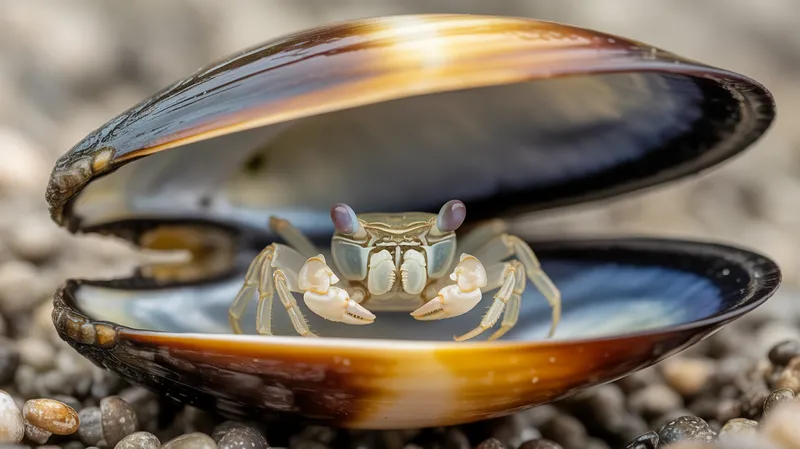
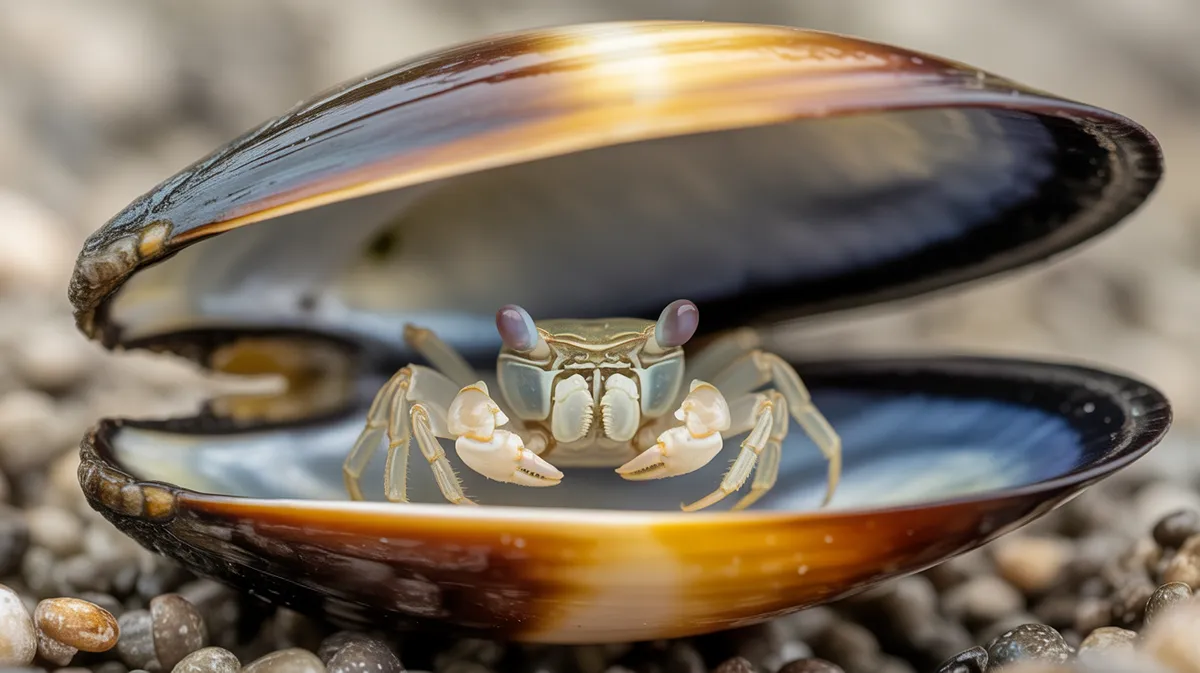
Pinnotheridae are among the smallest crabs in the world, a few millimetres across, and they spend their adult lives inside another animal — the mantle cavity of an oyster, mussel or scallop, or the burrow of a worm or a sea cucumber's respiratory tree. The female is the true resident: soft-bodied, pale, with a thin uncalcified carapace because she never needs armour, and often too large to leave through the host's siphon once she has grown. The males are smaller, harder and mobile, and swim between hosts to mate. The relationship was long described as commensal, a free ride, but the evidence now points to genuine parasitism in at least some species: the crab intercepts food from the mucus strings the bivalve uses to move particles to its mouth, and infested oysters show reduced growth, thinner shells and damaged gill tissue. Pea crabs are found worldwide, and finding one in a cooked mussel is a common and harmless surprise. They were considered a delicacy in the United States — George Washington reportedly liked them — and oyster pea crabs were once served as a garnish. The crab's larvae are free-swimming and must locate a host by chemical cue, and most fail.
Fascinating facts
Tiny Crustacean
Pea crabs typically grow no larger than a pea, with adults averaging just 5-15 millimeters across.
Commensal Lifestyle
They live inside the shells of bivalves, benefiting from protection and food without usually harming their host.
Difficult to Spot
Due to their small size and translucent bodies, pea crabs often go unnoticed unless their host shell is opened.
Detailed description
The pea crab (Pinnotheres pisum) is a minute decapod crustacean, typically measuring 5–15 mm in carapace width, with females generally larger and more rounded than the smaller, more mobile males. The carapace is thin, soft, and translucent, often appearing pale cream to light brown, which aids in camouflage within the host's mantle cavity. Unlike most crabs, pea crabs possess reduced and delicate chelae (claws), and their legs are elongated and slender, facilitating movement within the confined space of a bivalve shell. Anatomically, their bodies are highly flexible, allowing them to maneuver in tight spaces. Pea crabs exhibit a commensal relationship with bivalve mollusks such as mussels (Mytilus spp.), oysters (Ostrea spp.), and clams, rarely causing significant harm to their hosts. They feed on suspended organic particles and plankton filtered by the host, sometimes supplementing their diet with mucus or tissue from the host. Social structure is generally solitary or limited to mating pairs within a single host, as competition for space is high. Their life cycle includes a planktonic larval stage, which is free-swimming before settling into a suitable host. Reproduction is sexual, with internal fertilization and females brooding eggs under their abdomen. Unique adaptations include specialized setae (bristles) for clinging to host tissues and a reduced exoskeleton for flexibility. Pea crabs are distributed in temperate and subtropical shallow coastal waters of the eastern Atlantic and Mediterranean, with populations also reported in the North Sea and along the coasts of western Europe.
Did you know?
Pea crabs can sometimes be found inside oysters served at restaurants, surprising unsuspecting diners!
Research & sources
Behaviour & social structure
Pea crabs are primarily nocturnal, emerging from the host's gill chamber at night to feed on detritus and planktonic particles that accumulate within the shell. Their feeding behavior is opportunistic, relying on the host's filtration currents to bring food within reach. They use their chelae to manipulate food particles and may occasionally scrape mucus from the host's gills. Social interactions are minimal, with aggressive encounters occurring if multiple crabs attempt to inhabit the same host. Males are more mobile and may move between hosts in search of mates, while females tend to remain within a single host for extended periods. Daily routines are closely tied to the activity of the host bivalve, as the crab's movement and feeding are facilitated when the host opens its shell. Pea crabs exhibit cryptic behavior, remaining hidden from predators and rarely venturing outside the host except during larval dispersal or mate searching.
Reproduction & life cycle
Mating occurs within the host shell, typically during warmer months (spring to late summer) when both sexes are present. Males locate females by chemical cues and may enter the host shell for copulation. Fertilization is internal; females carry fertilized eggs attached to their pleopods (swimmerets) beneath the abdomen, brooding them until hatching. The incubation period lasts approximately 2–3 weeks, depending on water temperature. Upon hatching, larvae are released into the water column as planktonic zoeae, undergoing several molts before settling and seeking a suitable bivalve host. There is no parental care beyond brooding, and juveniles are independent upon settlement. Females may produce multiple broods per season if environmental conditions are favorable.
Adaptations & survival
Pea crabs have evolved a suite of morphological and behavioral adaptations for their commensal lifestyle. Their soft, flexible exoskeleton allows them to squeeze into the narrow spaces of the host's mantle cavity, while specialized setae on their legs provide grip on slippery tissues. Their reduced size and pale coloration enhance concealment from both predators and host immune responses. Behaviorally, they synchronize their activity with the host's feeding and shell-opening cycles, minimizing detection. Evolutionary specializations include a shortened larval phase to increase the likelihood of host colonization and the ability to exploit multiple bivalve species, increasing their ecological niche.
Cultural significance
Pea crabs have a minor but notable presence in human culture, particularly in regions where oysters and mussels are consumed. In some culinary traditions, the accidental discovery of a pea crab inside an oyster is considered a sign of good luck or a delicacy, especially in the eastern United States. There is little evidence of broader mythological or symbolic significance, and they are not widely used in traditional medicine or crafts.
Recent research
Recent research has focused on the ecological impact of pea crabs on commercial bivalve populations, with studies indicating that heavy infestations can reduce host growth rates and market value. Molecular studies have clarified species boundaries within the Pinnotheridae family, revealing cryptic diversity and host-specific lineages. Ongoing research investigates the chemical and behavioral cues used by larvae to locate suitable hosts, as well as the physiological adaptations that allow pea crabs to evade host immune responses. There is also interest in the potential role of pea crabs as bioindicators of bivalve health and coastal ecosystem integrity.
Sources
Host specificity and genetic structure in the pea crab Pinnotheres pisum
Bierbaum, R. & F. F. Costa (2016)
scientificEcology and Host Relationships of Pinnotheres pisum (Linnaeus, 1767) (Decapoda, Pinnotheridae) in European Coastal Waters
Beukema, J.J. & De Bruin, W. (1977)
scientificEcology and host specificity of Pinnotheres pisum (Brachyura: Pinnotheridae) in European coastal waters
Beukema, J.J. & Dekker, R. (2020)
scientificVideos
Habitat
Shallow coastal waters inside the shells of bivalve mollusks

Conservation
The Pea Crab is currently classified as Least Concern on the IUCN Red List.
Threats & challenges
Currently, Pinnotheres pisum faces few direct threats and is classified as Least Concern. However, populations may be indirectly affected by declines in bivalve hosts due to overfishing, pollution, habitat destruction, and climate change. Human activities that reduce bivalve abundance or degrade coastal habitats can limit available hosts and disrupt the crab's life cycle. Invasive bivalve species may alter host availability, while aquaculture practices can inadvertently spread pea crabs to new regions. Despite these challenges, the species remains widespread and locally abundant in suitable habitats.
Taxonomy
Scientific name
Pinnotheres pisum
- Kingdom
- Animalia
- Phylum
- Arthropoda
- Class
- Malacostraca
- Order
- Decapoda
- Family
- Pinnotheridae
- Genus
- Pinnotheres
- Species
- pisum
Community notes
Share your observations about the Pea Crab.
No community notes yet. Be the first!
Discover more wildlife
More fascinating animals from the encyclopedia.