
About the Peanut worm
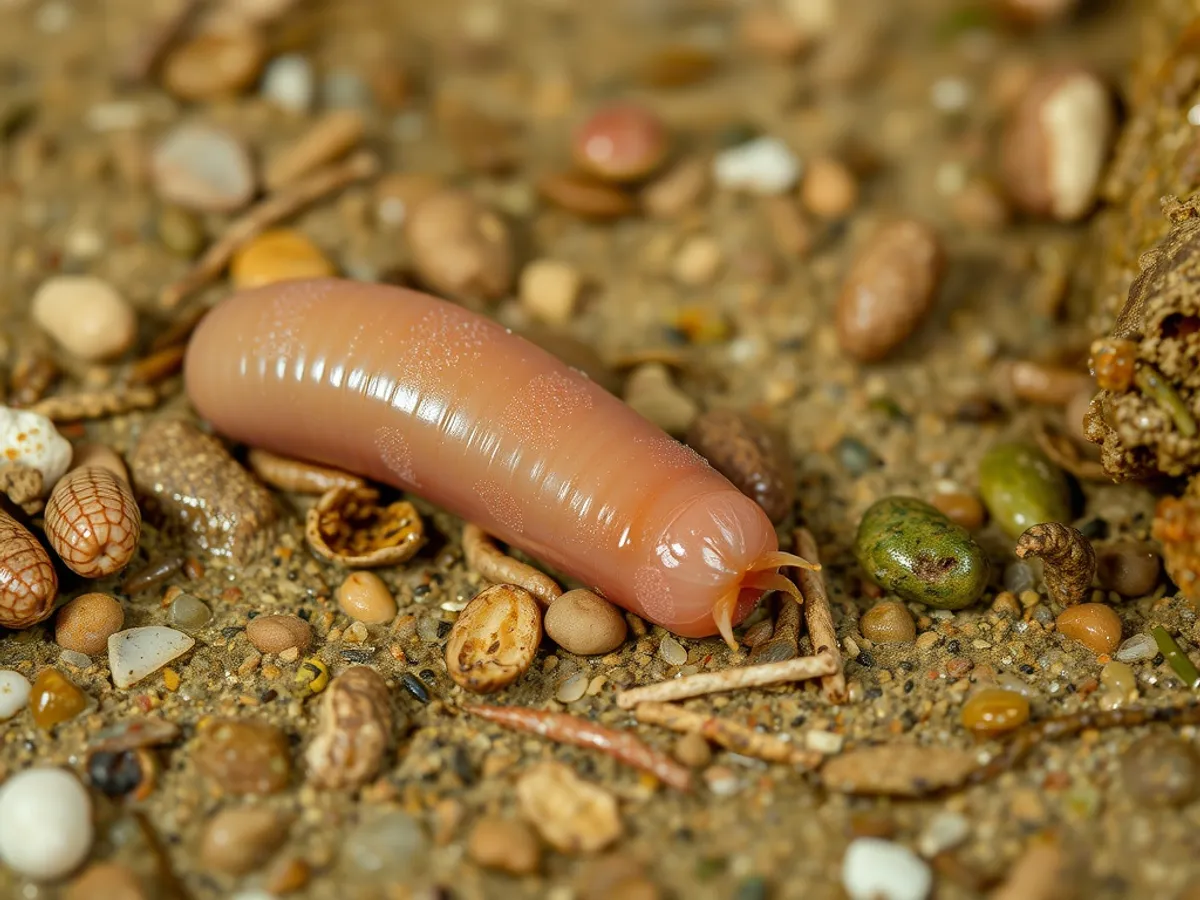
The peanut worm is a marine invertebrate named for its ability to contract its body into a shape resembling a peanut. Belonging to the phylum Sipuncula, it has an unsegmented, cylindrical body that can stretch and retract, with a retractable introvert used for feeding. Peanut worms inhabit burrows in sand, mud, or rock crevices in shallow waters across many oceans worldwide. They are detritivores, feeding primarily on organic particles and microorganisms they collect from sediment. Although not well-known, they play an important ecological role in nutrient cycling and sediment turnover.
Fascinating facts
Burrowing Experts
Peanut worms are proficient at burrowing into sand, mud, and rock crevices, helping aerate and mix marine sediments.
Regeneration Abilities
They can regenerate lost or damaged body parts, which helps them survive predation and environmental hazards.
Wide Distribution
Peanut worms are found in shallow marine environments all over the world, from the tropics to polar regions.
Detailed description
Sipunculus nudus, commonly known as the peanut worm, is a marine invertebrate characterized by its unsegmented, cylindrical body, which typically ranges from 10 to 30 centimeters in length, though some individuals may reach up to 50 centimeters. The body is divided into two main regions: the trunk and the introvert, the latter being a retractable, muscular extension equipped with numerous tentacles surrounding the mouth, used for feeding and environmental sensing. The skin is smooth, sometimes slightly wrinkled, and varies in color from pale pink to brownish, often matching the surrounding sediment. Peanut worms lack specialized respiratory or circulatory organs; instead, gas exchange occurs across the body surface, and a spacious coelomic cavity facilitates internal transport. They are primarily nocturnal, spending daylight hours buried in U-shaped burrows or crevices within sandy or muddy substrates, emerging at night to feed. Their feeding apparatus allows them to sift through sediment, extracting detritus, microorganisms, and organic particles. S. nudus exhibits remarkable regenerative abilities, capable of regenerating lost parts of the introvert. The species is solitary and exhibits little social interaction, though high local densities can occur in favorable habitats. Reproduction is primarily sexual, with external fertilization, and larvae are planktonic before settling to the benthos. The peanut worm plays a significant ecological role by bioturbating sediments, thus enhancing nutrient cycling and sediment aeration.
Did you know?
Peanut worms lack both a true circulatory and respiratory system, relying on diffusion through their body wall for gas exchange.
Research & sources
Wikipedia summary
The Sipuncula or Sipunculida is a class containing about 162 species of marine annelid worms, that have secondarily lost their segmentation. Sipuncula was once considered a phylum of unsegmented worms, but was demoted to a class of Annelida, based on recent molecular work.
Behaviour & social structure
Peanut worms are primarily sedentary and solitary, spending most of their lives within self-constructed burrows in soft sediments or natural crevices in rocky substrates. They extend their introvert at night to feed, using the tentacles to gather organic particles and microorganisms from the surrounding sediment. Feeding is accomplished by selective deposit-feeding, where the animal ingests sediment and extracts edible material, often leaving behind processed, cleaner sediment. S. nudus shows little to no aggression or territoriality, and direct interactions between individuals are rare, even in dense populations. Their activity is influenced by tidal cycles, with increased feeding and movement during high tide when food availability is greater and predation risk is lower. They are sensitive to vibrations and changes in water chemistry, rapidly retracting the introvert into the trunk when disturbed. There is no evidence of complex social structures or cooperative behaviors.
Reproduction & life cycle
Sipunculus nudus is dioecious, with separate male and female individuals. Spawning is typically synchronized with environmental cues such as temperature, lunar cycles, and tidal patterns, often occurring in late spring or early summer. Gametes are released into the water column, where external fertilization takes place. The fertilized eggs develop into planktonic trochophore larvae, which drift with currents for several days to weeks before settling to the substrate and metamorphosing into juvenile worms. There is no parental care; all development occurs externally. Population studies indicate that S. nudus can reach sexual maturity within one to two years, depending on environmental conditions. Breeding seasons may vary geographically, with some populations exhibiting multiple spawning events per year in warmer regions.
Adaptations & survival
Sipunculus nudus exhibits several adaptations for its burrowing and detritivorous lifestyle. The retractable introvert, equipped with tentacles, allows efficient exploration and feeding within sediments while minimizing exposure to predators. Its unsegmented, flexible body facilitates movement through narrow burrows and rapid withdrawal when threatened. The lack of specialized respiratory organs is compensated by a large body surface area and a fluid-filled coelomic cavity, enabling effective gas exchange and nutrient transport. The worm secretes mucus to stabilize burrow walls and reduce desiccation. S. nudus displays high tolerance to hypoxic (low oxygen) conditions, an adaptation to life in sediment-rich environments. Its ability to regenerate lost body parts, particularly the introvert, provides resilience against predation and injury.
Cultural significance
In several East Asian countries, particularly China and Vietnam, Sipunculus nudus is regarded as a delicacy and is consumed in various traditional dishes, often prized for its texture and nutritional value. It is sometimes referred to as 'sea intestine' or 'bibi worm' in local markets. The species is also used as bait in recreational and commercial fishing. There are no significant mythological or symbolic associations reported, but its economic importance in coastal communities is notable.
Recent research
Recent molecular phylogenetic studies have confirmed the placement of Sipuncula as a class within the phylum Annelida, overturning its former status as a separate phylum. Ongoing research focuses on the worm's regenerative capabilities, with implications for developmental biology and regenerative medicine. Studies of S. nudus' role in sediment bioturbation have highlighted its importance in nutrient cycling and ecosystem engineering. Genomic and transcriptomic analyses are providing insights into its evolutionary adaptations to hypoxic environments and its unique immune system. There is also active research on the potential impacts of environmental stressors, such as microplastics and heavy metals, on peanut worm physiology and population health.
Videos
Habitat
Marine coastal sediments

Conservation
The Peanut worm is currently classified as Least Concern on the IUCN Red List.
Threats & challenges
Currently, Sipunculus nudus is not considered threatened and is listed as Least Concern by conservation authorities. However, localized populations may be impacted by coastal development, sediment pollution, eutrophication, and bottom trawling, which can disrupt their habitats. In some regions, S. nudus is harvested for use as fishing bait and as a delicacy in traditional cuisines, leading to potential overexploitation. Climate change and ocean acidification may pose long-term threats by altering sediment composition and water chemistry. Despite these challenges, the species remains widespread and abundant in many areas, with stable population trends overall.
Taxonomy
Scientific name
Sipunculus nudus
- Kingdom
- Animalia
- Phylum
- Sipuncula
- Class
- Sipunculidea
- Order
- Sipunculida
- Family
- Sipunculidae
- Genus
- Sipunculus
- Species
- nudus
Community notes
Share your observations about the Peanut worm.
No community notes yet. Be the first!
Discover more wildlife
More fascinating animals from the encyclopedia.