
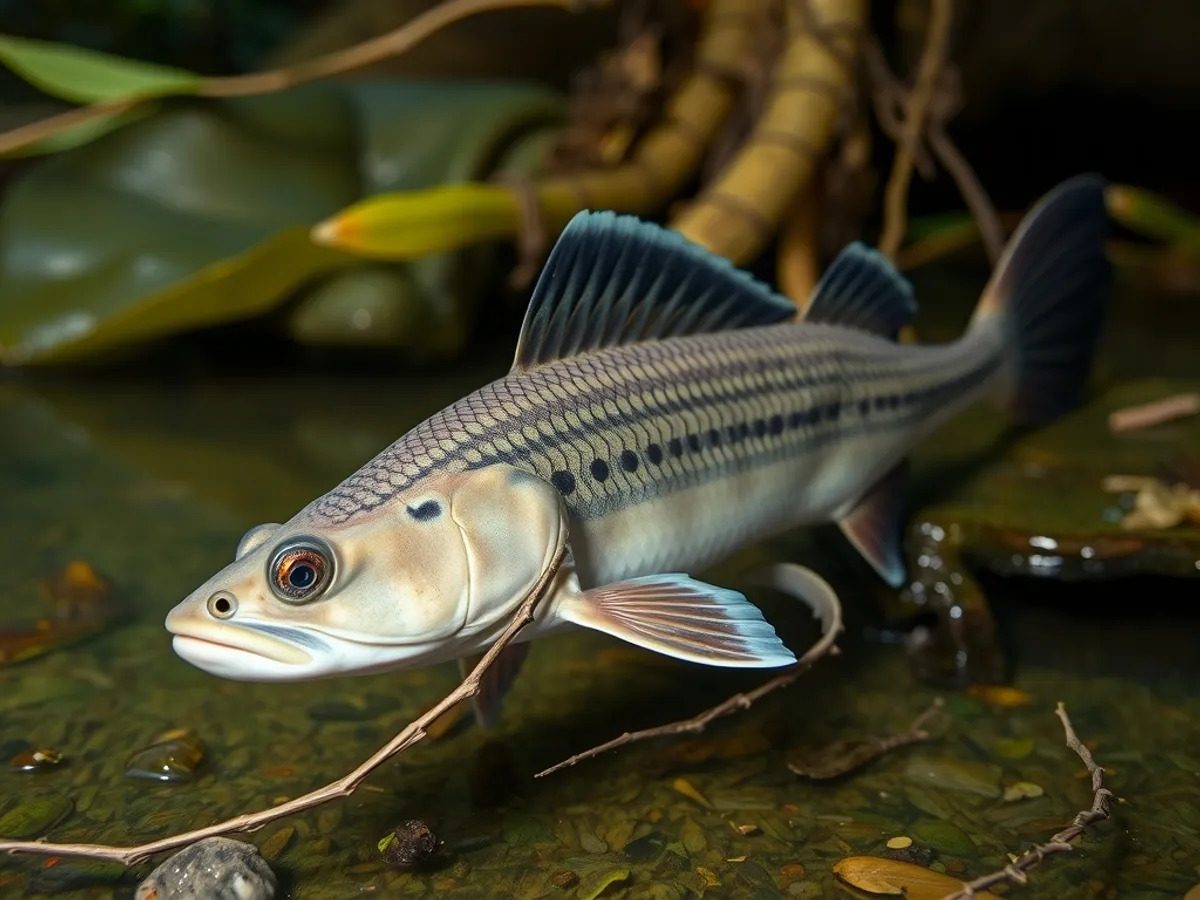
About the Pintado Catfish
The Pintado Catfish, also known as the spotted sorubim, is a large, predatory freshwater fish native to South America. Its distinctively elongated body is adorned with dark, jagged spots and stripes, making it easily recognizable in its native rivers. This nocturnal hunter primarily inhabits river channels and floodplains, where it uses its sensitive barbels to detect prey in murky waters. Pintado Catfish are highly valued both as a game fish and in commercial fisheries due to their size and firm, tasty flesh. Despite their popularity, their populations remain relatively stable, though localized declines have been noted due to overfishing and habitat degradation.
Fascinating facts
Sport Fishing Favorite
The Pintado Catfish is highly prized by anglers for its size and strength, making it a popular target in South American sport fishing.
Floodplain Migrator
During the rainy season, Pintado Catfish migrate into newly flooded forests and plains to spawn and feed.
Top River Predator
As an apex predator in its habitat, the Pintado Catfish feeds on fish, crustaceans, and even small mammals and birds that venture too close to the water.
Detailed description
The Pintado Catfish (Pseudoplatystoma corruscans) is a large, robust siluriform fish endemic to the major river basins of South America, particularly the Paraná and São Francisco rivers. Adults can reach lengths of up to 1.5 meters (5 feet) and weigh over 50 kilograms (110 lbs), making them among the largest freshwater catfish in the region. Their elongated, laterally compressed bodies are marked by a striking pattern of irregular black or dark brown spots and vertical stripes on a silvery-gray background, providing camouflage in the dappled light of turbid river channels. The head is broad and flattened, equipped with long, sensitive barbels that facilitate prey detection in low-visibility environments. The mouth is large and terminal, suited for engulfing a variety of prey. The species is primarily nocturnal, emerging from daytime refuges among submerged structures or deep pools to hunt at night. Pintado Catfish are solitary or loosely aggregating, except during spawning migrations. Their diet is highly carnivorous, consisting mainly of fish, crustaceans, and occasionally small mammals or birds. They are known for their strong swimming ability and seasonal migratory behavior, especially during the rainy season when they move upstream to spawn. The species exhibits indeterminate growth, continuing to increase in size throughout its lifespan, which can exceed 20 years in the wild.
Did you know?
Pintado Catfish undertake seasonal migrations during the rainy season, traveling long distances to spawn in flooded areas.
Research & sources
Behaviour & social structure
Pintado Catfish are predominantly nocturnal predators, relying on their acute chemosensory and mechanosensory barbels to locate prey in the often-murky waters of their habitats. They are ambush hunters, lying in wait among submerged logs or riverbank vegetation before lunging at passing prey. Their diet is opportunistic, with a preference for smaller fish such as characins and cichlids, but they will also consume crustaceans, insects, and occasionally terrestrial animals that fall into the water. Social interactions are generally limited outside of the breeding season, as adults are territorial and solitary. During the day, individuals seek shelter in deep pools or under debris to avoid predators and conserve energy. Seasonal flooding triggers increased activity and upstream migrations, during which temporary aggregations may form. Juveniles are more gregarious, often schooling for protection against predators.
Reproduction & life cycle
Pseudoplatystoma corruscans exhibits seasonal reproduction, with spawning typically occurring during the rainy season (October to March) when river levels rise and floodplain habitats become accessible. The species is known for long-distance spawning migrations, with adults traveling hundreds of kilometers upstream to reach suitable breeding grounds. Spawning is synchronous and occurs in open water, where females release thousands of buoyant eggs that are fertilized externally by males. There is no parental care; eggs and larvae drift downstream and settle in floodplain nurseries, where abundant food and shelter promote rapid growth. Sexual maturity is reached at around 4-5 years of age, depending on environmental conditions. Fecundity is high, with large females producing up to 200,000 eggs per spawning event.
Adaptations & survival
The Pintado Catfish possesses several adaptations for survival in dynamic riverine environments. Its elongated, streamlined body and powerful musculature enable efficient swimming against strong currents and during long migratory journeys. The extensive network of barbels around the mouth is highly sensitive to chemical and tactile cues, allowing the detection of prey in turbid or dark waters. The cryptic coloration, with spots and stripes, provides effective camouflage among submerged vegetation and debris. Physiologically, the species is tolerant of fluctuating oxygen levels, often encountered in floodplain habitats. Their large mouths and expandable stomachs allow them to exploit a wide range of prey sizes, enhancing their role as apex predators in their ecosystem.
Cultural significance
The Pintado Catfish holds significant economic and cultural value in South America. It is a prized target for sport anglers due to its size and fighting ability, and is a staple in regional cuisines, particularly in Brazil and Argentina, where it is prepared in traditional dishes such as 'moqueca de pintado.' In local folklore, large catfish are sometimes associated with river spirits or omens, reflecting their prominence in the aquatic landscape. The species is also important for artisanal and commercial fisheries, providing livelihoods for riverine communities. In recent years, Pintado Catfish have been introduced to aquaculture, further highlighting their economic importance.
Recent research
Recent research has focused on the genetic diversity and population structure of Pseudoplatystoma corruscans, revealing significant genetic differentiation among river basins, likely due to historical river course changes and contemporary barriers such as dams. Studies on their migratory behavior using telemetry have provided insights into movement patterns and habitat use, informing conservation strategies. Ongoing research in aquaculture aims to optimize breeding and rearing techniques to reduce pressure on wild stocks. Additionally, ecological studies have highlighted the species' role as a top predator and its influence on fish community dynamics in floodplain ecosystems.
Sources
Biology and ecology of the South American catfish Pseudoplatystoma corruscans
A. Agostinho, L.C. Gomes, H.F. Júlio Jr. (2003)
scientificBiology and ecology of the South American catfish Pseudoplatystoma spp.: a review
A. Buitrago-Suárez & B. Burr (2007)
scientificVideos
Habitat
Large tropical freshwater rivers

Conservation
The Pintado Catfish is currently classified as Least Concern on the IUCN Red List.
Threats & challenges
While currently listed as Least Concern by the IUCN, Pintado Catfish face several localized threats. Overfishing, both for commercial markets and recreational angling, has led to population declines in heavily exploited areas. Habitat degradation, particularly the construction of dams and waterway modifications, disrupts migratory routes and spawning grounds, fragmenting populations and reducing reproductive success. Pollution from agricultural runoff and urbanization further impacts water quality and prey availability. Despite these challenges, the species' broad distribution and high reproductive output have helped maintain stable populations in less-impacted regions. However, ongoing monitoring is necessary to detect and manage emerging threats, especially as fishing pressure and habitat alteration intensify.
Taxonomy
Scientific name
Pseudoplatystoma corruscans
- Kingdom
- Animalia
- Phylum
- Chordata
- Class
- Actinopterygii
- Order
- Siluriformes
- Family
- Pimelodidae
- Genus
- Pseudoplatystoma
- Species
- corruscans
Community notes
Share your observations about the Pintado Catfish.
No community notes yet. Be the first!
Discover more wildlife
More fascinating animals from the encyclopedia.