
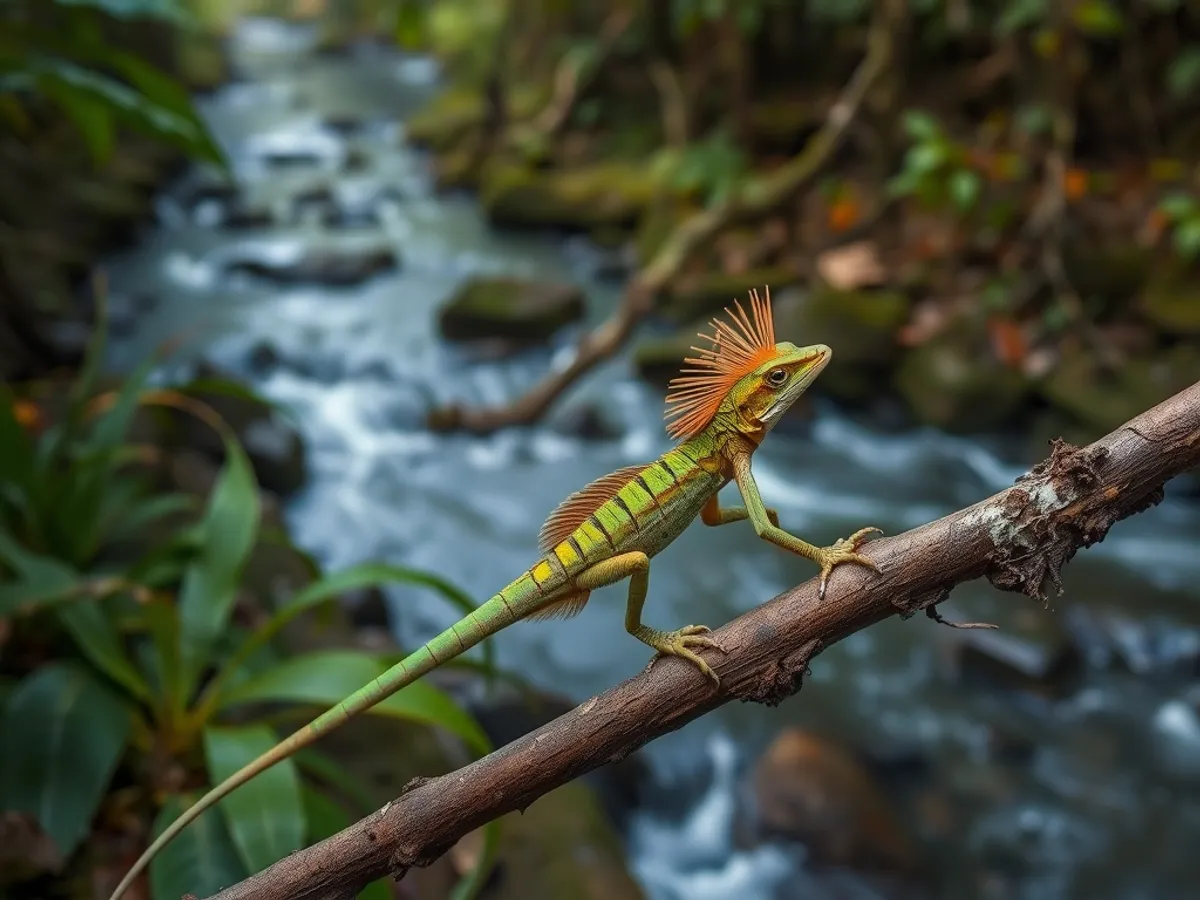
About the Plumed Basilisk
The Plumed Basilisk, also known as the Green Basilisk or Jesus Christ Lizard, is a striking reptile native to the rainforests of Central America. Characterized by its vibrant green coloration and distinct fin-like crests on its head, back, and tail, this lizard is highly adapted to an arboreal lifestyle. Plumed Basilisks are exceptional runners and are famous for their ability to sprint across the surface of water to evade predators. They are diurnal and spend much of their time basking in the sun or hunting for insects and small animals among dense foliage.
Fascinating facts
Water Running Ability
The Plumed Basilisk's long toes and specialized scales allow it to run bipedally across water surfaces to escape predators.
Habitat Choice
They prefer humid, lowland rainforests near rivers and streams, rarely straying far from water.
Crested Appearance
Males have three prominent crests on their head, back, and tail, which are used in display behaviors and to differentiate them from females.
Detailed description
The Plumed Basilisk (Basiliscus plumifrons) is a medium to large-sized lizard, with adult males reaching up to 80 cm (31 in) in total length, including their long, laterally compressed tails, while females are typically smaller, averaging 60–70 cm (24–28 in). This species is easily recognized by its vivid emerald-green coloration, often adorned with light blue or turquoise spots along the flanks, and by the presence of three prominent crests on the head, back, and tail—features most developed in adult males. The skin is covered in fine, granular scales, and the toes are exceptionally long and fringed, adaptations that aid in locomotion across water. Plumed Basilisks are primarily arboreal, spending much of their lives in the dense vegetation of lowland rainforests, often near rivers and streams. They are diurnal and highly alert, relying on their keen eyesight and agility to detect and evade predators. When threatened, they can drop from branches into water and run bipedally across the surface for several meters, a feat enabled by specialized toe fringes and rapid limb movement. Their diet is omnivorous, consisting of insects, small vertebrates, fruits, flowers, and occasionally aquatic prey. Social structure is loosely organized, with dominant males defending territories that overlap with the home ranges of several females. Plumed Basilisks are solitary outside the breeding season and are known for their secretive, cryptic behavior, often remaining motionless to avoid detection.
Did you know?
A Plumed Basilisk can dash across the surface of water for up to 20 meters before sinking or needing to swim.
Research & sources
Wikipedia summary
The plumed basilisk, also called the green basilisk, double crested basilisk, or Jesus Christ lizard, is a species of lizard in the family Corytophanidae. The species is native to Central America.
Behaviour & social structure
Plumed Basilisks are most active during the early morning and late afternoon, spending these periods foraging for food and basking in sunlit patches to regulate their body temperature. They are opportunistic feeders, employing a sit-and-wait strategy to ambush insects, spiders, small lizards, and occasionally fish or amphibians. Frugivory is also observed, especially during periods of high fruit availability. Social interactions are primarily limited to the breeding season, when males display territorial behaviors such as head-bobbing, dewlap extension, and chasing rivals. Agonistic encounters may involve posturing and short chases but rarely escalate to physical combat. Juveniles are highly secretive and remain close to dense cover to avoid predation. Plumed Basilisks exhibit a strong flight response, often escaping threats by leaping into water and utilizing their unique water-running ability. At night, they sleep on branches overhanging water, which provides an escape route from nocturnal predators.
Reproduction & life cycle
Breeding in Basiliscus plumifrons typically coincides with the onset of the rainy season, which varies geographically but generally occurs from May to September. Males court females through visual displays, including crest erection and rapid head movements. After successful copulation, females lay clutches of 5–15 eggs in moist, sandy soil, often in concealed locations near water. The incubation period ranges from 8 to 10 weeks, depending on temperature and humidity. Hatchlings emerge fully independent, measuring about 9–13 cm (3.5–5 in) in length, and receive no parental care. Females may produce multiple clutches per season if conditions are favorable. Sexual maturity is reached at approximately 18–24 months, with males developing their characteristic crests as they mature.
Adaptations & survival
The Plumed Basilisk's most famous adaptation is its ability to run bipedally across water, a behavior facilitated by elongated toes with specialized lateral fringes that increase surface area and prevent sinking during rapid movement. This 'Jesus Christ lizard' trait is a highly effective anti-predator strategy. The species' cryptic coloration and ability to remain motionless for extended periods provide camouflage among foliage. Arboreal adaptations include strong, grasping limbs and a prehensile tail for balance and agility in trees. Their omnivorous diet allows them to exploit a wide range of food resources, increasing their resilience to environmental fluctuations. The prominent crests in males are thought to play a role in sexual selection, signaling fitness to potential mates and rivals.
Cultural significance
The Plumed Basilisk holds a unique place in local folklore and popular culture, primarily due to its remarkable ability to run on water, which has earned it the nickname 'Jesus Christ lizard.' This trait has been featured in documentaries, nature programs, and ecotourism marketing in Central America. While not traditionally used in indigenous medicine or ritual, the species is sometimes regarded as a symbol of agility and escape. Its striking appearance and unusual behavior have made it a subject of fascination and study in both scientific and lay communities.
Recent research
Recent research has focused on the biomechanics of the basilisk's water-running ability, revealing that the lizard can achieve speeds of up to 1.5 meters per second while sprinting across water, with each step lasting less than 0.1 seconds. Studies using high-speed videography and force measurements have elucidated the role of toe fringes and limb kinematics in generating the necessary lift and propulsion. Genetic studies have explored the evolutionary relationships within the Corytophanidae family, clarifying the divergence between Basiliscus species. Ongoing ecological research is examining the impact of habitat fragmentation on population genetics and dispersal. There is also interest in the species' role as a seed disperser due to its frugivorous tendencies.
Videos
Habitat
Tropical rainforest near rivers and streams
 Tropical Regions
Rainforest
Dense, wet forests with the highest biodiversity on Earth, containing more than half of the world's plant and animal species.
 Global
Forest
Wooded areas with significant tree cover and diverse plant and animal communities.
 Global
Freshwater
Lakes, rivers, and wetlands with diverse aquatic ecosystems.
Conservation
The Plumed Basilisk is currently classified as Least Concern on the IUCN Red List.
Threats & challenges
Currently assessed as Least Concern by the IUCN, the Plumed Basilisk faces localized threats from habitat destruction due to deforestation, agricultural expansion, and urbanization in Central America. Collection for the pet trade poses an additional, though less significant, threat. Predation by birds of prey, snakes, and mammals is a natural challenge, particularly for juveniles. Climate change and alteration of riverine habitats may impact local populations in the future. Despite these pressures, the species remains widespread and relatively abundant in suitable habitats, though ongoing habitat loss could lead to regional declines.
Taxonomy
Scientific name
Basiliscus plumifrons
- Kingdom
- Animalia
- Phylum
- Chordata
- Class
- Reptilia
- Order
- Squamata
- Family
- Corytophanidae
- Genus
- Basiliscus
- Species
- plumifrons
Where to see a plumed basilisk
2 zoos and aquariums in 1 country are recorded as keeping this species.
 Sacramento Zoo🇺🇸 Sacramento, United States
 The Miami-Dade Zoological Park and Gardens🇺🇸 United States
Community notes
Share your observations about the Plumed Basilisk.
No community notes yet. Be the first!
Discover more wildlife
More fascinating animals from the encyclopedia.