
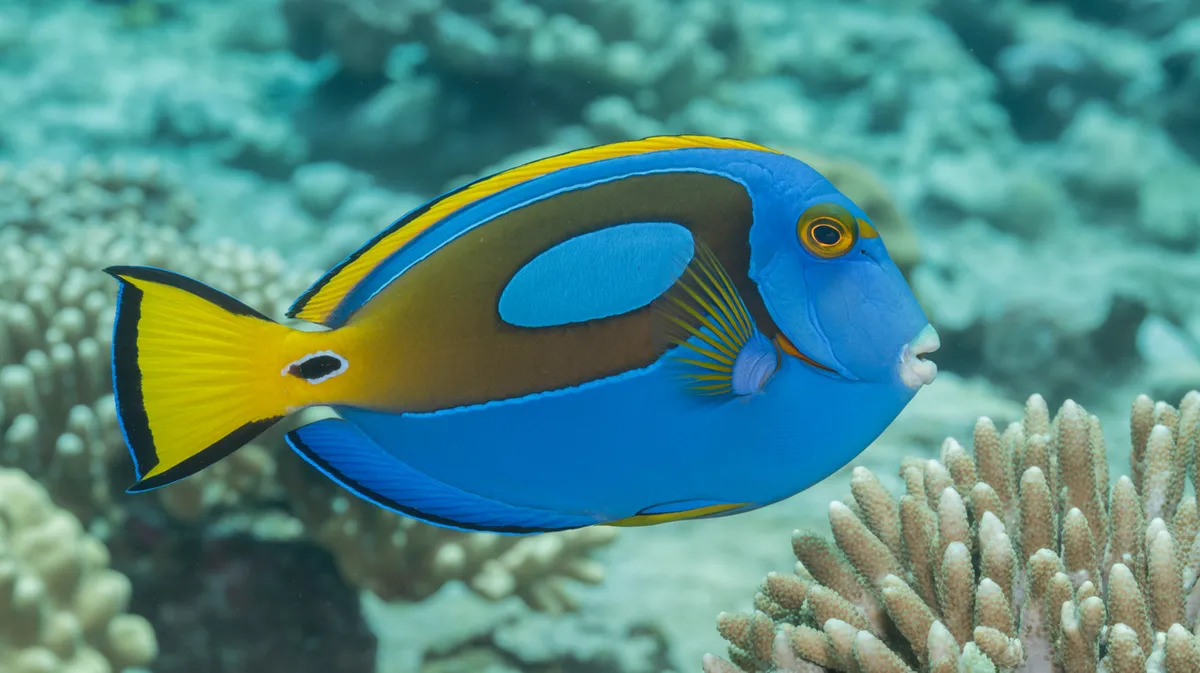
About the Powder-Blue Surgeonfish
The Powder-Blue Surgeonfish is a strikingly colorful marine fish known for its vibrant blue body, black face mask, and yellow dorsal fin. Native to the coral reefs of the Indian Ocean, this species is highly sought after in the aquarium trade due to its vivid appearance and active swimming behavior. Powder-Blue Surgeonfish are social, often found grazing in small groups over shallow reef flats and lagoons. They play a crucial ecological role by feeding on algae, which helps maintain the health of coral reefs. Despite their beauty, they can be territorial and display aggression toward other surgeonfish, especially in confined spaces.
Fascinating facts
Vivid Colors
The Powder-Blue Surgeonfish is famous for its bright blue body, yellow dorsal fin, and distinctive black face mask, making it a favorite among marine aquarium enthusiasts.
Sharp Defense
This species has a razor-sharp, scalpel-like spine near its tail base, which it uses for protection and to assert dominance among rivals.
Algae Eater
Powder-Blue Surgeonfish play a vital role on coral reefs by grazing on algae, preventing overgrowth that can harm corals.
Detailed description
The Powder-Blue Surgeonfish (Acanthurus leucosternon) is a medium-sized marine fish, typically reaching 23–25 cm (9–10 inches) in length, with a laterally compressed, oval-shaped body that enhances maneuverability among coral branches. Its coloration is highly distinctive: the body is an intense powder blue, contrasted by a jet-black facial mask and a bright yellow dorsal fin, while the pectoral fins are translucent and the caudal fin is white with a black margin. The species is equipped with a sharp, retractable scalpel-like spine on each side of the caudal peduncle, used for defense and in territorial disputes. Powder-Blue Surgeonfish are diurnal, spending daylight hours actively grazing on benthic algae, which helps prevent algal overgrowth on coral reefs. Socially, they are often observed in small, loosely organized aggregations, though they can be solitary or form larger groups in areas of abundant food. Their social structure is influenced by resource availability and population density, with dominant individuals defending prime grazing territories. Reproduction occurs via broadcast spawning, typically synchronized with lunar cycles, where males and females release gametes into the water column for external fertilization. Larvae are planktonic, drifting with currents before settling onto suitable reef habitats. Notably, the species exhibits rapid color changes in response to stress or social interactions, a trait mediated by specialized chromatophores in the skin. Powder-Blue Surgeonfish are integral to reef health, acting as primary herbivores and facilitating coral recruitment by controlling algal competition.
Did you know?
Despite their delicate appearance, Powder-Blue Surgeonfish can become quite aggressive when defending their territory, especially toward similar-looking species.
Research & sources
Behaviour & social structure
Acanthurus leucosternon displays pronounced territoriality, especially among males, who patrol and defend feeding areas using visual displays and, if necessary, their caudal spines. Feeding is primarily on filamentous and turf algae, which they crop from rocks and dead coral surfaces using their small, serrated teeth. Foraging occurs throughout the day, with peak activity in the morning and late afternoon. Social interactions range from peaceful shoaling to aggressive chasing and displays, particularly when conspecifics encroach on established territories. At night, individuals seek shelter within reef crevices or under ledges to avoid nocturnal predators. The species is known for its high activity level, constantly swimming and rarely remaining stationary except when sleeping or hiding. In the wild, they may form mixed-species aggregations with other herbivorous fishes, enhancing foraging efficiency and predator vigilance.
Reproduction & life cycle
Powder-Blue Surgeonfish are oviparous, engaging in group spawning events that are often synchronized with the lunar cycle, particularly around the new or full moon. During courtship, males display intensified coloration and perform rapid, looping swims to attract females. Spawning typically occurs at dusk, when pairs or small groups ascend into the water column to simultaneously release eggs and sperm, maximizing fertilization success and dispersal. The fertilized eggs are pelagic, hatching into planktonic larvae (acronurus stage) after approximately 24–48 hours, depending on water temperature. Larval development lasts 6–8 weeks, during which time the larvae drift with ocean currents before settling onto suitable reef habitats as juveniles. There is no parental care post-spawning; survival of offspring depends on dispersal, predation rates, and habitat quality.
Adaptations & survival
Acanthurus leucosternon possesses several adaptations for reef life. Its laterally compressed body and sharp, scalpel-like caudal spines provide both agility and defense in complex coral environments. The specialized mouth and dentition are adapted for scraping algae from hard substrates, a niche critical for reef maintenance. Chromatophores in the skin enable rapid color changes, allowing individuals to signal aggression, submission, or stress. Socially, the ability to form aggregations offers protection from predators and increases foraging efficiency. Physiologically, the species has a high metabolic rate to support its active lifestyle and can tolerate moderate fluctuations in salinity and temperature, though it is sensitive to poor water quality.
Cultural significance
The Powder-Blue Surgeonfish is highly valued in the marine aquarium trade for its vivid coloration and active behavior, often symbolizing the beauty and diversity of coral reef ecosystems in popular media and conservation campaigns. In some Indian Ocean coastal communities, surgeonfishes are occasionally harvested for food, though A. leucosternon is more commonly targeted for ornamental purposes. The species has no prominent role in traditional mythology or folklore but is increasingly recognized as an ambassador species for coral reef conservation due to its popularity and ecological importance.
Recent research
Recent research on Acanthurus leucosternon has focused on its role in reef resilience, particularly its effectiveness in controlling algal growth and facilitating coral recruitment. Studies have examined the impacts of aquarium trade collection on wild populations, highlighting the need for sustainable harvesting practices and improved captive breeding techniques. Genetic analyses have revealed significant population connectivity across the Indian Ocean, suggesting larval dispersal plays a key role in maintaining genetic diversity. Ongoing research is investigating the effects of climate change on the species' distribution, physiology, and reproductive success, as well as the potential for adaptation to shifting environmental conditions.
Sources
Acanthurus leucosternon (Powder-blue Surgeonfish): Taxonomy, Distribution, and Ecology
Randall, J.E. (2001)
scientificAcanthurus leucosternon (Powder-blue Surgeonfish): Taxonomy, Ecology, and Behavior
Randall, J.E. & Clements, K.D. (2001)
scientificVideos
Habitat
Coral reefs

Conservation
The Powder-Blue Surgeonfish is currently classified as Least Concern on the IUCN Red List.
Threats & challenges
While currently listed as Least Concern by the IUCN, the Powder-Blue Surgeonfish faces localized threats from over-collection for the aquarium trade, habitat degradation due to coral reef loss, and climate change impacts such as coral bleaching and ocean acidification. Unsustainable fishing practices and destructive collection methods can reduce local populations and disrupt reef ecosystems. Additionally, increased competition with invasive species and declining water quality pose ongoing challenges. Population trends are generally stable across much of its range, but declines have been noted in areas with intense human activity or reef degradation.
Taxonomy
Scientific name
Acanthurus leucosternon
- Kingdom
- Animalia
- Phylum
- Chordata
- Class
- Actinopterygii
- Order
- Acanthuriformes
- Family
- Acanthuridae
- Genus
- Acanthurus
- Species
- leucosternon
Community notes
Share your observations about the Powder-Blue Surgeonfish.
No community notes yet. Be the first!
Discover more wildlife
More fascinating animals from the encyclopedia.