
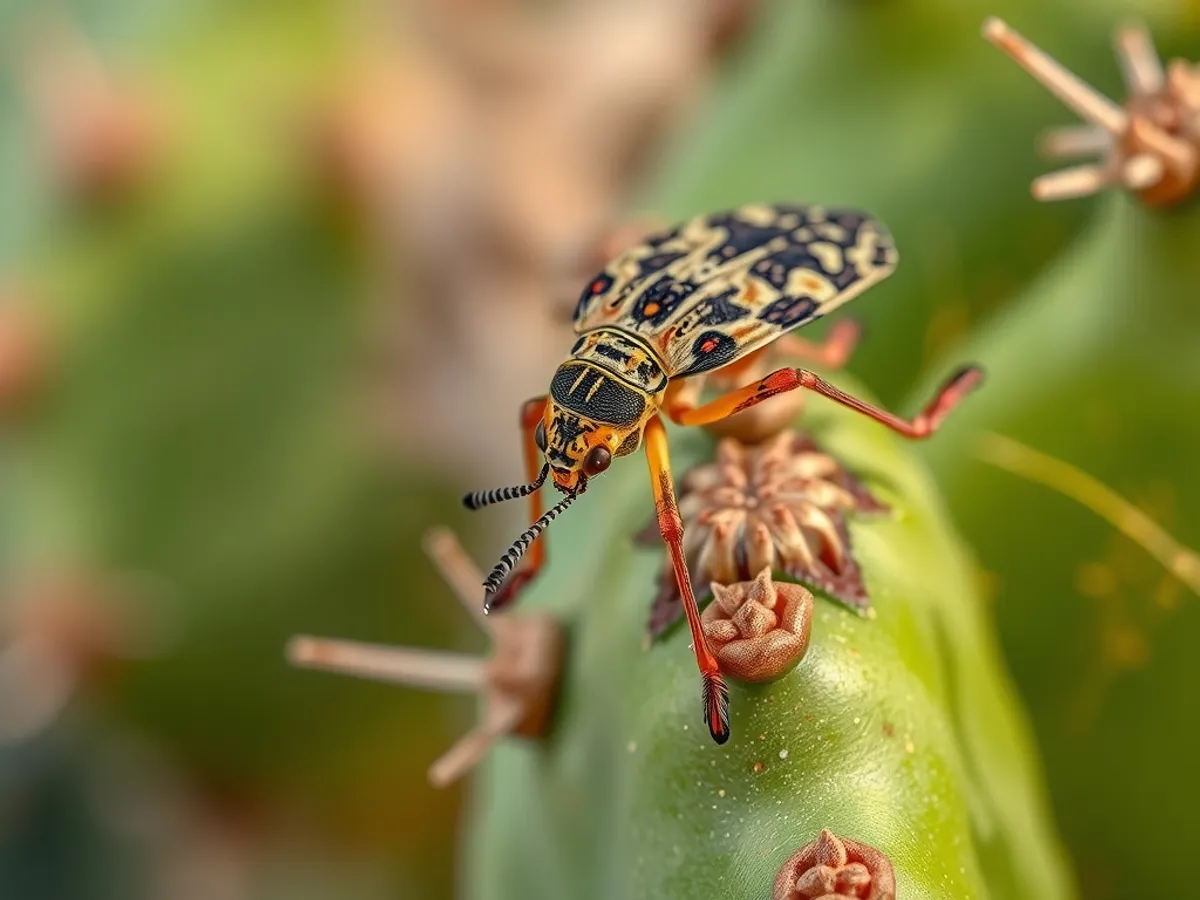
About the Prickly Pear Lace Bug
The prickly pear lace bug is a small, intricately patterned insect known for feeding on the pads of prickly pear cacti. Measuring only a few millimeters in length, this bug displays a delicate, lace-like pattern on its wings that gives it a distinctive appearance. It is primarily found in arid and semi-arid regions where prickly pear cacti grow, and can be a significant pest to both wild and cultivated cactus populations. Its feeding can cause yellowing, stippling, and even death of cactus pads under severe infestations.
Fascinating facts
Lace-like Appearance
The wings and thorax of the prickly pear lace bug are covered in delicate, transparent veins that resemble lace, making them one of the most ornate-looking insects.
Cactus Specialist
This bug feeds almost exclusively on prickly pear cacti, using specialized mouthparts to extract plant sap.
Potential Pest
High populations can weaken or even kill cactus pads, making the bug a pest in gardens and agricultural settings where prickly pear is grown.
Detailed description
The Prickly Pear Lace Bug (Corythucha cactaceae) is a diminutive hemipteran insect, typically measuring 2.5–3.5 mm in length. Its most striking feature is the ornate, reticulated pattern of its pronotum and forewings, which are semi-transparent and resemble delicate lace, providing effective camouflage against the spiny surfaces of prickly pear cacti (Opuntia spp.). The body is dorsoventrally flattened, aiding in concealment within the crevices of cactus pads. Adults are pale with brownish markings, while nymphs are darker and covered in spiny setae. This species is highly specialized for life on cacti, with piercing-sucking mouthparts adapted to feed on plant sap. Prickly Pear Lace Bugs are generally sedentary, remaining on their host plant throughout their life cycle. They are gregarious, often found in dense aggregations on the undersides of cactus pads, where they feed and reproduce. Their excrement, known as 'honeydew,' can promote sooty mold growth, further damaging the host plant. Severe infestations can lead to chlorosis, necrosis, and even pad abscission or death of the cactus. The insect's life cycle includes egg, five nymphal instars, and adult stages, with multiple generations per year in favorable climates.
Did you know?
Prickly pear lace bugs are so small and well-camouflaged that their presence is often only noticed after visible damage to cactus pads appears.
Research & sources
Behaviour & social structure
Corythucha cactaceae exhibits a sedentary lifestyle, rarely leaving the host cactus except during dispersal or overcrowding. Feeding occurs primarily on the undersides of cactus pads, where groups of adults and nymphs aggregate for protection and efficient resource use. They use their stylet-like mouthparts to pierce the epidermis and extract phloem sap, causing visible stippling and yellowing of the tissue. The bugs are most active during cooler parts of the day, often seeking shelter from extreme heat by clustering in shaded crevices. Defensive behaviors include dropping from the plant when disturbed and producing excrement that deters some predators. There is little evidence of complex social structure, but aggregation may provide collective defense against desiccation and predation. Predators include lady beetles, lacewing larvae, and certain parasitoid wasps.
Reproduction & life cycle
Reproduction in the Prickly Pear Lace Bug is sexual, with adults engaging in brief courtship behaviors before mating. Females lay clusters of 10–30 eggs, typically inserted into the cactus epidermis or deposited in crevices on the undersides of pads. Eggs are oval, translucent, and hatch after 7–14 days depending on temperature. Nymphs undergo five molts over 2–3 weeks, with development rates accelerating in warmer conditions. There is no parental care post-oviposition. In warm, arid regions, C. cactaceae can complete up to 3–5 generations per year, with overlapping cohorts. Population peaks often occur in late spring and summer, coinciding with new cactus growth.
Adaptations & survival
Corythucha cactaceae has evolved several adaptations for survival in arid environments and on spiny host plants. Its lace-like exoskeleton provides camouflage and may help dissipate heat. The flattened body allows it to remain hidden in narrow crevices, reducing predation risk and water loss. Specialized tarsal claws enable secure attachment to the smooth, waxy surfaces of cactus pads. The insect's feeding apparatus is adapted for extracting sap from tough cactus tissues. Physiologically, it is tolerant of high temperatures and desiccation, aided by behavioral aggregation that reduces individual water loss. Its rapid reproductive cycle allows quick population expansion during favorable conditions.
Cultural significance
The Prickly Pear Lace Bug has limited direct cultural significance, but its impact on prickly pear cacti has indirect effects on cultures that rely on these plants for food, fodder, and traditional medicine, particularly in Mexico and the southwestern United States. Outbreaks can threaten local economies and traditional practices involving Opuntia species. The insect is occasionally referenced in agricultural extension literature as a notable pest, but it does not feature prominently in folklore or symbolism.
Recent research
Recent research on Corythucha cactaceae has focused on its role as an emerging pest in commercial cactus production, particularly in Mexico and the southern United States. Studies have examined its population dynamics, host specificity, and the efficacy of natural predators and parasitoids in biological control. Molecular analyses have clarified its phylogenetic relationships within Tingidae and its adaptation to arid environments. Ongoing research is investigating the insect's potential to spread to new regions as climate change alters the distribution of Opuntia cacti. Integrated pest management strategies are being developed to minimize chemical pesticide use and promote sustainable control.
Sources
The Lace Bugs (Hemiptera: Tingidae) of the United States and Canada
Carl J. Drake and Florence A. Ruhoff (1965)
scientificHost Plant Associations and Distribution of Corythucha cactaceae
Guilherme C. Moura, et al. (2018)
scientificTaxonomy, Biology, and Host Specificity of Corythucha cactaceae
P.A. Gagnon, D.L. Wagner, et al. (2011)
scientificBiology and Management of the Prickly Pear Lace Bug, Corythucha cactaceae (Hemiptera: Tingidae), on Opuntia spp.
M. A. Quiroz-Guzmán, J. L. Carrillo-Sánchez, et al. (2020)
scientificVideos
Habitat
Deserts and arid regions with prickly pear cacti


Conservation
The Prickly Pear Lace Bug is currently classified as Least Concern on the IUCN Red List.
Threats & challenges
Currently, the Prickly Pear Lace Bug faces few natural threats and is considered a pest species in many regions. Its populations are regulated by natural enemies such as predatory insects and parasitoids, but outbreaks can occur when these controls are disrupted. Human activities, such as the introduction of biological control agents for invasive cacti, may inadvertently affect lace bug populations. Climate change could alter the distribution of both the insect and its host plants, potentially expanding its range. In agricultural settings, heavy infestations can threaten commercial cactus crops, prompting pesticide use that may impact non-target species. Despite these challenges, the species is widespread and not considered at risk.
Taxonomy
Scientific name
Corythucha cactaceae
- Kingdom
- Animalia
- Phylum
- Arthropoda
- Class
- Insecta
- Order
- Hemiptera
- Family
- Tingidae
- Genus
- Corythucha
- Species
- cactaceae
Community notes
Share your observations about the Prickly Pear Lace Bug.
No community notes yet. Be the first!
Discover more wildlife
More fascinating animals from the encyclopedia.