
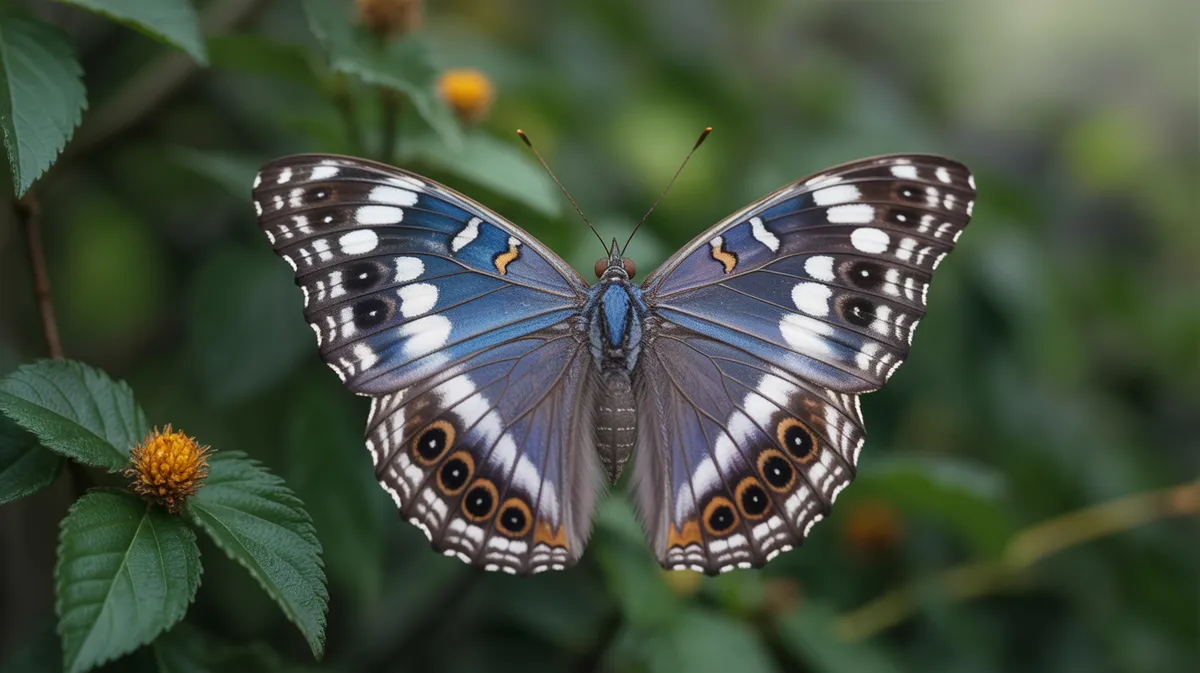
About the Purple Emperor Butterfly
The Purple Emperor Butterfly is a striking large butterfly native to the woodlands of Europe and parts of Asia. Males display a brilliant iridescent purple sheen on their upper wings, while females are larger and brown with white markings. This species is elusive, often spending much of its time high in the tree canopy and descending only occasionally to feed on sap, carrion, or animal droppings. The Purple Emperor is noted for its territorial behavior, especially in males, who aggressively defend sunny treetop perches.
Fascinating facts
Dazzling Iridescence
The male's purple coloration is not from pigment, but from light reflecting off microscopic scales on its wings.
Canopy Dweller
This butterfly spends most of its life high in the treetops, making it difficult to spot from the ground.
Unusual Diet
Purple Emperors are attracted to carrion, dung, and even animal sweat, rather than feeding on nectar like most butterflies.
Detailed description
The Purple Emperor Butterfly (Apatura iris) is a large nymphalid butterfly, with a wingspan ranging from 70 to 92 mm, making it one of the largest butterflies in Europe. Males are renowned for their striking, iridescent purple-blue coloration on the upper wings, a result of structural coloration rather than pigment, while females lack this iridescence and are generally larger, with dark brown wings marked by white bands and spots. The underwings are cryptically patterned in mottled brown, grey, and orange, providing excellent camouflage against tree bark. The species is highly arboreal, spending much of its life in the upper canopy of mature deciduous woodlands, particularly favoring areas with abundant sallow (Salix spp.), the larval food plant. Adults are rarely seen at flowers; instead, they are attracted to tree sap, carrion, dung, and even human sweat, from which they obtain essential minerals and nutrients. Purple Emperors are solitary outside of the breeding season, with males exhibiting pronounced territoriality, defending sunlit perches high in the canopy. Their flight is powerful and gliding, interspersed with rapid wingbeats, allowing them to cover large areas in search of mates or resources. The species is univoltine, producing one generation per year, with adults typically on the wing from late June to early August. The larvae are green with small yellowish tubercles and two distinctive 'horns' on the head, providing camouflage among willow leaves.
Did you know?
Purple Emperor males are known to land on sweaty humans to obtain salt and minerals from perspiration.
Research & sources
Behaviour & social structure
Purple Emperors are crepuscular and diurnal, most active during warm, sunny weather, particularly in the late morning and early afternoon. Males establish and defend territories in the upper canopy, often returning to the same perch after patrolling their domain. They engage in aerial dogfights with rivals and other large insects, sometimes even chasing birds. Feeding behavior is unusual for a butterfly: adults rarely visit flowers, instead descending to the ground to feed on sap flows, rotting fruit, animal feces, and carrion, which provide sodium and amino acids critical for reproduction. Females are less conspicuous, spending more time searching for suitable oviposition sites on sallow leaves. The species is generally solitary, with limited social interaction outside of mating or territorial disputes. Roosting occurs in the canopy, where the butterflies are well-camouflaged and protected from predators.
Reproduction & life cycle
The breeding season occurs from late June through early August. Males patrol and defend territories to attract females, often engaging in elaborate courtship flights. Mating typically takes place in the canopy, after which females descend to lay eggs singly on the upper surfaces of sallow leaves. Eggs are pale green and spherical, hatching after approximately 10-14 days. The larval stage lasts through late summer and autumn, with caterpillars feeding exclusively on sallow leaves. In preparation for overwintering, larvae enter diapause in late autumn, anchoring themselves to a twig or leaf petiole with silk. Pupation occurs the following spring, with the chrysalis resembling a sallow leaf, further aiding in camouflage. There is no parental care after egg-laying, and the species produces one generation per year (univoltine).
Adaptations & survival
Apatura iris exhibits several notable adaptations. The iridescent purple coloration of males is produced by microscopic scales on the wings that reflect light at specific angles, serving both as a sexual signal and a deterrent to rivals. The cryptic underwing pattern provides effective camouflage against predators when at rest. Larvae possess two prominent head horns and a body shape that mimics sallow twigs and leaves, aiding in predator avoidance. The butterfly's preference for feeding on non-floral resources is an adaptation to canopy life, where flowers are scarce but sap and animal matter are more readily available. Overwintering as a larva in diapause allows the species to survive harsh winter conditions and synchronize development with the availability of fresh sallow leaves in spring.
Cultural significance
The Purple Emperor has long fascinated naturalists and butterfly enthusiasts, symbolizing the mystery and beauty of ancient woodlands. In Victorian England, it was a prized specimen for collectors, contributing to its elusive reputation. The butterfly features in British folklore as the 'Emperor of the Woods,' and its dramatic appearance and behavior have inspired numerous works of art and literature. Today, it is a flagship species for woodland conservation efforts in Europe, often used to promote the importance of preserving native woodlands and their biodiversity.
Recent research
Recent research has focused on the structural basis of the male's iridescent coloration, revealing complex nanostructures in the wing scales that manipulate light. Studies on habitat requirements have highlighted the importance of sallow diversity and woodland structure for supporting viable populations. Ongoing citizen science projects, such as the UK Purple Emperor Monitoring Scheme, are providing valuable data on distribution and population trends. Genetic studies are underway to clarify the relationships between Apatura iris and closely related species, as well as to assess genetic diversity across its range. There is also growing interest in the butterfly's unusual feeding behavior and its role in nutrient cycling within woodland ecosystems.
Videos
Habitat
Deciduous and mixed woodlands

Conservation
The Purple Emperor Butterfly is currently classified as Least Concern on the IUCN Red List.
Threats & challenges
While currently listed as Least Concern, the Purple Emperor faces several localized threats. Habitat loss and fragmentation due to the clearance of mature woodlands and the removal of sallow trees reduce suitable breeding sites. Intensive forestry practices, pesticide use, and climate change also pose risks by altering woodland structure and microclimates. The species is sensitive to changes in woodland management, particularly the reduction of sallow undergrowth. However, in some regions, conservation efforts such as woodland restoration and the planting of sallow have led to population increases. Monitoring suggests that populations are stable or increasing in parts of the UK and Western Europe, but declines have been noted in areas with significant habitat loss.
Taxonomy
Scientific name
Apatura iris
- Kingdom
- Animalia
- Phylum
- Arthropoda
- Class
- Insecta
- Order
- Lepidoptera
- Family
- Nymphalidae
- Genus
- Apatura
- Species
- iris
Community notes
Share your observations about the Purple Emperor Butterfly.
No community notes yet. Be the first!
Discover more wildlife
More fascinating animals from the encyclopedia.