
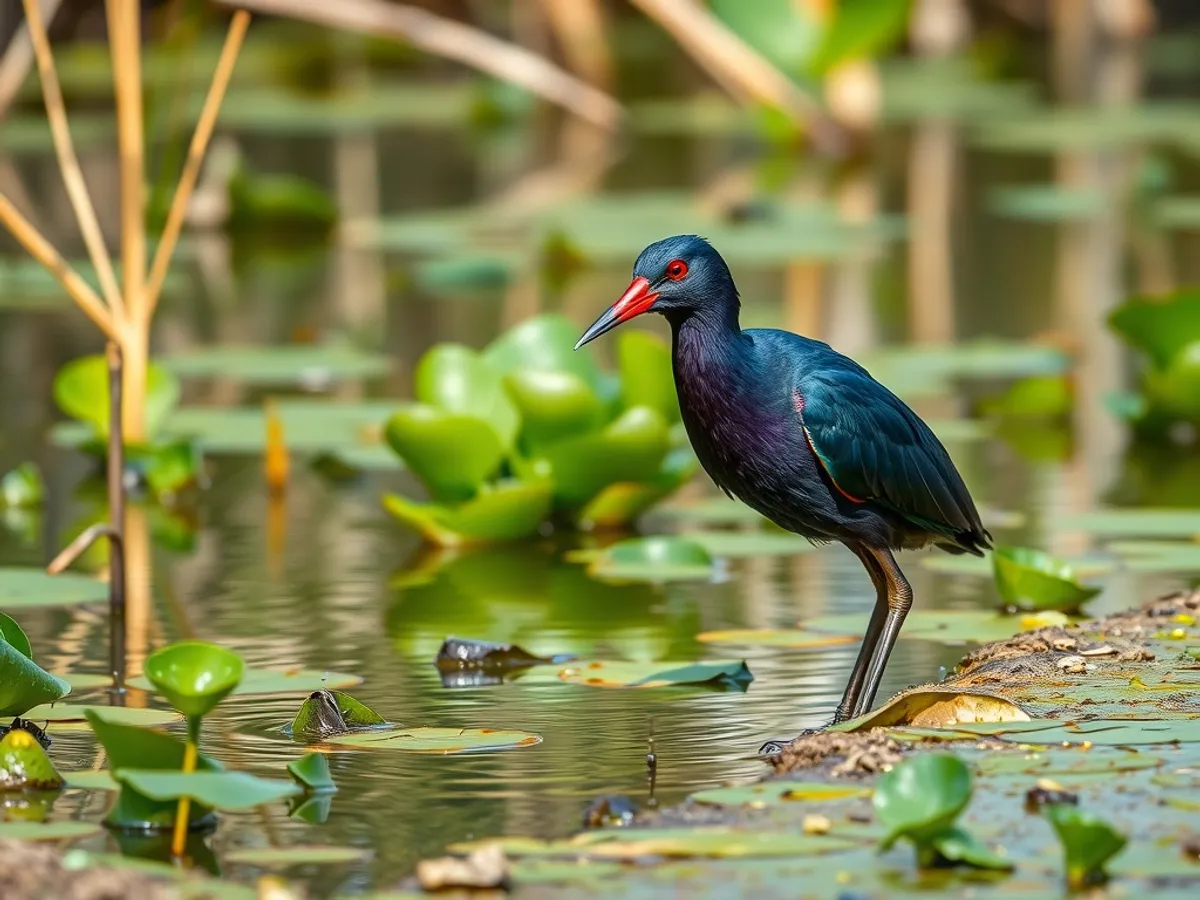
About the Purple Gallinule
The Purple Gallinule is a strikingly colorful bird known for its bright purple-blue plumage, greenish wings and back, and vivid red-and-yellow bill. Found primarily in wetlands, marshes, and swamps, it is adept at walking across floating vegetation thanks to its long yellow legs and exceptionally long toes. This bird is native to the southeastern United States, Central America, the Caribbean, and parts of northern South America. Its omnivorous diet and ability to exploit a variety of wetland habitats contribute to its adaptability and widespread presence. The Purple Gallinule is admired by birdwatchers for its flamboyant appearance and unusual foraging behavior.
Fascinating facts
Brilliant Colors
The Purple Gallinule sports a vivid mix of purple, blue, and green feathers, with a striking red and yellow bill, making it one of the most colorful marsh birds in the Americas.
Extra-long Toes
Its exceptionally long toes allow it to balance and walk easily on floating vegetation like lily pads while searching for food.
Surprising Migrant
Purple Gallinules are capable of long-distance flight and are sometimes found far outside their normal range, especially during migration or after storms.
Detailed description
The Purple Gallinule (Porphyrio martinicus) is a medium-sized rail, measuring 26–37 cm (10–15 in) in length, with a wingspan of 50–61 cm (20–24 in) and weighing 140–300 g (5–10.5 oz). Its plumage is a remarkable iridescent blend of purple-blue on the head, neck, and underparts, with olive-green upperparts and back. The bill is robust, triangular, and vividly colored—red at the base with a yellow tip—while the frontal shield is pale blue. The legs are long and bright yellow, with exceptionally elongated toes that allow the bird to distribute its weight and walk atop floating vegetation such as lily pads. Purple Gallinules are strong fliers, capable of long migratory journeys, but they are also agile climbers and swimmers. Their eyes are deep red, providing keen vision for foraging. The species is diurnal, highly vocal, and exhibits a variety of calls, including cackles, clucks, and squawks. Socially, they are often solitary or found in small family groups, but may gather in larger numbers at abundant food sources. The Purple Gallinule is notable for its adaptability, thriving in both pristine and disturbed wetland environments across its range, which extends from the southeastern United States through Central America, the Caribbean, and into northern South America.
Did you know?
Despite their tropical appearance, Purple Gallinules occasionally wander as far north as Canada during migration, surprising birdwatchers with rare sightings.
Research & sources
Wikipedia summary
Purple gallinule is an alternative name for two species of birds in the rail family. It can refer to:Purple swamphen, a group of closely related species of swamphen of the Old World American purple gallinule, Porphyrio martinicus of the New World
Behaviour & social structure
Purple Gallinules are omnivorous foragers, feeding on a wide range of plant and animal matter. Their diet includes seeds, grains, fruits (notably water lilies and lotus), aquatic insects, spiders, snails, small fish, amphibians, and even the eggs and young of other birds. They forage by walking atop floating vegetation, using their long toes for balance, and by climbing reeds and shrubs to access food. Feeding is primarily visual and occurs throughout the day, with peaks in early morning and late afternoon. The species is territorial during the breeding season, with pairs defending nesting sites aggressively. Outside of breeding, they may be more tolerant of conspecifics, especially at rich feeding sites. Purple Gallinules are known for their secretive behavior, often slipping quietly into dense cover when threatened, but can also be surprisingly bold and inquisitive, especially in areas with little human disturbance. They are strong swimmers and can dive to escape predators.
Reproduction & life cycle
Breeding occurs primarily from late spring to early summer in the northern part of their range (April–August), but can be year-round in tropical areas. Purple Gallinules are monogamous during the breeding season, with pairs forming strong bonds. Courtship involves mutual preening, vocalizations, and display flights. Nests are constructed by both sexes, typically as floating platforms or in dense emergent vegetation, using reeds, grasses, and leaves. Clutch size ranges from 5 to 10 eggs, which are creamy-white with brown speckles. Both parents share incubation duties for 18–20 days. Chicks are precocial, covered in black down, and leave the nest within a day of hatching. Both parents feed and protect the young, which fledge at about 5–7 weeks. Multiple broods per season are possible in favorable conditions.
Adaptations & survival
The Purple Gallinule exhibits several key adaptations for wetland life. Its extremely long toes enable it to walk on floating vegetation without sinking, a trait uncommon among rails. The bird’s iridescent plumage provides camouflage among the colorful wetland flora, while its strong, slightly curved bill is adapted for grasping and manipulating a variety of foods. Its frontal shield, a bare patch on the forehead, may play a role in social signaling. Behavioral flexibility is another adaptation—Purple Gallinules can exploit both natural and artificial wetlands, and readily shift their diet based on seasonal availability. Their migratory ability allows them to colonize new habitats and escape adverse conditions.
Cultural significance
The Purple Gallinule is admired by birdwatchers for its striking appearance and unusual behaviors, making it a flagship species for wetland conservation in the Americas. In some Caribbean cultures, it is associated with water spirits and considered a symbol of beauty and agility. Its presence in folklore is limited compared to Old World relatives, but it occasionally appears in local art and ecotourism materials. There are no significant traditional uses or hunting pressures reported.
Recent research
Recent research has focused on the species’ migratory patterns, using satellite telemetry to track long-distance movements between North and South America. Studies have examined the impact of wetland management practices on breeding success, highlighting the importance of maintaining diverse aquatic vegetation. Genetic analyses are clarifying relationships within the Porphyrio genus, revealing interesting patterns of divergence and occasional hybridization with other gallinules. Ongoing monitoring is assessing the effects of climate change on range shifts and breeding phenology.
Videos
Habitat
Freshwater marshes, swamps, ponds, and wetland edges

Conservation
The Purple Gallinule is currently classified as Least Concern on the IUCN Red List.
Threats & challenges
While currently listed as Least Concern by the IUCN, Purple Gallinules face several localized threats. Wetland drainage, habitat fragmentation, and pollution (especially pesticide runoff) pose significant risks. In some regions, invasive plants alter wetland structure, impacting food availability and nesting sites. Collisions with vehicles and power lines are occasional hazards during migration. Climate change may affect the timing and availability of breeding habitats. Despite these challenges, the species’ adaptability and broad range have helped maintain stable global populations, though local declines have been reported in areas of intensive wetland loss.
Taxonomy
Scientific name
Porphyrio martinicus
- Kingdom
- Animalia
- Phylum
- Chordata
- Class
- Aves
- Order
- Gruiformes
- Family
- Rallidae
- Genus
- Porphyrio
- Species
- martinicus
Community notes
Share your observations about the Purple Gallinule.
No community notes yet. Be the first!
Discover more wildlife
More fascinating animals from the encyclopedia.