
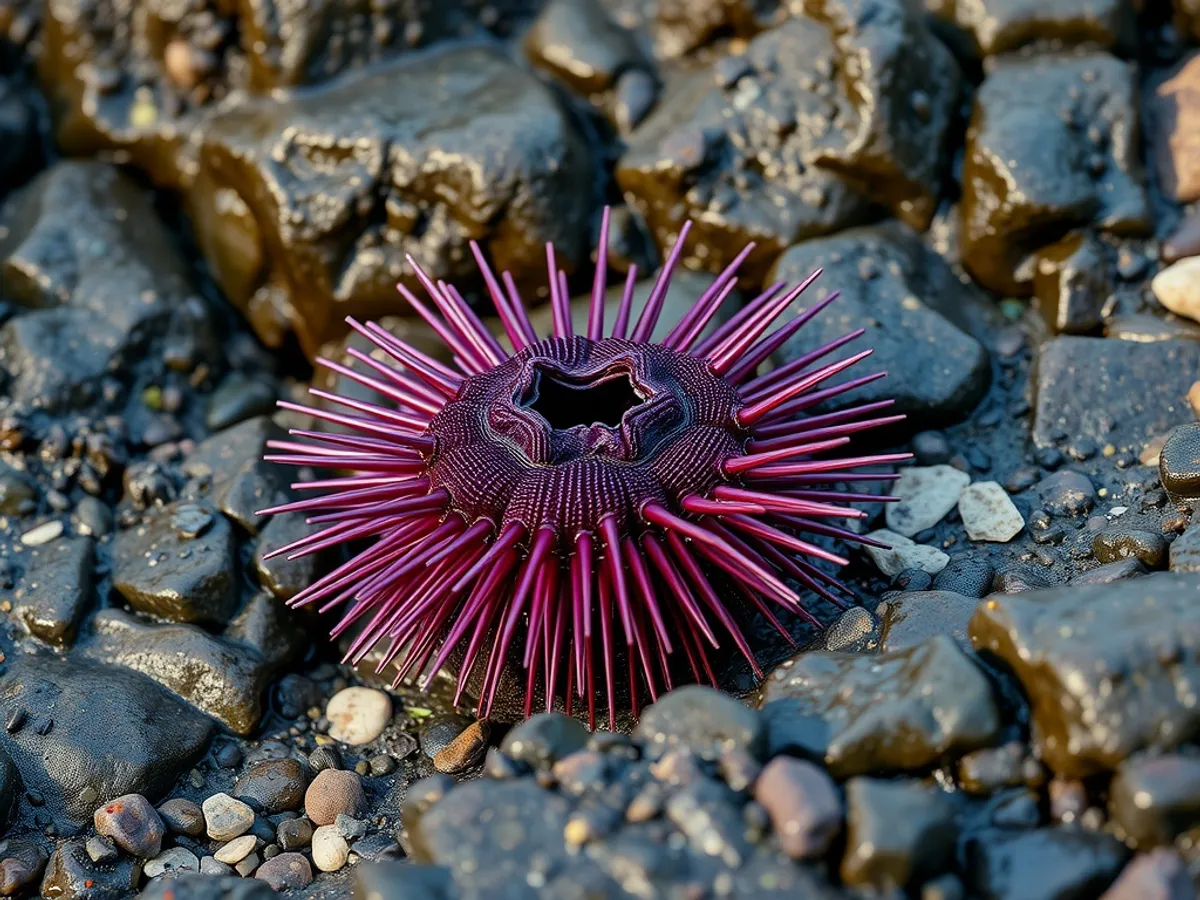
About the Purple Sea Urchin
Strongylocentrotus purpuratus is the animal at the centre of one of the most consequential ecological collapses on the west coast of North America. When sea star wasting disease annihilated the sunflower star, its main predator, from 2013 onward, and a marine heatwave weakened the kelp at the same time, purple urchin densities on parts of the northern California coast exploded by orders of magnitude and grazed bull kelp forests down to bare rock — "urchin barrens" that now cover much of a coastline that once held dense canopy. The urchins then do something remarkable: with nothing left to eat, they do not simply starve. They drop their metabolism, hollow out, and persist as "zombie urchins" for years in a near-dormant state, waiting; any kelp recruit that appears is eaten immediately, so the barren is self-sustaining. This is why simply restoring the kelp does not work without removing the urchins. The urchin's mouth is Aristotle's lantern, a five-jawed calcite apparatus with self-sharpening teeth that can grind through limestone. Its genome was fully sequenced in 2006 and revealed a startlingly complex innate immune system with over 200 Toll-like receptors, and the species is one of the great model organisms of developmental biology. The tube feet are hydraulic, extended by water pressure.
Fascinating facts
Spiky Protection
The long, sharp spines of the Purple Sea Urchin serve as an effective defense against many predators, such as sea otters and starfish.
Genetic Model
Purple Sea Urchins are widely used in biological research, particularly in developmental biology and genomics, due to their easily studied embryos.
Ecosystem Engineers
Their grazing behavior can shape entire marine landscapes, with overabundant populations leading to the formation of urchin barrens where kelp forests disappear.
Detailed description
The Purple Sea Urchin (Strongylocentrotus purpuratus) is a globular echinoderm, typically measuring 6–10 cm in diameter, with some individuals reaching up to 13 cm. Its rigid test (shell) is composed of interlocking calcareous plates, covered in hundreds of movable, sharply pointed spines that provide both protection and locomotion. The vivid purple coloration, which results from a combination of pigments in the test and spines, serves as camouflage among the rocky substrates and kelp holdfasts. Beneath the spines, tube feet equipped with suction discs extend from the ambulacral grooves, enabling precise movement and strong attachment to surfaces, even in turbulent intertidal zones. The mouth, located on the underside, houses Aristotle's lantern—a complex jaw apparatus with five calcareous teeth used to scrape and chew algae. Purple sea urchins are primarily nocturnal grazers, emerging at night to feed and retreating into crevices during the day to avoid predation. They lack a centralized brain but possess a nerve ring and radial nerves, coordinating their sensory and motor functions. As ecosystem engineers, their feeding can dramatically alter kelp forest structure, sometimes resulting in the formation of 'urchin barrens' where kelp is nearly eliminated. Their lifespan can exceed 20 years, with some individuals living up to 70 years under optimal conditions.
Did you know?
Despite their small size, Purple Sea Urchins can have a massive impact on their ecosystem, sometimes transforming lush kelp forests into barren seascapes.
Research & sources
Behaviour & social structure
Purple sea urchins are largely sedentary but can exhibit significant movement in response to food availability or environmental stress. They use their spines and tube feet for slow, deliberate locomotion, often clustering in crevices or under rocks during daylight hours to avoid predators such as sea otters, starfish, and certain fish. Feeding behavior is primarily herbivorous, focused on macroalgae (notably kelp), but they may opportunistically consume detritus or small invertebrates. When kelp is abundant, they graze on attached fronds; in scarcity, they may consume encrusting algae or even bore into rock to access endolithic algae. Social interactions are minimal, but dense aggregations can form, especially in overgrazed habitats. Chemical cues in the water can trigger mass movement or spawning events. Urchins exhibit a daily rhythm, with increased activity at night and during high tides.
Reproduction & life cycle
Strongylocentrotus purpuratus is a broadcast spawner, with external fertilization occurring in the water column. Spawning typically peaks from late winter to early spring, triggered by environmental cues such as temperature and photoperiod. Males and females release sperm and eggs simultaneously, with a single female capable of releasing several million eggs per spawning event. Fertilized eggs develop into planktonic echinopluteus larvae, which drift with ocean currents for 4–6 weeks before settling and metamorphosing into juvenile urchins. There is no parental care; survival of offspring is dependent on environmental conditions and predation rates. Sexual maturity is reached at 2–5 years, depending on food availability and local population density.
Adaptations & survival
Purple sea urchins possess several adaptations for survival in dynamic coastal environments. Their spines deter many predators and can be regenerated if broken. The tube feet not only facilitate movement but also aid in respiration and sensory perception, detecting chemical and tactile cues. Aristotle's lantern allows efficient grazing on tough algal surfaces. The ability to withstand periods of starvation by resorbing gonadal tissue is a key adaptation to fluctuating food supplies. Their test structure provides resistance to wave action and desiccation during low tides. Genetically, S. purpuratus exhibits remarkable resilience to environmental stressors, including hypoxia and ocean acidification, partly due to a highly diverse immune gene repertoire.
Cultural significance
Purple sea urchins have limited direct use in traditional human culture compared to other urchin species, but their roe (uni) is occasionally harvested for culinary purposes, particularly in California. They are important model organisms in developmental biology and genomics, with their embryos used extensively in research on fertilization, gene regulation, and evolution. In indigenous coastal cultures, sea urchins are sometimes referenced in local mythology and traditional ecological knowledge, symbolizing resilience and the interconnectedness of marine life.
Recent research
Strongylocentrotus purpuratus is a key model organism in developmental and evolutionary biology. Its genome, sequenced in 2006, revealed an unexpectedly complex immune system and provided insights into deuterostome evolution. Recent research focuses on the species' responses to ocean acidification and warming, with studies showing variable resilience among populations. Ongoing ecological studies examine the role of urchin grazing in kelp forest dynamics and the potential for restoration through predator reintroduction or urchin removal. Notably, research into their regenerative abilities and longevity is shedding light on aging processes and stem cell biology.
Sources
Strongylocentrotus purpuratus: A Model System for the Study of Developmental Biology
Sea Urchin Genome Sequencing Consortium (2006)
scientificThe genome of the sea urchin Strongylocentrotus purpuratus
Sea Urchin Genome Sequencing Consortium (2006)
scientificThe genome of the sea urchin Strongylocentrotus purpuratus
Sea Urchin Genome Sequencing Consortium (2006)
scientificVideos
Habitat
Rocky coastal shores and kelp forests

Conservation
The Purple Sea Urchin is currently classified as Least Concern on the IUCN Red List.
Threats & challenges
While currently listed as Least Concern, Purple Sea Urchin populations face several challenges. Overfishing of natural predators (notably sea otters and sunflower sea stars) has led to population explosions in some regions, resulting in destructive 'urchin barrens' and loss of kelp forests. Conversely, disease outbreaks (e.g., sea star wasting disease) and environmental changes, such as marine heatwaves and ocean acidification, can cause population declines or alter reproductive success. Human activities, including coastal development and pollution, also impact their habitats. Climate change poses a long-term threat by affecting kelp growth and altering ocean chemistry, potentially impacting larval development and survival.
Taxonomy
Scientific name
Strongylocentrotus purpuratus
- Kingdom
- Animalia
- Phylum
- Echinodermata
- Class
- Echinoidea
- Order
- Echinoida
- Family
- Strongylocentrotidae
- Genus
- Strongylocentrotus
- Species
- purpuratus
Where to see a purple sea urchin
1 zoo and aquarium in 1 country are recorded as keeping this species.

Community notes
Share your observations about the Purple Sea Urchin.
No community notes yet. Be the first!
Discover more wildlife
More fascinating animals from the encyclopedia.