
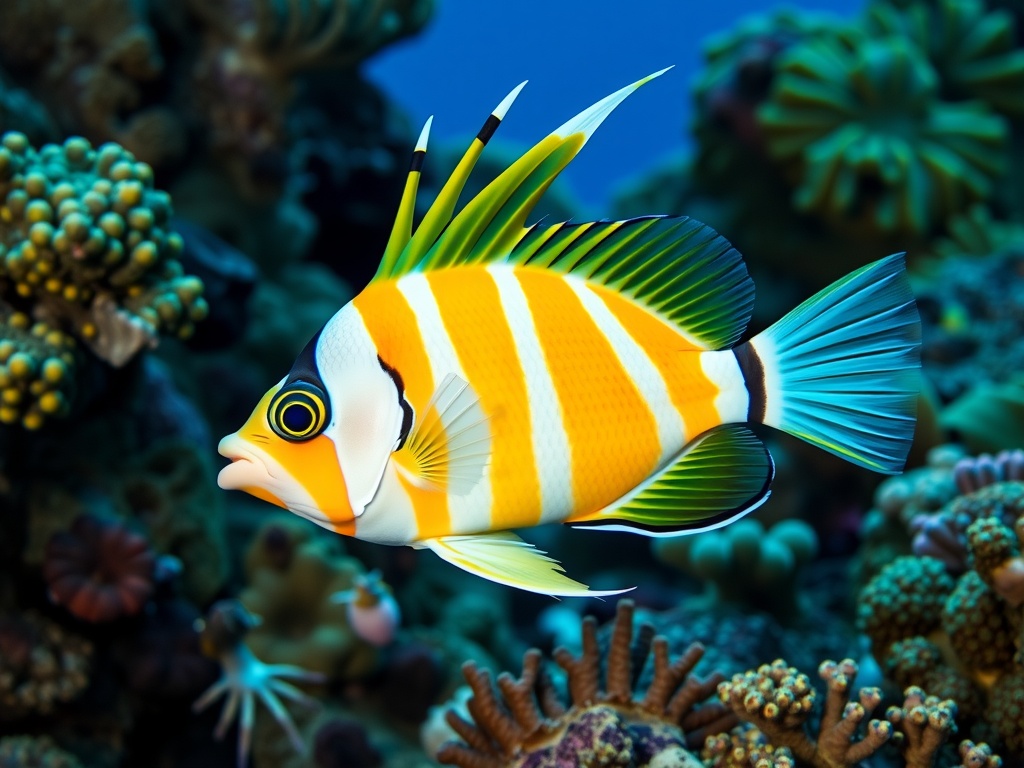
About the Queen angelfish
The queen angelfish is a vibrantly colored marine fish native to the western Atlantic Ocean, notable for its striking blue and yellow coloration and a distinctive blue 'crown' or 'mask' on its forehead. It inhabits coral reefs, often seen alone or in pairs, gracefully navigating through the reef crevices in search of food. Adults can be quite territorial, especially during breeding seasons, and are easily recognized by their elongated dorsal and anal fins. The queen angelfish is popular in the aquarium trade, but its specialized diet and space needs make it challenging for most home aquarists.
Fascinating facts
Royal Marking
The queen angelfish's blue 'crown' on its head is unique and gives the species its regal name.
Habitat Specialist
They are most commonly found at depths between 1 and 70 meters on coral reefs of the Caribbean Sea and western Atlantic.
Juvenile Cleaners
Juvenile queen angelfish set up cleaning stations where larger fish visit to have parasites removed from their bodies.
Detailed description
The queen angelfish (Holacanthus ciliaris) is a medium to large marine angelfish, typically reaching lengths of 30–45 cm (12–18 in), with some individuals growing up to 45 cm. Its body is laterally compressed and oval-shaped, featuring a vivid palette of electric blue and yellow hues. The most distinctive feature is the iridescent blue 'crown' or 'mask' on its forehead, edged with a ring of bright blue spots, which gives the species its common name. The dorsal and anal fins are elongated and filamentous, especially in adults, enhancing their graceful appearance. Juveniles differ in coloration, displaying a deep blue body with vertical yellow bars, gradually transitioning to adult coloration as they mature. Queen angelfish possess small, brush-like teeth adapted for grazing on sessile invertebrates. Their large pectoral fins and strong caudal peduncle allow for agile maneuvering among complex reef structures. They are diurnal, spending daylight hours actively foraging and retreating to sheltered crevices at night. The species is generally solitary or found in pairs, exhibiting territorial behaviors, particularly during breeding periods. Their lifespan in the wild is estimated at 15–20 years, although longevity in captivity can be shorter due to dietary and environmental challenges.
Did you know?
The 'crown' spot on the queen angelfish's head inspired its royal namesake—it resembles a crown or halo.
Research & sources
Wikipedia summary
The queen angelfish, also known as the blue angelfish, golden angelfish, or yellow angelfish, is a species of marine angelfish found in the western Atlantic Ocean. It is a benthic warm-water species that lives in coral reefs. It is recognized by its blue and yellow coloration and a distinctive spot or "crown" on its forehead. This crown distinguishes it from the closely related and similar-looking Bermuda blue angelfish, with which it overlaps in range and can interbreed.
Behaviour & social structure
Queen angelfish are primarily solitary, though pairs are often observed, especially during the breeding season. They maintain and defend territories, which they patrol regularly to deter intruders, particularly other angelfish species. Their diet is omnivorous but highly specialized, consisting mainly of sponges, tunicates, hydroids, bryozoans, and algae, supplemented by small invertebrates such as jellyfish and plankton. Feeding involves picking at the substrate with their protractile mouths, allowing them to extract food from crevices. Juveniles sometimes act as 'cleaners,' removing ectoparasites from larger fish. Queen angelfish are crepuscular, with peak activity at dawn and dusk, and they seek shelter within the reef at night to avoid predators. Social interactions are complex, involving visual displays and color changes to communicate dominance or readiness to spawn.
Reproduction & life cycle
Queen angelfish are oviparous and exhibit a monogamous mating system, with pairs forming stable bonds that may last for several breeding seasons. Spawning typically occurs at dusk, with both partners ascending into the water column to release gametes simultaneously, maximizing fertilization and dispersal by currents. Females can release between 25,000 and 75,000 eggs per spawning event, and may spawn several times during the breeding season, which peaks in late spring and summer. The eggs are pelagic, hatching within 15–20 hours into planktonic larvae that drift with ocean currents for several weeks before settling onto the reef as juveniles. There is no parental care post-spawning, and high larval mortality is common due to predation and environmental factors.
Adaptations & survival
Queen angelfish have evolved several adaptations for reef life. Their laterally compressed bodies and elongated fins enable precise maneuvering through tight coral crevices. The bright coloration serves both as camouflage among colorful corals and as a warning signal to potential competitors. Their specialized jaws and teeth are adapted for feeding on sponges, a resource few other fish exploit due to the sponges' chemical defenses. Juvenile cleaning behavior provides a mutualistic relationship with larger fish, reducing predation risk and increasing survival. Their ability to change coloration slightly during social interactions aids in communication and establishing dominance hierarchies.
Cultural significance
The queen angelfish is a popular species in the marine aquarium trade, prized for its striking appearance, though its specialized dietary needs make it challenging to keep in captivity. In Caribbean folklore, the fish's 'crown' has inspired local myths, symbolizing royalty and grace. It is often featured in tourism materials and artwork throughout the Caribbean and Florida, representing the vibrant biodiversity of coral reefs. There are no known traditional medicinal or subsistence uses, as the species is not typically targeted for food due to its tough, unpalatable flesh.
Recent research
Recent research has focused on the queen angelfish's role in reef ecosystem dynamics, particularly its dietary specialization on sponges and its influence on sponge community structure. Genetic studies have explored hybridization zones with Holacanthus bermudensis, providing insights into speciation and gene flow in marine angelfishes. Ongoing studies are examining the impacts of climate change on their reproductive timing and larval dispersal patterns. Advances in underwater imaging and tagging have improved understanding of their territoriality and home range sizes. Conservation research is investigating the effects of marine protected areas on population resilience.
Videos
Habitat
Coral reefs

Conservation
The Queen angelfish is currently classified as Least Concern on the IUCN Red List.
Threats & challenges
While currently listed as Least Concern by the IUCN, queen angelfish face several threats. Habitat degradation due to coral reef loss, ocean acidification, and climate change poses significant risks to their populations. Overfishing for the aquarium trade, although regulated, can locally deplete populations. Pollution and sedimentation also negatively impact reef health and, consequently, queen angelfish abundance. Hybridization with the closely related Bermuda blue angelfish (Holacanthus bermudensis) in overlapping ranges may affect genetic integrity, though the long-term effects are not fully understood. Overall, populations are stable, but localized declines have been reported in areas of intense human activity.
Taxonomy
Scientific name
Holacanthus ciliaris
- Kingdom
- Animalia
- Phylum
- Chordata
- Class
- Actinopterygii
- Order
- Perciformes
- Family
- Pomacanthidae
- Genus
- Holacanthus
- Species
- ciliaris
Where to see a queen angelfish
1 zoo and aquarium in 1 country are recorded as keeping this species.

Community notes
Share your observations about the Queen angelfish.
No community notes yet. Be the first!
Discover more wildlife
More fascinating animals from the encyclopedia.