
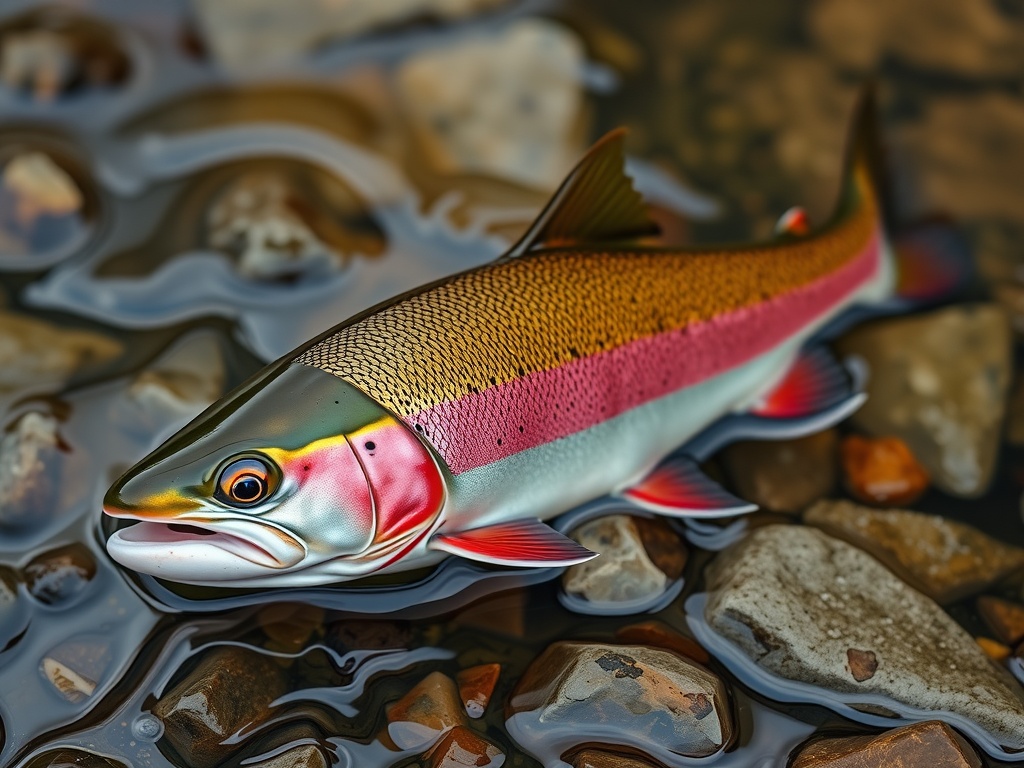
About the Rainbow trout
The rainbow trout is a vibrant freshwater fish native to cold-water rivers and lakes in North America, but has been introduced worldwide for sport fishing. Recognized by its iridescent coloring and distinctive pinkish stripe along its sides, the rainbow trout is highly adaptable and can thrive in a variety of aquatic environments. It is a popular species among anglers due to its spirited fight and is also valued in aquaculture for food. Rainbow trout can display anadromous behavior, migrating to the ocean and returning to freshwater to spawn, a form known as steelhead.
Fascinating facts
Popular Game Fish
Rainbow trout are one of the most sought-after freshwater fish by anglers worldwide due to their fighting ability and tasty flesh.
Colorful Appearance
They get their name from the vivid, multicolored stripe running along each side of their body, which shimmers in sunlight.
Anadromous Variety
The steelhead form of rainbow trout migrates between freshwater and saltwater, showcasing remarkable adaptability.
Detailed description
The rainbow trout (Oncorhynchus mykiss) is a medium-sized salmonid fish, typically ranging from 30 to 80 cm in length and weighing 2 to 8 kg, though individuals over 20 kg have been recorded in optimal environments. Its body is streamlined and laterally compressed, covered in small cycloid scales, and features an adipose fin characteristic of salmonids. The species is named for its striking coloration: a broad, iridescent pink to red lateral stripe runs from gill cover to tail, set against a silvery body with a greenish to bluish back and black spots scattered across the dorsal surface, fins, and tail. Juveniles, known as parr, display distinct vertical bars and spots for camouflage. Rainbow trout exhibit remarkable phenotypic plasticity, adapting their morphology and coloration to local habitats. They are highly active swimmers, capable of rapid bursts of speed and agile maneuvers to evade predators or capture prey. Their sensory systems are well-developed, including a lateral line for detecting vibrations and acute vision adapted for both surface and subsurface feeding. The steelhead form is anadromous, undergoing physiological changes (smoltification) to transition between freshwater and marine environments. Lifespan varies, but most wild individuals live 4–6 years, with some reaching over a decade. Rainbow trout are opportunistic feeders and play a vital ecological role as both predator and prey in their native and introduced ranges.
Did you know?
Rainbow trout can hybridize with other trout species, sometimes producing hybrids known as 'cutbows' when crossed with cutthroat trout.
Research & sources
Wikipedia summary
The rainbow trout is a species of trout native to cold-water tributaries of the Pacific Ocean in North America and Asia. The steelhead is an anadromous (sea-run) form of the coastal rainbow trout (O. m. irideus) or Columbia River redband trout (O. m. gairdneri) that usually returns to freshwater to spawn after living two to three years in the ocean.
Behaviour & social structure
Rainbow trout are primarily diurnal, exhibiting peak activity during dawn and dusk (crepuscular periods). They are opportunistic feeders, preying on aquatic and terrestrial insects, crustaceans, mollusks, small fish, fish eggs, and even plankton when available. Feeding strategies include surface foraging, drift-feeding in currents, and ambush predation from cover. Social structure varies: juveniles often form loose schools for protection, while adults are more solitary or form loose aggregations, especially during spawning migrations. Territoriality is pronounced in confined habitats, with dominant individuals defending prime feeding or spawning sites. Rainbow trout use visual and olfactory cues to locate prey and conspecifics, and display a range of behaviors such as jumping, leaping, and rapid darting to escape predators or obstacles. In anadromous populations (steelhead), complex migratory behaviors are observed, including long-distance navigation using geomagnetic and olfactory cues.
Reproduction & life cycle
Rainbow trout are iteroparous, capable of spawning multiple times over their lifespan, though mortality is high post-spawning, especially in steelhead. Spawning typically occurs in spring, but timing varies with latitude and water temperature (optimal range: 6–12°C). Females excavate nests (redds) in gravel substrates of well-oxygenated streams or lake outlets. Males compete for access to females, displaying aggressive behaviors and courtship displays. Females deposit 200 to 8,000 eggs per spawning event, depending on size and condition, which are externally fertilized by one or more males. Incubation lasts 3–12 weeks, influenced by water temperature. There is no parental care after egg burial; fry emerge and disperse to shallow, protected habitats. Sexual maturity is reached at 2–4 years in most populations, but can vary widely based on environmental conditions and life history strategy (resident vs. anadromous).
Adaptations & survival
Rainbow trout possess several key adaptations for survival in variable environments. Their streamlined body and powerful musculature enable efficient swimming in fast-flowing waters. The lateral line system detects subtle water movements, aiding in prey detection and predator avoidance. Smoltification in steelhead involves physiological changes such as increased salinity tolerance, altered coloration, and modified osmoregulatory function to facilitate migration between freshwater and marine habitats. Their coloration provides camouflage against both aerial and aquatic predators, with countershading and disruptive spotting. Behavioral flexibility allows them to exploit diverse food sources and habitats. High reproductive output and rapid growth rates enhance colonization success, particularly in introduced ranges.
Cultural significance
Rainbow trout hold significant cultural and economic value worldwide. They are among the most popular freshwater game fish, prized for their fighting ability and culinary qualities. The species has been widely introduced for recreational angling and aquaculture, contributing billions to local economies. In indigenous cultures of the Pacific Northwest, rainbow trout and steelhead have traditional importance as food sources and in ceremonial contexts. Symbolically, the rainbow trout often represents purity, resilience, and the beauty of wild rivers in art and literature.
Recent research
Recent research has focused on the genetic basis of life history variation (resident vs. anadromous forms), with studies identifying key genes involved in smoltification and migration. Conservation genomics is being used to assess population structure and hybridization with native species. Climate change studies are examining thermal tolerance and adaptive capacity, with evidence that some populations are evolving increased heat resilience. Advances in telemetry and stable isotope analysis have improved understanding of movement ecology and trophic dynamics. Ongoing research in aquaculture aims to enhance disease resistance, growth rates, and sustainability.
Sources
Oncorhynchus mykiss (Rainbow Trout): Species Account
G.A. Hammerson, N. Bogutskaya et al. (2024)
scientificLife-history variation in rainbow trout (Oncorhynchus mykiss): Heritability and genetic correlations
Nichols, K.M. et al. (2008)
scientificVideos
Habitat
Cold, clear freshwater rivers, streams, and lakes


Conservation
The Rainbow trout is currently classified as Least Concern on the IUCN Red List.
Threats & challenges
While globally listed as Least Concern, rainbow trout face localized threats including habitat degradation (e.g., sedimentation, water pollution, damming), competition and hybridization with native salmonids, overfishing, and climate change impacts such as altered stream flows and rising temperatures. In some regions, introduced rainbow trout have become invasive, outcompeting or hybridizing with native fish and altering aquatic ecosystems. Conservation challenges include maintaining genetic diversity, protecting critical spawning habitats, and managing interactions with native species. Hatchery supplementation, while supporting fisheries, can sometimes reduce wild population fitness through genetic introgression.
Taxonomy
Scientific name
Oncorhynchus mykiss
- Kingdom
- Animalia
- Phylum
- Chordata
- Class
- Actinopterygii
- Order
- Salmoniformes
- Family
- Salmonidae
- Genus
- Oncorhynchus
- Species
- mykiss
Where to see a rainbow trout
1 zoo and aquarium in 1 country are recorded as keeping this species.
Community notes
Share your observations about the Rainbow trout.
No community notes yet. Be the first!
Discover more wildlife
More fascinating animals from the encyclopedia.