
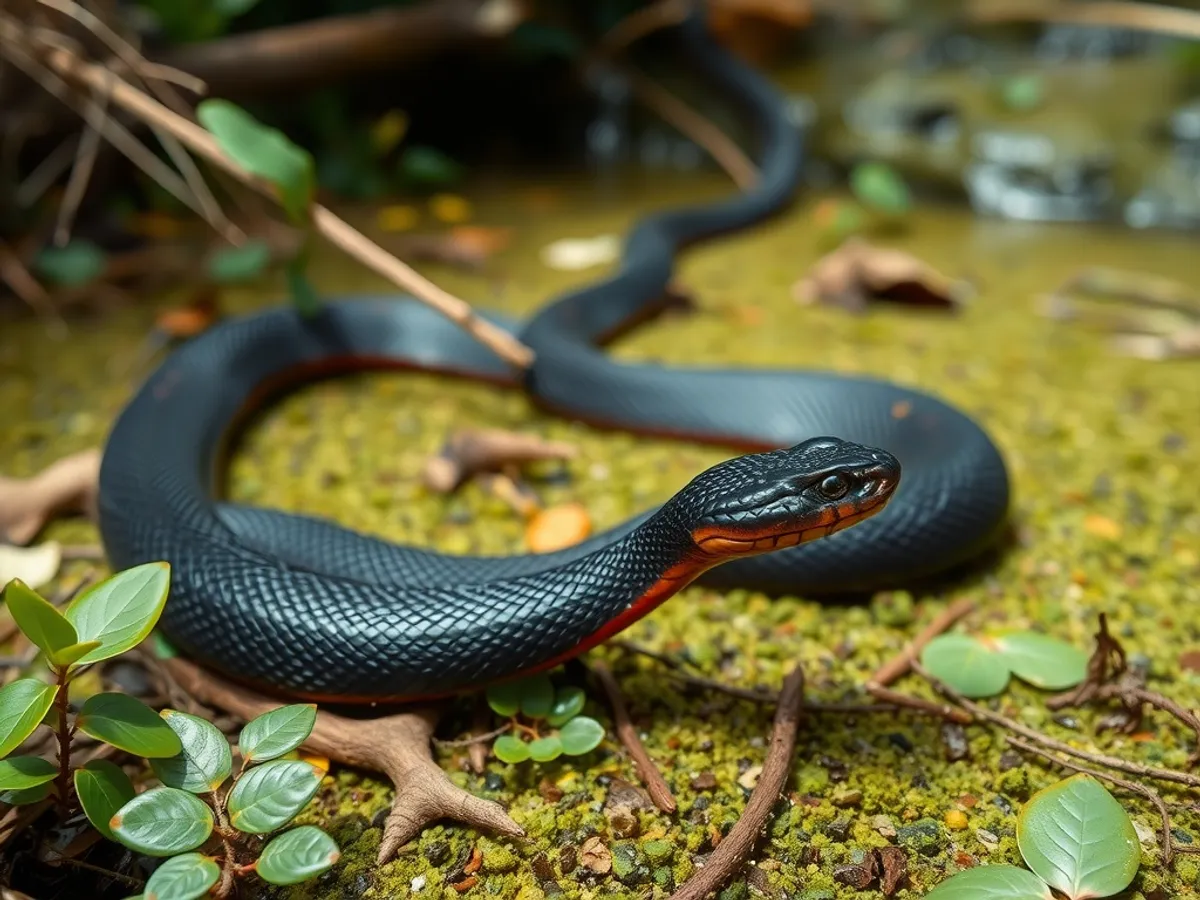
About the Red-bellied Black Snake
The Red-bellied Black Snake is a highly recognizable venomous snake native to eastern Australia, known for its glossy black upper body and striking red or crimson belly. This medium-to-large snake is commonly found near water sources such as streams, swamps, and wetlands, where it preys on frogs, fish, and small mammals. Although venomous, its bite is rarely fatal to humans, as the species is generally shy and avoids confrontation. The Red-bellied Black Snake plays an important ecological role in controlling amphibian populations and is a key predator in its habitat.
Fascinating facts
Water-Loving Snake
Red-bellied Black Snakes are often found near water sources such as creeks, swamps, and wetlands, which provide both food and shelter.
Amphibian Specialist
Their diet largely consists of frogs, making them important for controlling amphibian populations in their ecosystems.
Live Birth
Unlike most snakes, female Red-bellied Black Snakes give birth to live young, with litters ranging from 5 to 40 offspring.
Detailed description
The Red-bellied Black Snake (Pseudechis porphyriacus) is a medium to large elapid, typically measuring 1.25–1.8 meters in length, though specimens up to 2.5 meters have been recorded. Its body is robust and muscular, with smooth, glossy black dorsal scales and vivid red to crimson ventral coloration that extends up the flanks, serving as a warning to potential predators. The head is only slightly distinct from the neck, with large eyes and round pupils adapted for diurnal activity. This species is highly aquatic compared to other Australian snakes, often found basking near or swimming in water bodies. Red-bellied Black Snakes are primarily solitary, exhibiting territorial behavior, especially during the breeding season. They are generally shy and secretive, relying on cryptic coloration and rapid retreat to avoid threats. Their diet is diverse, including amphibians (especially frogs), fish, reptiles (including other snakes), and small mammals. The species is viviparous, giving birth to live young rather than laying eggs, an adaptation to its often cool and wet habitat. Red-bellied Black Snakes play a crucial ecological role as both predator and prey, helping regulate populations of amphibians and small vertebrates while serving as food for larger birds of prey and introduced mammals.
Did you know?
The Red-bellied Black Snake is immune to the venom of many other Australian snakes, including the deadly Eastern Brown Snake.
Research & sources
Wikipedia summary
The red-bellied black snake is a species of venomous snake in the family Elapidae, indigenous to Australia. Originally described by George Shaw in 1794 as a species new to science, it is one of eastern Australia's most commonly encountered snakes. Averaging around 1.25 m in length, it has glossy black upperparts, bright red or orange flanks, and a pink or dull red belly. It is not aggressive and generally retreats from human encounters, but will defend itself if provoked. Although its venom can cause significant illness, no deaths have been recorded from its bite, which is less venomous than other Australian elapid snakes. The venom contains neurotoxins, myotoxins, and coagulants and has haemolytic properties. Victims can also lose their sense of smell.
Behaviour & social structure
Red-bellied Black Snakes are primarily diurnal, most active during the early morning and late afternoon, especially in warm, humid conditions. They are strong swimmers and frequently hunt in or near water, using both ambush and active foraging strategies. When hunting, they rely on both sight and chemosensory cues, flicking their tongues to detect prey. Their feeding behavior is opportunistic; they will consume frogs, tadpoles, fish, skinks, small mammals, and even other snakes, including venomous species such as the Eastern Brown Snake (Pseudonaja textilis). Social interactions are minimal outside the breeding season, though males may engage in ritualized combat for access to females. When threatened, they may flatten their bodies, hiss loudly, and display their red sides as a warning. Biting is a last resort, as they prefer to escape if possible. They often shelter under logs, rocks, or dense vegetation, and may use the same basking or hiding sites repeatedly.
Reproduction & life cycle
Breeding occurs in spring (September to November), with males actively searching for females and sometimes engaging in combat with rivals. The species is viviparous, with females giving birth to live young rather than laying eggs—a trait advantageous in cooler, wetter climates where egg incubation would be risky. Gestation lasts approximately 3–5 months, and females give birth to litters of 5–40 neonates (average 12–20), each measuring 12–22 cm at birth. There is no parental care post-birth; the young are independent immediately and disperse quickly to avoid predation, including cannibalism by adults. Sexual maturity is typically reached at 2–3 years of age, depending on food availability and environmental conditions.
Adaptations & survival
The Red-bellied Black Snake exhibits several key adaptations for survival in its semi-aquatic environment. Its smooth, hydrodynamic scales and muscular body enable efficient swimming. The bright red ventral coloration serves as aposematic (warning) signaling to deter predators. Its venom is a complex cocktail of neurotoxins, myotoxins, and hemolysins, evolved to rapidly immobilize a variety of prey, particularly amphibians, which are otherwise resistant to many snake venoms. Viviparity (live birth) is an adaptation to cool, moist habitats, reducing the risk of egg predation and fungal infection. Behavioral adaptations include basking to regulate body temperature and the use of communal basking sites, especially in cooler months. The species also demonstrates resistance to the toxins of some of its prey, such as cane toads (Rhinella marina), although ingestion of large toads can still be fatal.
Cultural significance
In Australian Aboriginal culture, snakes often hold significant mythological roles, though the Red-bellied Black Snake itself is less prominent than some other species. It is sometimes featured in local folklore as a symbol of danger and respect for nature. The species is occasionally referenced in Australian literature and media as an iconic, yet misunderstood, part of the country's wildlife. There are no known traditional medicinal or utilitarian uses of this species, but its striking appearance and role in controlling pest populations have led to a degree of appreciation among naturalists and herpetologists.
Recent research
Recent research has focused on the composition and pharmacological properties of the Red-bellied Black Snake's venom, revealing unique peptides with potential medical applications, including anticoagulants and myotoxins. Studies have also examined the species' resistance to cane toad toxins, providing insights into rapid evolutionary adaptation. Ongoing ecological research tracks population dynamics in response to habitat modification and climate change. Genetic studies have clarified its relationship to other Pseudechis species, supporting its status as a distinct lineage within the genus. Citizen science initiatives and radio-telemetry studies are improving understanding of movement patterns, habitat use, and responses to urban environments.
Videos
Habitat
Freshwater wetlands, forests, and woodlands near bodies of water


Conservation
The Red-bellied Black Snake is currently classified as Least Concern on the IUCN Red List.
Threats & challenges
While currently listed as Least Concern by the IUCN, the Red-bellied Black Snake faces several threats. Habitat loss and fragmentation due to urbanization, agriculture, and wetland drainage reduce suitable environments. Road mortality is significant, as snakes are often killed while basking on warm surfaces. The introduction of invasive species, particularly the cane toad, has caused localized declines due to poisoning. Persecution by humans, often due to fear or misunderstanding, also contributes to mortality. Despite these challenges, the species remains widespread and relatively common in suitable habitats, though local populations may be vulnerable to ongoing environmental changes.
Taxonomy
Scientific name
Pseudechis porphyriacus
- Kingdom
- Animalia
- Phylum
- Chordata
- Class
- Reptilia
- Order
- Squamata
- Family
- Elapidae
- Genus
- Pseudechis
- Species
- porphyriacus
Community notes
Share your observations about the Red-bellied Black Snake.
No community notes yet. Be the first!
Discover more wildlife
More fascinating animals from the encyclopedia.