
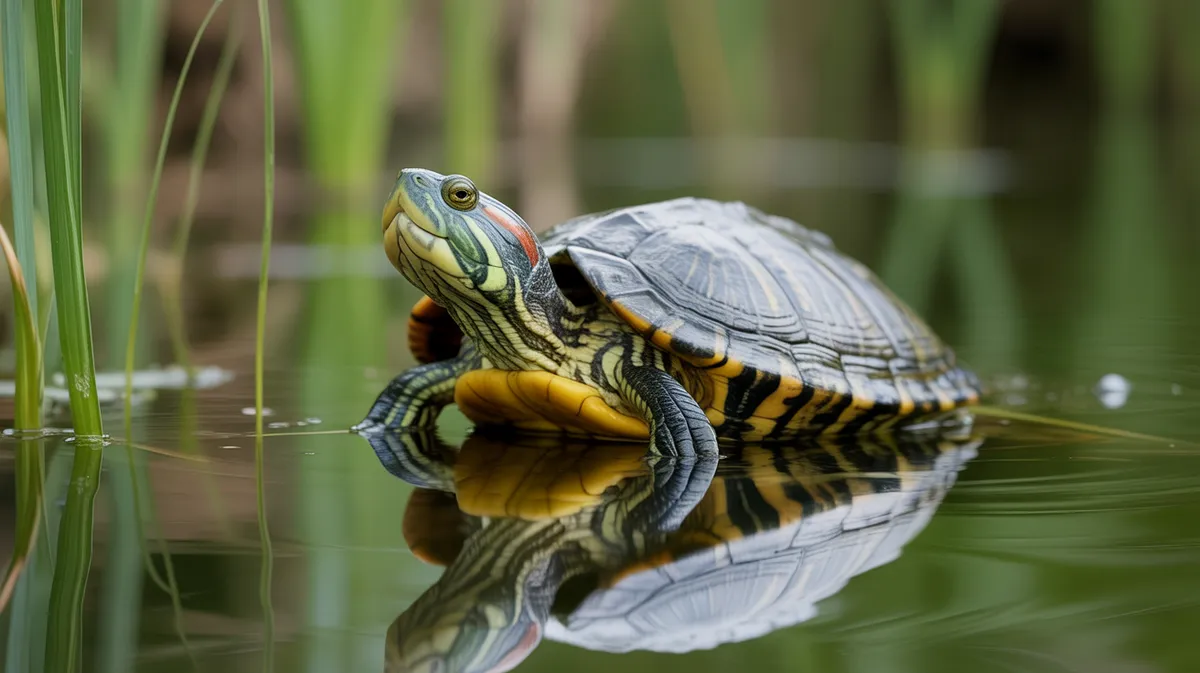
About the Red-eared Slider
Trachemys scripta elegans is native to a modest slice of the Mississippi and Rio Grande drainages and is now, thanks to the pet trade, one of the world's 100 worst invasive species, established on every continent except Antarctica. Millions of hatchlings were sold as thumbnail-sized novelties in the 1960s and 70s, grew to dinner-plate size, and were dumped in ponds; the United States banned the sale of turtles under 10 cm in 1975, largely because of Salmonella in children, and the trade simply shifted to export. Sliders outcompete native turtles for basking sites and food — in Europe they displace the European pond terrapin, in Asia they threaten multiple endemic species — and they are long-lived, prolific and tolerant of polluted water. The red stripe behind the eye gives the name, and it fades with age, so old males can turn almost uniformly black, a condition called melanism that also comes with a long-clawed forelimb used to flutter in front of a female's face during courtship. Sliders are omnivorous, shifting from a heavily carnivorous juvenile diet to a more herbivorous adult one, and they can live 30 years or more. Like most emydids, sex is set by incubation temperature.
Fascinating facts
Long Lifespan
Red-eared sliders can live up to 40 years in captivity with proper care, making them a long-term commitment as pets.
Invasive Species
Due to pet releases, red-eared sliders have established populations on every continent except Antarctica, often outcompeting native turtles.
Basking Behavior
These turtles spend hours basking in the sun to regulate their body temperature and prevent fungal infections on their shells.
Detailed description
The Red-eared Slider (Trachemys scripta elegans) is a medium-sized, semi-aquatic turtle, typically reaching 15–28 cm (6–11 in) in carapace length, with females generally larger than males. Its most distinctive feature is the prominent red or orange stripe behind each eye, set against an olive to dark green head. The carapace is smooth, oval, and slightly domed, adorned with yellowish stripes and blotches, while the plastron (underside) is yellow with dark, irregular markings. Limbs are webbed for efficient swimming, and strong claws are present, especially in males. Red-eared Sliders are ectothermic and spend significant time basking in sunlight to regulate their body temperature. They are opportunistic omnivores, consuming aquatic vegetation, insects, crustaceans, fish, and carrion, with dietary preferences shifting from carnivorous in juveniles to more herbivorous in adults. In the wild, they are highly adaptable, tolerating a range of water conditions and temperatures. Socially, they are often observed basking communally but do not form complex social structures. Their lifespan in the wild averages 20–30 years, but individuals in captivity can exceed 40 years with proper care.
Did you know?
Red-eared sliders can recognize their keepers and may beg for food by swimming excitedly at the edge of their enclosure.
Research & sources
Wikipedia summary
The red-eared slider or red-eared terrapin is a subspecies of the pond slider, a semiaquatic turtle belonging to the family Emydidae. It is the most popular pet turtle in the United States, also popular as a pet across the rest of the world, and is the most invasive turtle. It is the most commonly traded turtle in the world.
Behaviour & social structure
Red-eared Sliders are diurnal, being most active during daylight hours. They spend mornings and afternoons basking on logs, rocks, or banks, often stacking atop one another for optimal sun exposure. Basking is crucial for thermoregulation, metabolic function, and shell health. When threatened, they slide quickly into the water, a behavior that inspired their common name. Foraging occurs primarily in shallow waters, where they use keen vision and olfaction to locate food. Juveniles are more predatory, actively hunting invertebrates and small fish, while adults shift to a more plant-based diet. Social interactions are limited, but competition for basking sites is common, and aggressive displays such as biting or shoving may occur. During the breeding season, males exhibit courtship behaviors including fluttering their elongated foreclaws near the female's face. Red-eared Sliders are known for their ability to recognize regular feeding times and may approach humans in anticipation of food.
Reproduction & life cycle
Breeding typically occurs in spring and early summer, triggered by rising temperatures and increased daylight. Males court females with a distinctive foreclaw display, vibrating their claws near the female's head. Copulation takes place in the water. Females may lay multiple clutches per season, each containing 2–30 eggs, depending on age and size. Nesting occurs on land, often several meters from water, where females dig holes in sandy or soft soil to deposit eggs. Incubation lasts 59–112 days, with temperature-dependent sex determination: warmer nests tend to produce females, cooler nests males. There is no parental care post-oviposition; hatchlings are independent upon emergence and instinctively make their way to water. Sexual maturity is reached at 2–5 years for males and 5–7 years for females.
Adaptations & survival
Red-eared Sliders possess several adaptations for semi-aquatic life. Their streamlined, hydrodynamic shell and webbed feet facilitate efficient swimming. The ability to bask and regulate body temperature is vital for digestion and immune function. They can remain submerged for extended periods, utilizing cloacal respiration to absorb oxygen through highly vascularized tissues near the tail. Their omnivorous diet and flexible feeding strategies allow them to exploit diverse food sources, contributing to their invasive success. Temperature-dependent sex determination is an evolutionary adaptation to environmental variability. Their cryptic coloration provides camouflage from predators, and their rapid escape response aids survival.
Cultural significance
Red-eared Sliders are among the most popular pet turtles worldwide, symbolizing longevity and adaptability in some cultures. Their presence in the pet trade has influenced legislation on exotic species and animal welfare. Invasive populations have prompted public education campaigns about responsible pet ownership. While not prominent in mythology, their image is widely recognized in media, educational materials, and as classroom pets, contributing to public awareness of turtle biology and conservation.
Recent research
Recent research has focused on the ecological impacts of Red-eared Slider invasions, particularly their competition with native turtle species and role as vectors for pathogens such as ranavirus and Salmonella. Studies on temperature-dependent sex determination have provided insights into the effects of climate change on population dynamics. Genetic analyses have clarified their taxonomy and hybridization with other Trachemys species. Ongoing research examines their physiological adaptations to urban environments and their potential as bioindicators of freshwater ecosystem health.
Videos
Habitat
Freshwater ponds, lakes, and slow-moving rivers with abundant vegetation


Conservation
The Red-eared Slider is currently classified as Least Concern on the IUCN Red List.
Threats & challenges
In their native range, Red-eared Sliders face predation from raccoons, birds, large fish, and alligators, especially as eggs and hatchlings. Habitat loss, pollution, and road mortality are significant threats. However, the primary conservation concern is their status as an invasive species in many parts of the world, where released or escaped pets outcompete native turtles for resources, transmit diseases, and disrupt local ecosystems. Their adaptability and prolific breeding exacerbate these impacts. While populations are stable or increasing globally, localized declines may occur due to over-collection for the pet trade or habitat degradation.
Taxonomy
Scientific name
Trachemys scripta elegans
- Kingdom
- Animalia
- Phylum
- Chordata
- Class
- Reptilia
- Order
- Testudines
- Family
- Emydidae
- Genus
- Trachemys
- Species
- scripta elegans
Where to see a red-eared slider
5 zoos and aquariums in 3 countries are recorded as keeping this species.
- 🦁Cheyenne Mountain Zoo🇺🇸 United States
- 🦁Colchester Zoo🇬🇧 United Kingdom
 Dierenpark ZieZoo🇳🇱 Netherlands
- 🦁Lake Superior Zoo🇺🇸 Duluth, United States
- 🦁Mill Mountain Zoo🇺🇸 United States
Community notes
Share your observations about the Red-eared Slider.
No community notes yet. Be the first!
Discover more wildlife
More fascinating animals from the encyclopedia.