
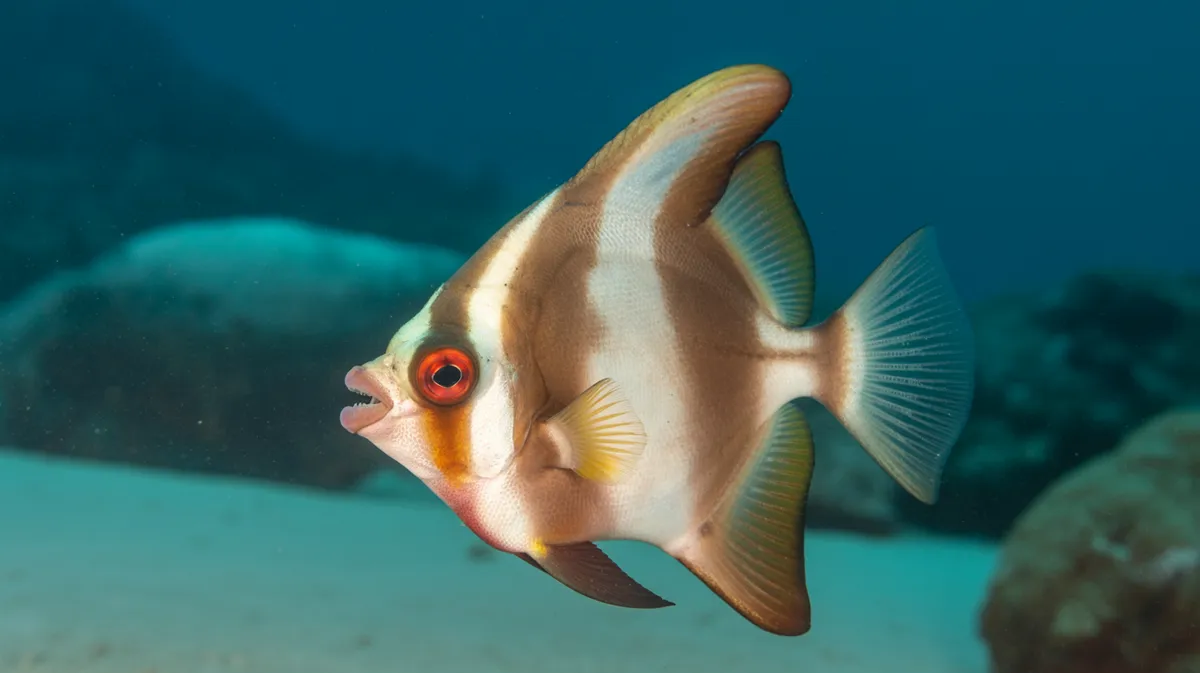
About the Red-lipped Batfish
Ogcocephalus darwini is a fish that has given up swimming. It lives on the sandy bottom around the Galapagos and Peru, at 3 to 120 m, and it walks on modified pectoral, pelvic and anal fins that it uses as legs, propping itself up and shuffling across the sediment; when forced to swim it does so clumsily and briefly. It is an anglerfish — family Ogcocephalidae, the batfishes — and it carries the same ancestral apparatus: a retractable illicium tipped with an esca, tucked into a cavity above the mouth beneath the pointed rostrum, which it extends to lure small fish, crustaceans and worms. Its lure works by chemical attraction rather than light, since it lives shallow enough for daylight. The famous scarlet lips are the subject of endless speculation and no confirmed answer; the leading hypothesis is that they are a species-recognition or courtship signal, since colour discrimination matters at the depths where it lives and the red would otherwise be a strange choice for an ambush predator. It is flattened, rough, covered in bony tubercles, and grows to about 20 to 25 cm. Its face and posture make it look permanently disgusted, which has made it an internet favourite.
Fascinating facts
Signature Red Lips
The Red-lipped Batfish's bright red lips are unique in the animal kingdom and may help individuals recognize each other during mating.
Walking Fish
Instead of swimming, this batfish uses its pectoral and pelvic fins to 'walk' awkwardly along the ocean floor.
Natural Angler
It possesses an illicium, a specialized lure-like projection on its snout, which it wiggles to attract prey close enough to catch.
Detailed description
The Red-lipped Batfish (Ogcocephalus darwini) is a member of the family Ogcocephalidae, notable for its highly specialized morphology and striking coloration. Adult individuals typically reach lengths of 20–40 cm, with a dorsoventrally flattened, triangular body that aids in stability on the seafloor. Its most distinctive feature is the vivid, vermilion-red lips, which are hypothesized to play a role in species recognition or sexual selection. The batfish's head is large and angular, with prominent eyes set high on the skull, and a pronounced, tubular snout. The illicium, a modified dorsal fin ray located above the mouth, acts as a lure to attract prey, though it is less developed than in other anglerfish relatives. Pectoral and pelvic fins are limb-like, enabling the fish to 'walk' or perch on the substrate rather than swim efficiently. The skin is covered with small, rough tubercles, providing protection and camouflage against the sandy or rocky ocean floor. Red-lipped Batfish are benthic and demersal, inhabiting depths from 3 to 76 meters, though most commonly found between 10 and 30 meters. Their cryptic coloration and sedentary lifestyle help them avoid predators and ambush prey. Internally, they possess a reduced swim bladder, reflecting their adaptation to a bottom-dwelling existence.
Did you know?
Despite its striking appearance, the Red-lipped Batfish is not poisonous and poses no threat to humans.
Research & sources
Behaviour & social structure
Red-lipped Batfish are solitary and primarily nocturnal, spending daylight hours resting motionless on the substrate. They exhibit minimal swimming, instead using their modified pectoral and pelvic fins to 'walk' or shuffle along the ocean floor in search of food. When hunting, they employ a sit-and-wait strategy, remaining still and using their illicium to attract small prey such as polychaete worms, crustaceans (e.g., shrimp, crabs), mollusks, and small benthic fishes. Upon approach, the batfish rapidly protrudes its mouth to create suction, engulfing prey. Social interactions are rare outside of the breeding season, and there is no evidence of territoriality or complex social structures. Batfish are generally cryptic and avoid open confrontation with predators, relying on camouflage and their rough, unpalatable skin.
Reproduction & life cycle
Reproductive behavior in Red-lipped Batfish is not extensively documented, but like other batfishes, they are presumed to be oviparous, releasing eggs and sperm into the water column for external fertilization. Spawning likely occurs seasonally, potentially linked to water temperature and food availability, with peaks observed during warmer months. Females produce buoyant, gelatinous egg masses that float near the surface, increasing dispersal potential. Embryonic development is rapid, with larvae hatching within a few days and remaining pelagic for several weeks before settling to the benthos. There is no parental care; both eggs and larvae are left to develop independently. Sexual maturity is reached at approximately 2–3 years of age.
Adaptations & survival
The Red-lipped Batfish exhibits several unique adaptations for benthic life. Its limb-like pectoral and pelvic fins allow for precise locomotion and stability on uneven substrates, a trait uncommon among most fishes. The reduced swim bladder minimizes buoyancy, facilitating a sedentary lifestyle. The illicium, though less pronounced than in deep-sea anglerfish, serves as an effective lure for attracting prey within striking distance. Its bright red lips may function in intraspecific communication or mate attraction, though this remains speculative. The rough, tuberculate skin provides physical protection and aids in camouflage. Sensory adaptations include well-developed lateral lines for detecting vibrations and movement in the substrate.
Cultural significance
The Red-lipped Batfish is not known to have significant roles in indigenous mythology or traditional uses, likely due to its deepwater habitat and rarity. However, its bizarre appearance and vivid coloration have made it a popular subject in ecotourism, marine photography, and popular science media. It is often cited as an example of the Galápagos Islands' unique and endemic fauna, contributing to the region's global scientific and conservation value.
Recent research
Recent research on Ogcocephalus darwini has focused on its phylogenetic relationships within the Lophiiformes (anglerfish order), as well as its ecological role in benthic communities of the Galápagos. Studies using molecular markers have clarified its evolutionary divergence from other batfishes. Ongoing ecological surveys are examining its population density, habitat preferences, and response to environmental changes such as El Niño events. There is growing interest in the function of its red lips, with hypotheses ranging from sexual selection to prey attraction, though experimental evidence remains limited. The species is also being monitored as a potential indicator of benthic ecosystem health in the Galápagos Marine Reserve.
Videos
Habitat
Ocean floor near the Galápagos Islands and off the coast of Peru

Conservation
The Red-lipped Batfish is currently classified as Least Concern on the IUCN Red List.
Threats & challenges
Currently, the Red-lipped Batfish faces minimal direct threats due to its restricted range and limited commercial value. Its habitat, primarily around the Galápagos Islands, is protected by marine reserves, reducing the risk from overfishing and habitat destruction. However, potential threats include habitat degradation from climate change (e.g., ocean warming, acidification), pollution, and incidental bycatch in artisanal fisheries. Population trends are stable, and the species is classified as Least Concern by the IUCN. Ongoing monitoring is necessary to detect any emerging threats, especially as tourism and fishing pressures increase in the region.
Taxonomy
Scientific name
Ogcocephalus darwini
- Kingdom
- Animalia
- Phylum
- Chordata
- Class
- Actinopterygii
- Order
- Lophiiformes
- Family
- Ogcocephalidae
- Genus
- Ogcocephalus
- Species
- darwini
Community notes
Share your observations about the Red-lipped Batfish.
No community notes yet. Be the first!
Discover more wildlife
More fascinating animals from the encyclopedia.