
About the Ropefish
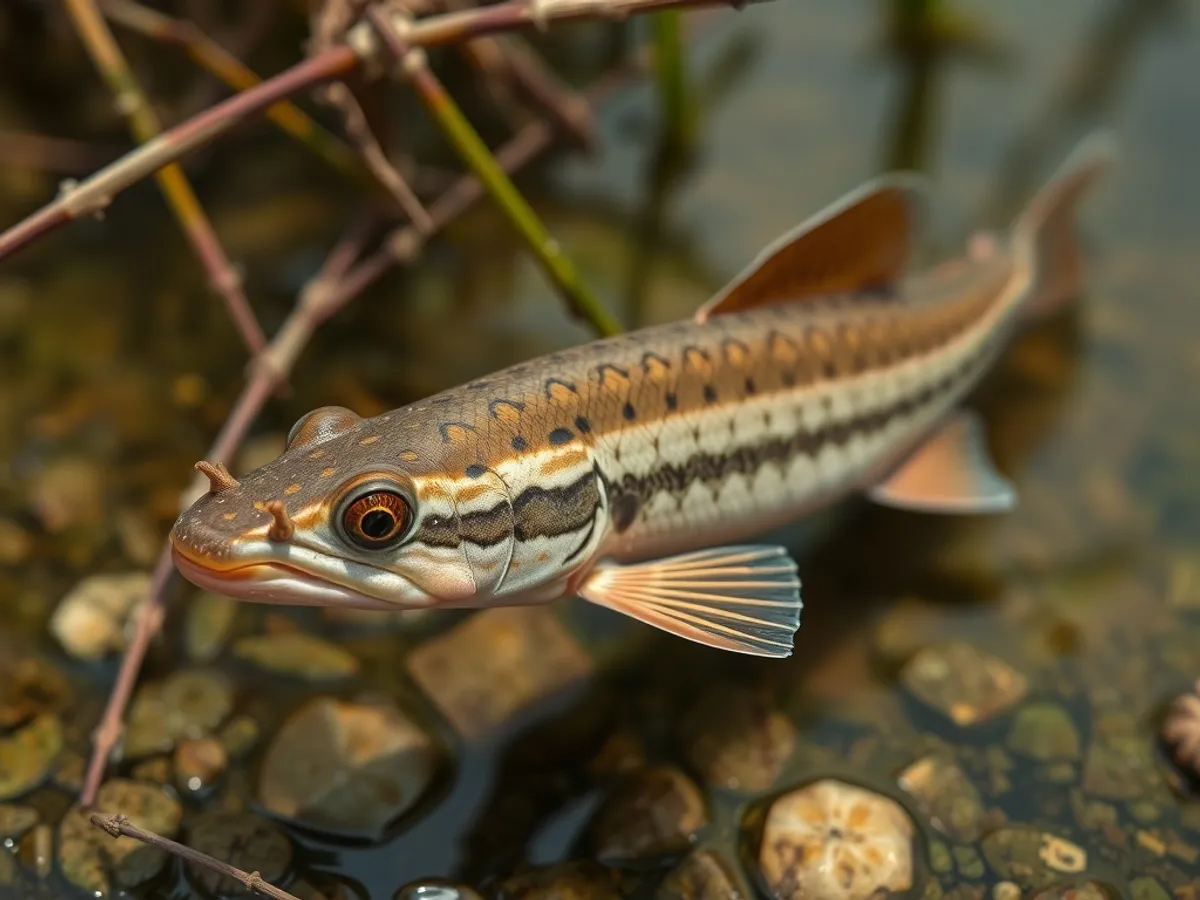
The ropefish, also known as the reedfish or snakefish, is a distinctive, elongated freshwater fish native to Central and West Africa. It has a long, cylindrical, eel-like body covered in thick, scale-armored skin, with a dorsal fin composed of a series of small, separate finlets. Ropefish are nocturnal, spending most of the day hiding among aquatic plants or debris, and emerging at night to hunt for prey. This species is known for its ability to breathe atmospheric air using a pair of lungs, allowing it to survive in oxygen-poor waters.
Fascinating facts
Snake-Like Body
Ropefish have an elongated, serpentine body that resembles a snake, which helps them navigate through dense underwater vegetation.
Air Breather
They possess a specialized swim bladder that functions as a lung, enabling them to breathe air directly from the surface.
Living Fossil
Ropefish are part of an ancient lineage of ray-finned fish, with anatomical features that have changed little for millions of years.
Detailed description
The ropefish (Erpetoichthys calabaricus) is a primitive ray-finned fish notable for its elongated, serpentine body, which can reach lengths of up to 90 cm (35 inches), though most individuals are typically 35–50 cm in captivity. Its body is covered in thick, ganoid scales—diamond-shaped, interlocking plates that provide substantial protection and are a characteristic of ancient fish lineages. The dorsal fin is unique, consisting of 7 to 18 small, separated finlets along the back, while the pectoral fins are robust and used for maneuvering along the substrate. Ropefish lack pelvic fins entirely. The head is flattened with sensory barbels near the nostrils, aiding in the detection of prey in murky waters. This species is equipped with both gills and a pair of true lungs, allowing facultative air-breathing—a crucial adaptation for surviving in hypoxic (low-oxygen) environments. Ropefish are primarily nocturnal, emerging at night to hunt small fish, crustaceans, insects, and other invertebrates. Socially, they are generally solitary but may tolerate conspecifics in loose aggregations, especially in the wild where resources are abundant. Reproduction is oviparous; females scatter eggs among submerged vegetation, and there is no parental care post-spawning. Ropefish are slow-growing and long-lived, with lifespans exceeding 15 years in captivity. Their evolutionary lineage dates back to the Cretaceous, making them living fossils and a subject of interest in evolutionary biology.
Did you know?
Ropefish do not have pelvic fins, a rare trait among modern fish.
Research & sources
Wikipedia summary
The reedfish, ropefish, or snakefish, Erpetoichthys calabaricus, is a species of fish in the family Polypteridae alongside the bichirs. It is the only member of the genus Erpetoichthys. It is native to fresh and brackish waters in West and Central Africa. The reedfish possesses a pair of lungs in addition to gills, allowing it to survive in very oxygen-poor water. It is threatened by habitat loss through palm oil plantations, other agriculture, deforestation, and urban development.
Behaviour & social structure
Ropefish are crepuscular to nocturnal, remaining hidden among dense aquatic vegetation or submerged roots during daylight hours. They exhibit a slow, deliberate swimming style, often gliding near the substrate or weaving through plants. Hunting is primarily ambush-based; ropefish use their acute sense of smell, facilitated by external nostrils and barbels, to locate prey in turbid waters. They may occasionally surface to gulp air, especially in stagnant or poorly oxygenated habitats. Social interactions are minimal; while not overtly territorial, ropefish may display mild aggression if crowded. In captivity, they can be observed exploring their environment at night, and are known to be escape artists, capable of leaving water temporarily if conditions deteriorate.
Reproduction & life cycle
Breeding in ropefish typically coincides with the rainy season in their native range, when water levels rise and vegetation becomes abundant. Courtship involves the male following and nudging the female. Females can lay several hundred adhesive eggs, which are scattered among aquatic plants or debris. Fertilization is external. There is no evidence of parental care; eggs hatch after 3–4 days, and larvae are initially planktonic, feeding on microscopic organisms. Sexual maturity is reached at approximately 2–3 years of age. Captive breeding is rare and challenging, often requiring simulation of seasonal changes and abundant plant cover.
Adaptations & survival
Ropefish possess several notable adaptations: their paired lungs allow them to breathe atmospheric air, enabling survival in hypoxic waters where many fish would perish. The ganoid scales provide armor against predators and abrasive substrates. Their elongated, flexible bodies facilitate movement through dense vegetation and narrow spaces. Barbels and a highly developed olfactory system compensate for poor vision in turbid environments. The ability to survive brief periods out of water, provided their skin remains moist, is another adaptation for fluctuating aquatic habitats. Evolutionarily, ropefish retain many ancestral features, such as a spiral valve intestine and a heterocercal tail, linking them to ancient actinopterygian fishes.
Cultural significance
Ropefish are not a major focus of traditional folklore or mythology, but they are sometimes used as a food source in local communities. Their unusual appearance and air-breathing abilities have made them popular in the global aquarium trade, where they are valued for their prehistoric look and peaceful temperament. In scientific circles, ropefish are considered living fossils and are important for studies on vertebrate evolution, particularly the transition from aquatic to terrestrial respiration.
Recent research
Recent research has focused on the ropefish's unique respiratory system, providing insights into the evolution of lungs in vertebrates. Genomic studies have clarified its phylogenetic position within Polypteriformes, confirming its status as a basal actinopterygian. Studies on their behavior in captivity have highlighted their intelligence, problem-solving abilities, and need for environmental enrichment. Conservation research is ongoing, with emphasis on habitat protection and the impact of land-use change in West Africa. Captive breeding protocols are being refined to reduce reliance on wild-caught specimens for the aquarium trade.
Videos
Habitat
Freshwater swamps, slow-moving rivers, and marshes

Conservation
The Ropefish is currently classified as Least Concern on the IUCN Red List.
Threats & challenges
The primary threats to ropefish populations are habitat loss and degradation, particularly from the expansion of palm oil plantations, deforestation, agricultural runoff, and urban development in West and Central Africa. Wetland drainage and pollution further reduce suitable habitats. While the species is still relatively widespread, localized declines have been observed. Ropefish are also collected for the aquarium trade, though this is not currently a major threat. Climate change and altered hydrological cycles may pose future risks. The IUCN currently lists Erpetoichthys calabaricus as Near Threatened, reflecting these ongoing pressures.
Taxonomy
Scientific name
Erpetoichthys calabaricus
- Kingdom
- Animalia
- Phylum
- Chordata
- Class
- Actinopterygii
- Order
- Polypteriformes
- Family
- Polypteridae
- Genus
- Erpetoichthys
- Species
- calabaricus
Community notes
Share your observations about the Ropefish.
No community notes yet. Be the first!
Discover more wildlife
More fascinating animals from the encyclopedia.