
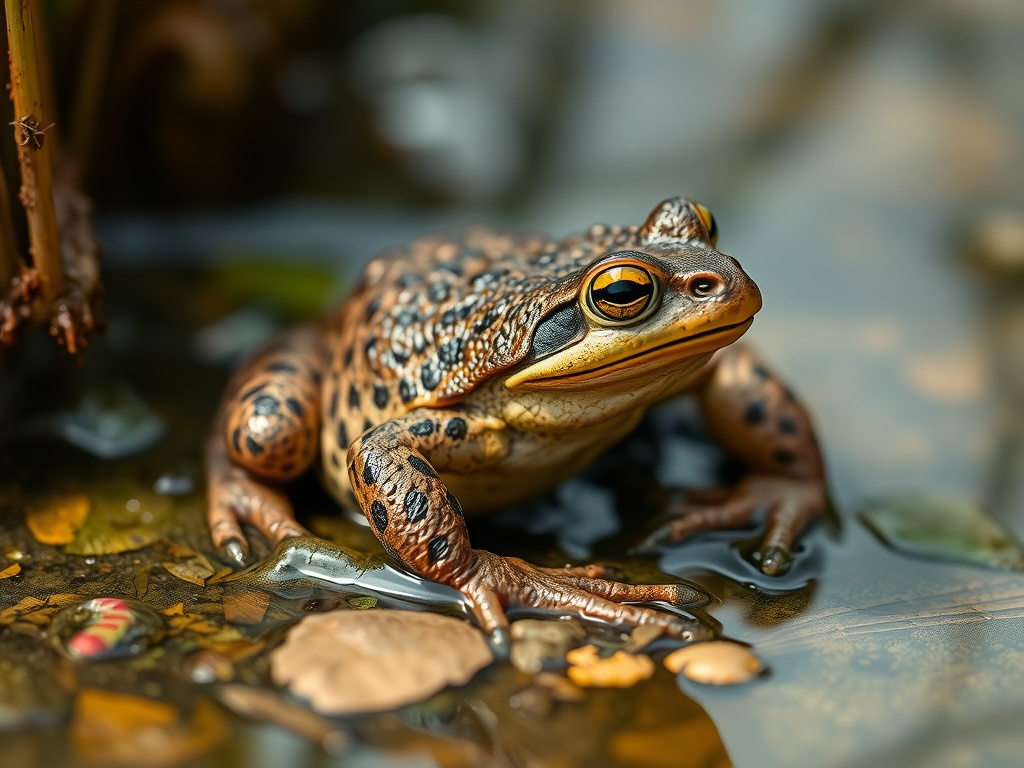
About the Rough-skinned Frog
The Rough-skinned Frog (Rana rugosa) is a medium-sized amphibian native to East Asia, known for its notably rough and warty skin compared to other frogs in its genus. Its coloration ranges from olive-brown to grayish, with dark markings that help it blend into muddy stream banks and wetlands. This species is semi-aquatic and is often found in slow-moving streams, rice paddies, and marshy lowlands. Rough-skinned Frogs are primarily nocturnal, emerging at night to feed and breed, and are recognized for their distinctive croaking calls during the rainy season.
Fascinating facts
Warty Appearance
The Rough-skinned Frog’s skin is covered in small bumps and glands, making it much rougher to the touch than most other frogs.
Thrives in Rice Fields
This frog is commonly found in rice paddies, where it helps control insect pest populations, benefiting local agriculture.
Adaptable Breeder
Its eggs can develop in both stagnant and moving water, allowing the species to colonize a diverse range of aquatic habitats.
Detailed description
The Rough-skinned Frog (Rana rugosa) is a medium-sized true frog, typically measuring 45–80 mm in snout-vent length, with females generally larger than males. Its skin is characteristically rough and covered in small tubercles and warts, a feature that distinguishes it from many other East Asian ranids. The dorsal coloration varies from olive-brown to grayish or dark brown, often with irregular dark blotches and a lighter ventral surface. The head is broad with a rounded snout, and the tympanum (external eardrum) is distinct. Hind limbs are long and muscular, adapted for both swimming and leaping, with well-developed webbing between the toes. Rana rugosa exhibits sexual dimorphism, with males developing nuptial pads during the breeding season. This species is primarily nocturnal and crepuscular, remaining hidden under vegetation or debris during the day. It is semi-aquatic, spending significant time in shallow water or on muddy banks, and is highly tolerant of a range of aquatic habitats, including polluted or disturbed environments. Its vocalizations are low-pitched and guttural, especially prominent during the rainy season when males call to attract females. The species is notable for its adaptability and resilience in human-altered landscapes, such as rice paddies and irrigation ditches.
Did you know?
Unlike most frogs, the Rough-skinned Frog can lay its eggs in both still and flowing water, resulting in greater reproductive success across varied habitats.
Research & sources
Behaviour & social structure
Rana rugosa is largely solitary outside of the breeding season, exhibiting territorial behavior among males during mating periods. It is most active at night, emerging from cover to forage along the water's edge. Its diet consists primarily of small invertebrates, including insects, spiders, worms, and occasionally small crustaceans. The frog employs a sit-and-wait hunting strategy, relying on its cryptic coloration and sudden lunges to capture prey. When threatened, it may leap into water or burrow into mud for protection. Social interactions are generally limited to breeding aggregations, where males compete acoustically and physically for access to females. Outside of breeding, individuals maintain loose home ranges and rarely interact.
Reproduction & life cycle
Breeding in Rana rugosa typically occurs from late spring to early summer, coinciding with the rainy season (May–July in most regions). Males congregate in shallow water and produce advertisement calls to attract females. Amplexus is axillary, with the male grasping the female behind the forelimbs. Females lay between 300 and 1,500 eggs in gelatinous strings, attaching them to submerged vegetation or debris. The eggs hatch within 7–14 days, depending on water temperature. Tadpoles are aquatic, feeding on algae and detritus, and undergo metamorphosis after 40–70 days. There is no parental care post-oviposition. Sexual maturity is typically reached at 1–2 years of age.
Adaptations & survival
The rough, tuberculate skin of Rana rugosa provides camouflage against muddy substrates and may deter some predators. Its tolerance for a wide range of water qualities, including slightly polluted or brackish environments, is unusual among amphibians and allows it to thrive in rice paddies and urban waterways. The species exhibits behavioral plasticity, adjusting activity patterns and breeding sites in response to habitat changes. Its robust limbs and webbed feet facilitate both swimming and terrestrial locomotion. During dry periods, it can aestivate in moist soil or under debris to avoid desiccation.
Cultural significance
In Japan and parts of East Asia, frogs are symbols of good fortune, fertility, and safe travel, though Rana rugosa is not as prominent in folklore as some other species. In rural areas, its presence in rice paddies is often seen as beneficial for pest control. The species has been used in educational settings and biological research, particularly in studies of amphibian osmoregulation and environmental adaptation. There are no significant traditional medicinal or culinary uses reported for this species.
Recent research
Recent genetic studies have revealed significant geographic variation within Rana rugosa, with evidence of cryptic species and multiple distinct lineages across Japan, Korea, and China. Research on its osmoregulatory physiology has shown unique adaptations to brackish water environments, making it a model organism for studying amphibian tolerance to salinity. Ongoing studies are examining the impact of agricultural chemicals on its development and reproductive success. Conservation genetics projects are monitoring hybridization events and population structure to inform management strategies.
Videos
Habitat
Freshwater wetlands, streams, and rice paddies
 Various Continental Regions
Grassland
Open areas dominated by grasses rather than trees, supporting numerous herbivores and their predators.
 Global
Forest
Wooded areas with significant tree cover and diverse plant and animal communities.
 Global
Freshwater
Lakes, rivers, and wetlands with diverse aquatic ecosystems.
Conservation
The Rough-skinned Frog is currently classified as Least Concern on the IUCN Red List.
Threats & challenges
Although currently listed as Least Concern, Rana rugosa faces localized threats from habitat loss due to urbanization, agricultural intensification, and water pollution. The conversion of wetlands and streams to concrete channels reduces suitable breeding sites. Pesticide use in rice cultivation can negatively impact tadpole survival. Hybridization with introduced populations and genetic introgression have been reported in some areas. Climate change, leading to altered precipitation patterns, may affect breeding success. Despite these challenges, the species' adaptability has allowed it to persist in many modified landscapes, and population trends remain stable overall.
Taxonomy
Scientific name
Rana rugosa
- Kingdom
- Animalia
- Phylum
- Chordata
- Class
- Amphibia
- Order
- Anura
- Family
- Ranidae
- Genus
- Rana
- Species
- rugosa
Community notes
Share your observations about the Rough-skinned Frog.
No community notes yet. Be the first!
Discover more wildlife
More fascinating animals from the encyclopedia.