
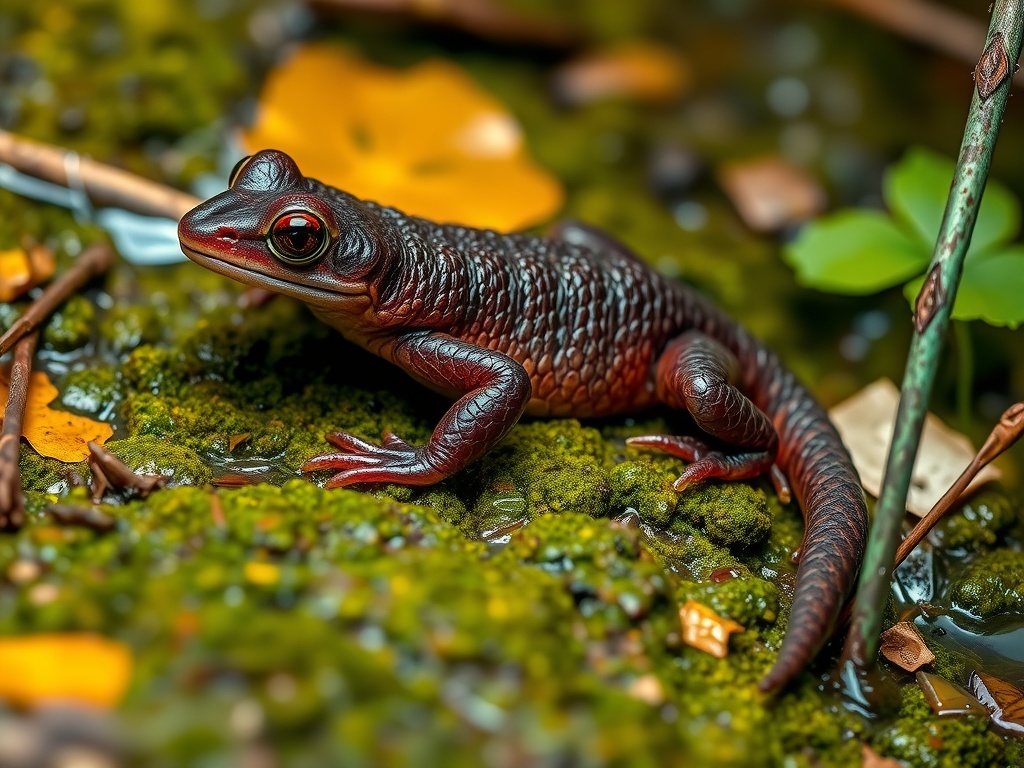
About the Rough-skinned Newt
Taricha granulosa is the single most poisonous amphibian in North America and one of the most toxic animals anywhere: its skin carries tetrodotoxin, the same sodium-channel blocker found in pufferfish, and a large newt from an Oregon population can hold enough to kill several adult humans if ingested. A widely cited 1979 case describes a man in Oregon who swallowed one on a dare and died. The newt itself is harmless to handle, because the toxin must be ingested; it does not sting or bite. Its toxicity is the centrepiece of the best-documented coevolutionary arms race in biology. The common garter snake, Thamnophis sirtalis, has evolved mutations in its sodium channel that confer resistance and allow it to eat the newts, and where snakes are most resistant the newts are most toxic — a geographic mosaic mapped across the Pacific Northwest by Edmund Brodie and colleagues. Resistant snakes pay for it: they are slower for hours after a meal, which makes them easier prey. When threatened, the newt performs the unken reflex, arching its head and tail back to display a vivid orange belly against its drab brown back, an honest warning. Adults are 12 to 22 cm and breed in ponds and slow streams from northern California to Alaska.
Fascinating facts
Powerful Toxins
The skin of the rough-skinned newt contains tetrodotoxin, a substance more potent than cyanide and deadly to most animals.
Forest Dwellers
These newts live primarily in moist forests, hiding under logs and leaf litter, but migrate to freshwater ponds and streams for breeding.
Snake Predators
Certain garter snake species have evolved resistance to the newt’s toxin, allowing them to prey on rough-skinned newts where other predators cannot.
Detailed description
The Rough-skinned Newt (Taricha granulosa) is a medium-sized salamander, typically measuring 12–20 cm (4.7–7.9 inches) in total length, with females generally larger than males. Its dorsal skin is distinctly rough and granular, colored dark brown to olive, while the ventral surface is a vibrant yellow-orange, serving as a warning (aposematic) signal to potential predators. The head is broad with a rounded snout, and the eyes are relatively small with yellow irises. Limbs are well-developed, and the tail is laterally compressed, aiding in swimming. This species possesses costal grooves along the sides, which are less pronounced than in some other salamanders. The skin contains high concentrations of tetrodotoxin, a potent neurotoxin, making the newt one of the most toxic amphibians in North America. Adults are primarily terrestrial outside the breeding season, inhabiting moist forests, woodlands, and grasslands, but return to aquatic environments for reproduction. Juveniles, known as efts, are terrestrial for several years before becoming aquatic adults. The newt’s lifespan in the wild is estimated at 12–15 years, with some individuals living longer in captivity. Its striking coloration, potent chemical defenses, and complex life cycle make the Rough-skinned Newt an important model for studies in ecology, evolution, and toxin resistance.
Did you know?
Despite their extreme toxicity, rough-skinned newts are harmless to handle if not ingested or if toxins do not enter the body through cuts or mucous membranes.
Research & sources
Wikipedia summary
The rough-skinned newt or roughskin newt is a North American newt known for the strong toxin exuded from its skin.
Behaviour & social structure
Rough-skinned Newts are mostly nocturnal or crepuscular, seeking shelter under logs, rocks, or leaf litter during the day to avoid desiccation and predation. They are solitary outside of the breeding season, exhibiting minimal social interaction except during courtship. Foraging primarily occurs at night, with adults preying on a variety of invertebrates, including earthworms, snails, slugs, and small arthropods; aquatic adults will also consume insect larvae, small crustaceans, and occasionally amphibian eggs or larvae. Their hunting strategy is largely opportunistic, relying on slow, deliberate movements and a keen sense of smell. When threatened, the newt adopts a defensive posture called the 'unken reflex,' arching its back and curling its tail to display the bright ventral coloration, warning predators of its toxicity. Despite its potent defenses, some predators, such as the Common Garter Snake (Thamnophis sirtalis), have evolved resistance to tetrodotoxin and may prey on newts. Seasonal migrations to breeding sites can involve considerable distances, and adults exhibit strong site fidelity, often returning to the same pond or stream each year.
Reproduction & life cycle
Breeding occurs from late winter to early spring (typically January to May, depending on latitude and elevation). Males arrive at aquatic breeding sites first, where they compete for access to females. Courtship involves a series of tactile and chemical cues: the male grasps the female in amplexus, then deposits a spermatophore (sperm packet) on the substrate, which the female picks up with her cloaca. Females lay between 100 and 400 eggs singly or in small clusters, attaching them to submerged vegetation or debris. Embryonic development lasts 3–5 weeks, depending on water temperature. Larvae are fully aquatic, possessing external gills and a finned tail, and undergo metamorphosis after 2–5 months. Juveniles (efts) may remain terrestrial for 1–3 years before returning to water as sexually mature adults. There is no parental care after egg deposition. Sexual maturity is typically reached at 4–6 years of age.
Adaptations & survival
The Rough-skinned Newt’s most notable adaptation is its production of tetrodotoxin, which is concentrated in the skin, ovaries, and liver. This neurotoxin blocks sodium channels in nerve cells, rendering the newt highly toxic to most vertebrate predators. Its aposematic (warning) coloration enhances the effectiveness of this chemical defense. The species also exhibits remarkable resistance to its own toxin, a result of evolutionary modifications to its sodium channels. The unken reflex, displaying the bright belly, is a behavioral adaptation that deters predation. Physiologically, the newt is well-adapted to both aquatic and terrestrial environments, with permeable skin that allows for cutaneous respiration, and a laterally compressed tail that aids in swimming. Its life cycle flexibility—spending years as terrestrial juveniles and returning to water for breeding—allows it to exploit a range of habitats and avoid aquatic predators during vulnerable life stages.
Cultural significance
The Rough-skinned Newt has featured in local folklore and indigenous knowledge systems, often as a symbol of warning or danger due to its toxicity. Some Pacific Northwest Native American groups recognized the newt’s poisonous nature and incorporated it into cautionary tales. In modern times, the species is a subject of fascination for naturalists and herpetologists, and is sometimes kept in captivity for educational purposes (with strict safety protocols). Its evolutionary arms race with the Common Garter Snake is a classic example in biology textbooks, illustrating coevolution and predator-prey dynamics.
Recent research
Recent research has focused on the molecular basis of tetrodotoxin resistance in both the newt and its predators, revealing convergent evolution in sodium channel genes. Studies have also examined the ecological consequences of newt toxicity, including its effects on community structure and predator behavior. Ongoing work investigates the environmental factors influencing toxin levels, such as diet and habitat quality. The Rough-skinned Newt is also used as a model organism in studies of amphibian navigation, migration, and reproductive behavior. Conservation genetics research is underway to monitor population connectivity and genetic diversity, especially in fragmented habitats.
Videos
Habitat
Moist forests near freshwater ponds and streams


Conservation
The Rough-skinned Newt is currently classified as Least Concern on the IUCN Red List.
Threats & challenges
Currently, the Rough-skinned Newt is classified as Least Concern by the IUCN, with stable populations across much of its range. However, localized threats include habitat loss due to urban development, logging, and wetland drainage. Road mortality during seasonal migrations can be significant in some areas. Introduced species, such as predatory fish and American Bullfrogs (Lithobates catesbeianus), may prey on larvae and eggs. Pollution, particularly pesticide runoff, can affect both terrestrial and aquatic habitats. Climate change poses a long-term threat by altering precipitation patterns and breeding site availability. Despite these challenges, the species’ broad distribution and high reproductive output contribute to its resilience.
Taxonomy
Scientific name
Taricha granulosa
- Kingdom
- Animalia
- Phylum
- Chordata
- Class
- Amphibia
- Order
- Urodela
- Family
- Salamandridae
- Genus
- Taricha
- Species
- granulosa
Community notes
Share your observations about the Rough-skinned Newt.
No community notes yet. Be the first!
Discover more wildlife
More fascinating animals from the encyclopedia.