
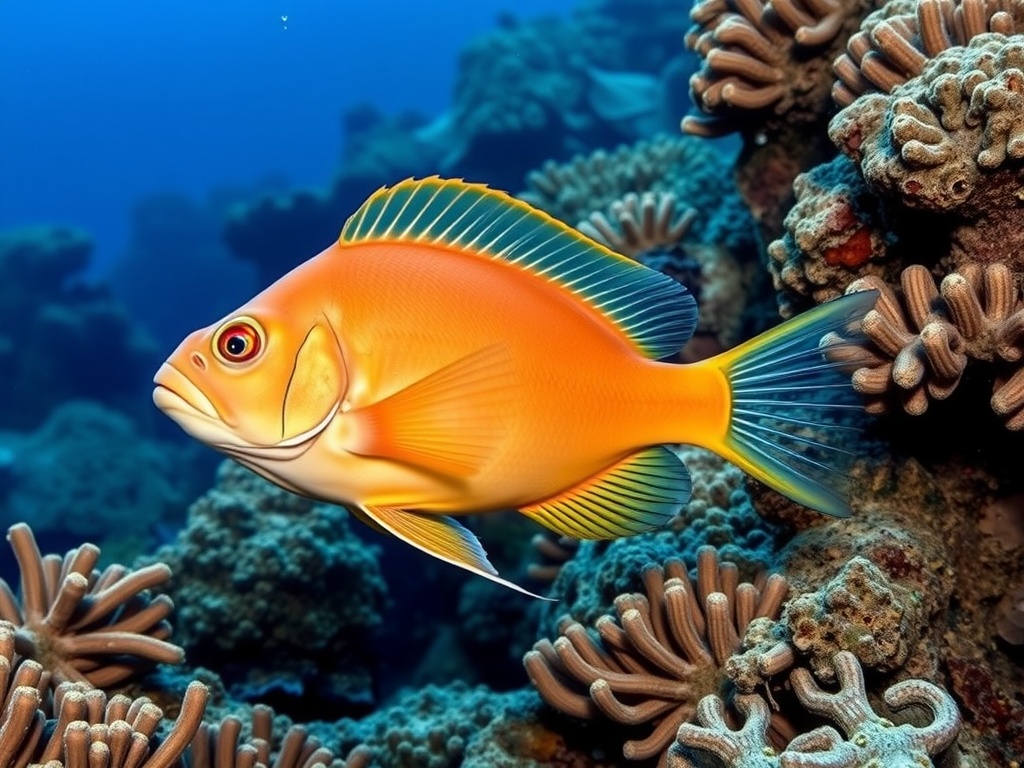
About the Royal gramma
The royal gramma is a small, brilliantly colored reef fish native to the Caribbean Sea. It is easily recognized by its vibrant purple anterior and golden-yellow posterior coloration, making it a popular species in home aquariums. Royal grammas are peaceful and shy, often taking refuge in caves and crevices among coral reefs. They play a role in maintaining reef health by feeding on small invertebrates and plankton. Despite their popularity in the aquarium trade, wild populations remain stable due to their wide distribution and adaptability.
Fascinating facts
Vivid Colors
The royal gramma's body is split into two distinct colors: a bright violet front half and a yellow back half, making it one of the most colorful reef fish.
Homebody Fish
They are highly territorial and rarely venture far from their chosen hiding spot within rocky crevices or coral outcrops.
Popular Aquarium Species
Due to their manageable size and peaceful temperament, royal grammas are a favorite among saltwater aquarium enthusiasts.
Detailed description
The royal gramma (Gramma loreto) is a small, vibrantly colored reef fish, typically reaching an adult length of 6–8 cm (2.4–3.1 in). Its body is laterally compressed, with a blunt snout and a continuous dorsal fin. The anterior half of the body is a striking violet to magenta, transitioning sharply at mid-body to a rich golden yellow toward the tail. The eyes are large and adapted for low-light environments, aiding in its crepuscular activity. Royal grammas possess a small mouth with fine teeth, suited for picking tiny prey from crevices. They are primarily benthic, spending most of their time near the substrate, often upside-down beneath ledges or within caves. Their coloration serves both as camouflage among the colorful reef and as a warning to potential predators. This species exhibits sexual monomorphism, making males and females difficult to distinguish externally. In the wild, individuals are often observed alone or in loose aggregations, each maintaining a small territory centered around a preferred shelter.
Did you know?
The royal gramma can rapidly change the intensity of its colors depending on mood or environmental conditions.
Research & sources
Wikipedia summary
The royal gramma, also known as the fairy basslet, is a species of fish in the family Grammatidae native to reef environments of the tropical western Atlantic Ocean. They are commonly kept in aquariums.
Behaviour & social structure
Royal grammas are generally solitary and territorial, especially males, who defend a small area containing several hiding spots. They are diurnal but most active during dawn and dusk, emerging from shelters to forage. Their feeding behavior is opportunistic; they pick at zooplankton, copepods, small crustaceans, and occasionally clean ectoparasites from other fish. When threatened, they retreat rapidly into crevices, often orienting themselves upside-down or sideways to fit into narrow spaces. Social interactions are mostly limited to courtship or territorial disputes, which involve lateral displays, fin spreading, and occasional chasing. In aquariums, they may display aggression toward conspecifics or similar-looking species if space is limited.
Reproduction & life cycle
Royal grammas are oviparous and exhibit distinct courtship behaviors. Spawning typically occurs during the warmer months, coinciding with increased food availability. Males construct nests from algae and detritus within sheltered crevices. Courtship involves the male displaying vivid colors and performing a series of rapid, darting movements to attract a female. After spawning, females lay adhesive eggs in the nest, which the male fertilizes externally. The male guards and fans the eggs, providing oxygenation and protection from predators and fungus until hatching, which occurs after 5–7 days. Larvae are planktonic, drifting with currents before settling onto the reef as juveniles.
Adaptations & survival
Gramma loreto is highly adapted to the complex reef environment. Its laterally compressed body allows it to navigate narrow crevices for shelter and foraging. The vivid coloration provides both camouflage among corals and a visual deterrent to predators. Its ability to orient upside-down or sideways enables it to exploit underhangs and caves inaccessible to many predators. The species' mouth morphology is specialized for picking small prey from tight spaces. Behavioral adaptations include rapid retreat responses and the use of visual displays to resolve territorial disputes without physical combat.
Cultural significance
The royal gramma is highly valued in the marine aquarium trade for its striking appearance and peaceful temperament. It is often featured in educational exhibits to highlight Caribbean reef biodiversity. While it does not hold significant roles in traditional folklore or mythology, its popularity has made it a symbol of vibrant reef life among aquarists and conservationists. The species is sometimes used as a model organism in studies of reef fish behavior and coloration.
Recent research
Recent research has focused on the royal gramma’s social structure, color vision, and ecological role as a cleaner fish. Studies have examined its ability to recognize conspecifics and rivals using visual cues, as well as its contribution to controlling parasite loads on other reef fish. Genetic analyses have clarified its phylogenetic relationships within Grammatidae and revealed low genetic differentiation across its range, suggesting high larval dispersal. Ongoing research investigates its resilience to environmental stressors, such as temperature fluctuations and ocean acidification, to inform conservation strategies.
Videos
Habitat
Coral reefs

Conservation
The Royal gramma is currently classified as Least Concern on the IUCN Red List.
Threats & challenges
Currently, the royal gramma faces few significant threats in the wild. Its wide distribution across the Caribbean and western Atlantic, coupled with its adaptability to various reef habitats, contributes to its stable population. However, localized threats include habitat degradation from coral reef loss, pollution, and overcollection for the aquarium trade. Sustainable collection practices and captive breeding have mitigated much of the pressure from the aquarium industry. Climate change and ocean acidification pose potential long-term threats by impacting coral reef health and prey availability.
Taxonomy
Scientific name
Gramma loreto
- Kingdom
- Animalia
- Phylum
- Chordata
- Class
- Actinopterygii
- Order
- Perciformes
- Family
- Grammatidae
- Genus
- Gramma
- Species
- loreto
Where to see a royal gramma
1 zoo and aquarium in 1 country are recorded as keeping this species.
Community notes
Share your observations about the Royal gramma.
No community notes yet. Be the first!
Discover more wildlife
More fascinating animals from the encyclopedia.