
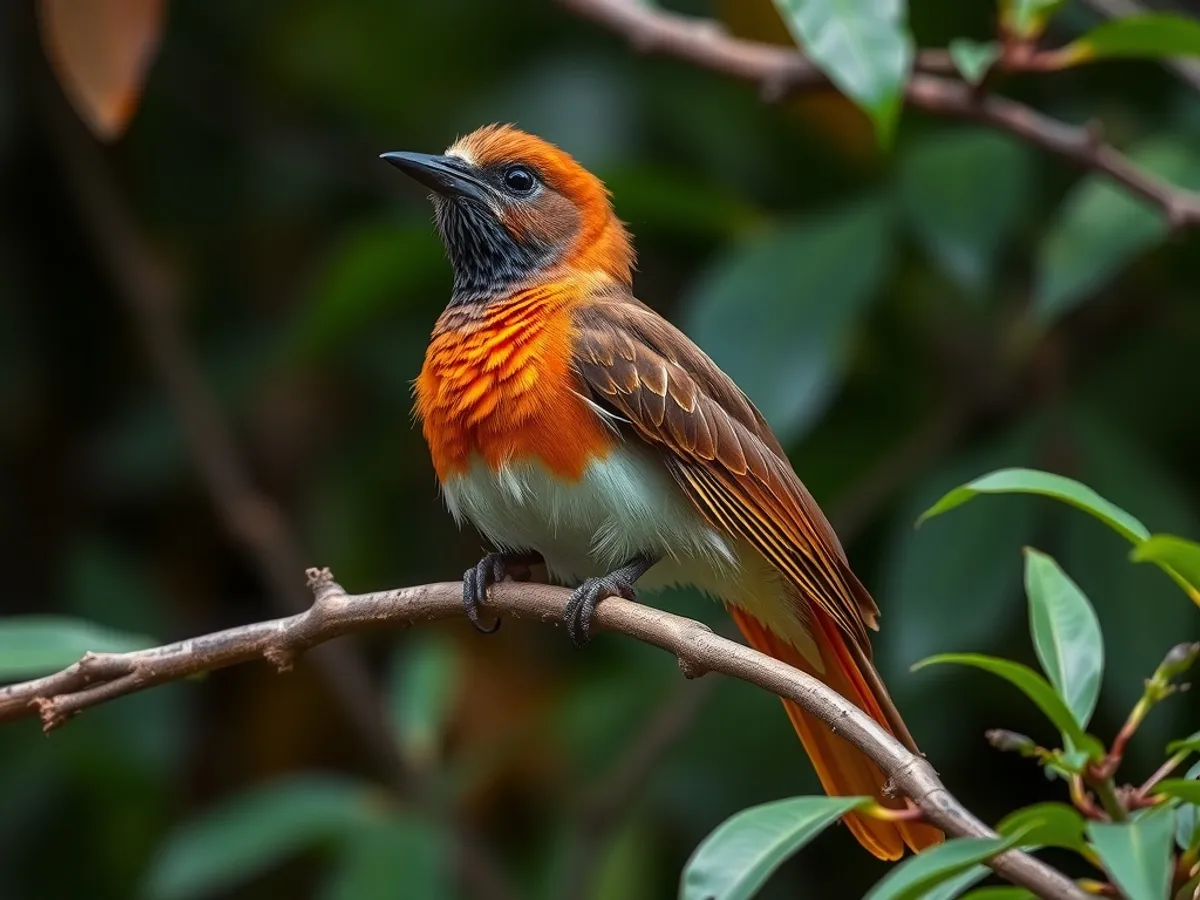
About the Rufous-tailed Jacamar
The Rufous-tailed Jacamar is a slender, vibrantly colored bird native to Central and South America, easily recognized by its iridescent green plumage and striking rufous (reddish-brown) tail. It sports a long, straight bill, perfect for catching flying insects mid-air, and is often seen perched quietly in forest clearings or edges. This bird is known for its swift, darting flights and its sharp, metallic calls. The Rufous-tailed Jacamar is generally solitary or found in pairs, exhibiting strong territorial behavior.
Fascinating facts
Aerial Hunter
The Rufous-tailed Jacamar specializes in catching flying insects, like butterflies and dragonflies, in mid-air using its pointed bill.
Burrow Nester
It nests in burrows dug into earth banks, termite mounds, or tree holes, rather than in trees like most birds.
Iridescent Plumage
The bird's feathers shimmer in different shades of green, gold, and bronze, giving it a jewel-like appearance.
Detailed description
The Rufous-tailed Jacamar (Galbula ruficauda) is a slender, medium-sized bird, typically measuring 25–27 cm (9.8–10.6 in) in length, with a weight of 17–27 g. It is distinguished by its iridescent metallic green upperparts, white throat (in males; females have a buff-colored throat), and a long, rufous-orange tail and underparts. Its bill is long, straight, and sharply pointed, perfectly adapted for aerial insect capture. The eyes are large and dark, providing keen vision for spotting prey in dappled forest light. Rufous-tailed Jacamars are most often seen perched upright on exposed branches at forest edges, clearings, or along rivers, from which they sally forth to catch flying insects. Their flight is rapid and direct, with short, whirring bursts of wingbeats. This species is generally solitary or found in territorial pairs, rarely forming larger groups. The plumage provides effective camouflage among sunlit foliage, and the bird’s still, upright posture aids in remaining inconspicuous. Vocalizations include sharp, metallic 'peep' or 'tsip' notes and trilling calls, especially during territorial disputes or courtship. The species exhibits little sexual dimorphism apart from throat coloration, and juveniles resemble adults but are duller overall.
Did you know?
Despite their vibrant colors, Rufous-tailed Jacamars can be remarkably difficult to spot as they remain motionless for long periods, blending into the surrounding foliage.
Research & sources
Wikipedia summary
The rufous-tailed jacamar is a near passerine bird which breeds in the tropical New World in southern Mexico, Central America and South America as far south as southern Brazil and Ecuador.
Behaviour & social structure
Rufous-tailed Jacamars are sit-and-wait predators, spending much of their day perched motionless before launching swift sallies to capture flying insects, primarily butterflies, bees, wasps, dragonflies, and other flying arthropods. They often return to the same perch after each foray. Prey with stingers, such as bees and wasps, are deftly handled: the jacamar repeatedly beats the insect against a branch to remove the stinger and wings before swallowing it whole. Socially, they are monogamous and territorial, with pairs defending feeding and nesting territories through vocalizations and aerial chases. Daily activity peaks in the early morning and late afternoon, with periods of inactivity during the hottest midday hours. Rufous-tailed Jacamars are known for their alertness and quick reactions, rarely spending long periods in open view. They sometimes join mixed-species foraging flocks but generally remain on the periphery.
Reproduction & life cycle
Breeding occurs during the local dry season, which varies geographically but often spans from March to August. Pairs excavate nesting burrows in earthen banks, road cuts, or occasionally arboreal termite nests, with tunnels ranging from 30–50 cm (12–20 in) in length. The female lays 2–4 glossy white eggs directly on the bare chamber floor. Both parents share incubation duties, which last 19–23 days. After hatching, both adults feed the chicks, bringing them a steady supply of insects. Fledging occurs after about 21–26 days, but young may remain near the nest for several weeks, gradually becoming independent. Nest predation by snakes, mammals, or ants is a significant cause of reproductive failure. Rufous-tailed Jacamars are capable of raising one or occasionally two broods per season.
Adaptations & survival
The Rufous-tailed Jacamar exhibits several key adaptations: its elongated, needle-like bill is specialized for snatching insects in flight, while its large eyes provide excellent visual acuity for tracking fast-moving prey. The iridescent green plumage offers camouflage among sun-dappled leaves, and the rufous tail may serve as a visual signal in territorial or courtship displays. Behavioral adaptations include the ability to remain motionless for extended periods, reducing detection by both prey and predators. Their nesting strategy—burrowing into banks or termite nests—offers protection from many ground-based predators and environmental extremes. Physiologically, jacamars have a rapid digestive system suited to a high-protein, insectivorous diet.
Cultural significance
While not a major figure in indigenous mythology, the Rufous-tailed Jacamar is admired in local cultures for its beauty and insect-catching prowess. In some regions, it is called the 'kingfisher of the forest,' though it is not closely related to true kingfishers. The bird is a favorite among birdwatchers and ecotourists, contributing to local economies. Its presence is sometimes seen as an indicator of healthy, insect-rich habitats. There are no known traditional uses or significant symbolic roles in folklore, but its striking appearance has inspired local art and handicrafts.
Recent research
Recent research has focused on the jacamar’s role in controlling insect populations, particularly pest species. Studies using stable isotope analysis have clarified its trophic position and dietary breadth. Ongoing behavioral studies examine its foraging efficiency and responses to habitat alteration. Genetic analyses have explored population structure across its range, revealing some regional differentiation but overall genetic connectivity. Acoustic research has documented variation in calls across subspecies, potentially aiding in cryptic species identification. The species is also used as a model in studies of iridescent plumage evolution and visual ecology.
Sources
Videos
Habitat
Tropical and subtropical forests and woodland edges


Conservation
The Rufous-tailed Jacamar is currently classified as Least Concern on the IUCN Red List.
Threats & challenges
Currently classified as Least Concern by the IUCN, the Rufous-tailed Jacamar maintains a wide distribution and stable population. However, local declines have been noted in areas of extensive deforestation, especially where forest edges and riverbanks are destroyed. Habitat fragmentation can isolate populations and reduce breeding success. Pesticide use may reduce insect prey availability and pose toxicological risks. Nest predation and competition for nesting sites with other burrowing birds or mammals are ongoing natural challenges. Despite these threats, the species shows some resilience by adapting to secondary growth, plantations, and disturbed habitats, provided suitable nesting banks remain.
Taxonomy
Scientific name
Galbula ruficauda
- Kingdom
- Animalia
- Phylum
- Chordata
- Class
- Aves
- Order
- Galbuliformes
- Family
- Galbulidae
- Genus
- Galbula
- Species
- ruficauda
Community notes
Share your observations about the Rufous-tailed Jacamar.
No community notes yet. Be the first!
Discover more wildlife
More fascinating animals from the encyclopedia.