
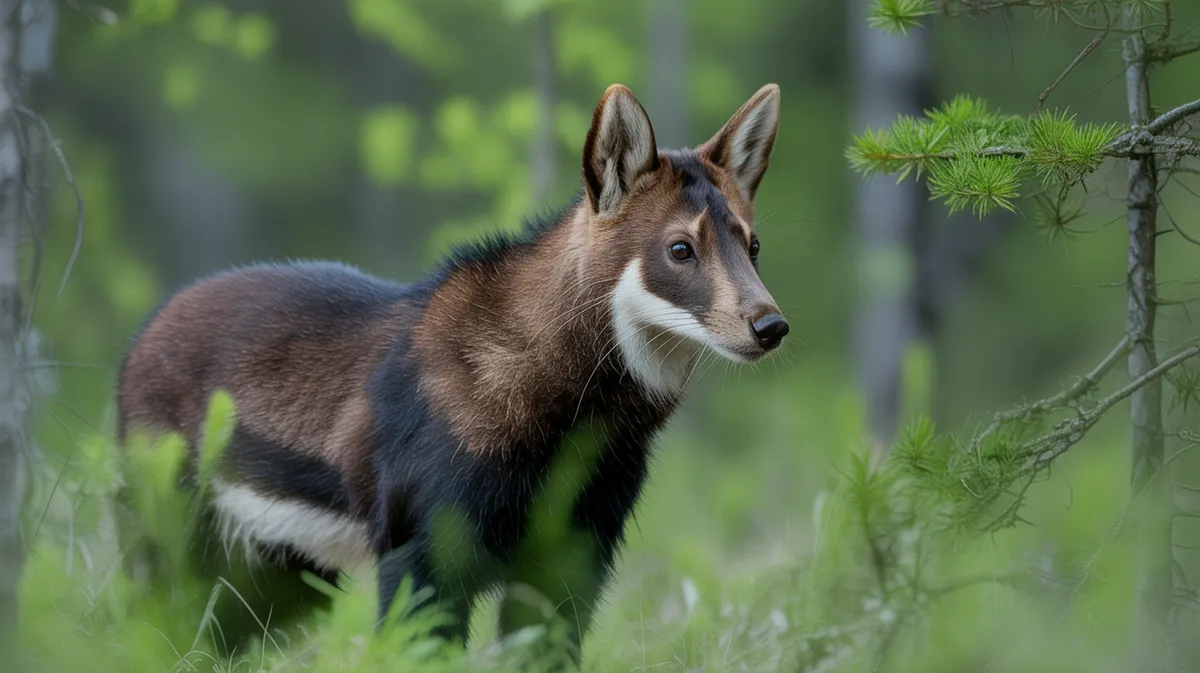
About the Sable
The sable is a small, agile mammal known for its luxurious, silky fur, which has made it highly valued in the fur trade for centuries. Native to the dense forests of northern Eurasia, particularly Russia and parts of Mongolia and China, the sable is a solitary and elusive creature. It is well-adapted to cold climates, using its keen senses to hunt a wide variety of prey including small mammals, birds, and insects. Sables are skilled climbers and swimmers, making them versatile predators within their forest habitat.
Fascinating facts
Fur Trade Legacy
Sable fur was once so prized that it was reserved for Russian royalty and aristocracy, playing a major role in the country's economy.
Forest Dweller
Sables thrive in dense, old-growth forests where they make nests in tree hollows, fallen logs, or thick undergrowth.
Active Hunter
They are opportunistic feeders and will eat anything from rodents and birds to berries and mushrooms, especially in the winter when prey is scarce.
Detailed description
The sable (Martes zibellina) is a medium-sized member of the mustelid family, typically measuring 38–56 cm in body length, with a bushy tail adding an additional 13–18 cm. Adult males weigh between 880–1800 g, while females are generally smaller, weighing 700–1000 g. Sables possess a slender, elongated body, short legs, and a pointed muzzle, with large, rounded ears and sharp, semi-retractable claws. Their dense, silky fur—ranging in color from pale yellowish-brown to almost black—provides exceptional insulation against the harsh Siberian winters. Sables are primarily solitary and territorial, marking their ranges with scent glands. They are crepuscular, most active during dawn and dusk, and are adept climbers and swimmers, enabling them to exploit a variety of ecological niches. Their omnivorous diet includes small mammals (such as voles and hares), birds, eggs, insects, berries, and occasionally carrion. Sables construct dens in tree roots, fallen logs, or abandoned burrows, often lining them with moss and leaves for insulation. Their keen sense of smell and acute hearing aid in both hunting and avoiding predators, while their agility allows them to escape threats by rapidly ascending trees or diving into dense undergrowth.
Did you know?
Despite their reputation for luxurious fur, sables are rarely seen in the wild due to their secretive and nocturnal lifestyle.
Research & sources
Wikipedia summary
The sable is a species of marten, a small omnivorous mammal primarily inhabiting the forest environments of Russia, from the Ural Mountains throughout Siberia, and northern Mongolia. Its habitat also borders eastern Kazakhstan, China, North Korea and Hokkaido, Japan.
Behaviour & social structure
Sables are predominantly solitary, with individuals maintaining territories ranging from 3 to 30 km², depending on habitat quality and prey availability. They use scent marking and vocalizations to communicate and delineate territory boundaries, with males having larger and more overlapping ranges than females. Sables are opportunistic feeders, employing a combination of stalking, ambush, and active foraging to catch prey. In winter, they may tunnel through snow to access subnivean rodents. They cache surplus food in tree hollows or burrows, especially during periods of abundance. Daily activity peaks at dawn and dusk, but sables may adjust their routines in response to prey movements or human disturbance. Social interactions are generally limited to the breeding season or between mothers and offspring. Aggressive encounters can occur at territory boundaries, but these are usually resolved through displays and vocalizations rather than physical combat.
Reproduction & life cycle
Sable breeding season occurs from June to August. They exhibit delayed implantation: after mating, the fertilized egg remains dormant for several months, with active gestation commencing in late winter. The total gestation period, including delayed implantation, ranges from 245 to 298 days, but active embryonic development lasts about 30–40 days. Females give birth in March or April to litters of 1–7 kits (average 2–3). Kits are born blind, deaf, and nearly hairless, weighing 25–35 g. Eyes open at 30–36 days, and weaning occurs at 7–8 weeks. The mother provides all parental care, fiercely defending the den and young. Kits begin to hunt independently at 2–3 months but may remain with the mother until autumn. Sexual maturity is reached at 2–3 years of age.
Adaptations & survival
Sables are highly adapted to cold, forested environments. Their luxurious fur consists of dense underfur and longer guard hairs, providing superior insulation against subzero temperatures. The fur's color variation offers camouflage across different forest substrates. Their elongated, flexible bodies and short limbs facilitate movement through dense undergrowth, snow, and narrow burrows. Sables possess sharp, curved claws for climbing trees and digging. They have a keen sense of smell for detecting prey under snow or leaf litter and acute hearing for locating small mammals. Behavioral adaptations include food caching and the use of insulated dens to survive periods of food scarcity and extreme cold. Their omnivorous diet and opportunistic feeding strategies allow them to exploit a wide range of food resources.
Cultural significance
The sable has played a significant role in Russian and Eurasian culture for centuries. Its fur, prized for its softness, warmth, and durability, was historically reserved for nobility and royalty, symbolizing wealth and status. Sable pelts were a major commodity in the fur trade, influencing the exploration and colonization of Siberia. The animal appears in Russian folklore as a symbol of agility and cunning. In heraldry, 'sable' refers to the color black, derived from the animal's name. Traditional uses include clothing, hats, and ceremonial garments. Sable farming remains an important economic activity in Russia and China.
Recent research
Recent genetic studies have clarified the sable's phylogenetic relationships within the genus Martes, revealing significant genetic diversity across its range and evidence of hybridization with other martens in overlapping habitats. Research on population dynamics has highlighted the impact of forest management and climate change on sable distribution and reproductive success. Studies using radio telemetry and camera traps have improved understanding of sable spatial ecology, home range size, and habitat preferences. Conservation research focuses on the effects of logging, fragmentation, and poaching, as well as the effectiveness of protected areas and sustainable trapping practices. Ongoing work is examining the sable's role as an indicator species for boreal forest ecosystem health.
Videos
Habitat
Boreal and mixed forests, taiga
Conservation
The Sable is currently classified as Least Concern on the IUCN Red List.
Threats & challenges
Historically, the sable population suffered severe declines due to overhunting for its valuable fur, particularly from the 16th to early 20th centuries. Today, regulated trapping and fur farming have stabilized wild populations in many regions. Current threats include habitat loss from logging, forest fires, and infrastructure development, particularly in southern parts of their range. Climate change poses emerging risks by altering forest composition and snow cover. Illegal poaching persists in some areas, driven by continued demand for high-quality sable pelts. Despite these pressures, the sable is classified as 'Least Concern' by the IUCN, with stable or recovering populations in most of its range, though local declines may occur where threats are unmanaged.
Taxonomy
Scientific name
Martes zibellina
- Kingdom
- Animalia
- Phylum
- Chordata
- Class
- Mammalia
- Order
- Carnivora
- Family
- Mustelidae
- Genus
- Martes
- Species
- zibellina
Community notes
Share your observations about the Sable.
No community notes yet. Be the first!
Discover more wildlife
More fascinating animals from the encyclopedia.