
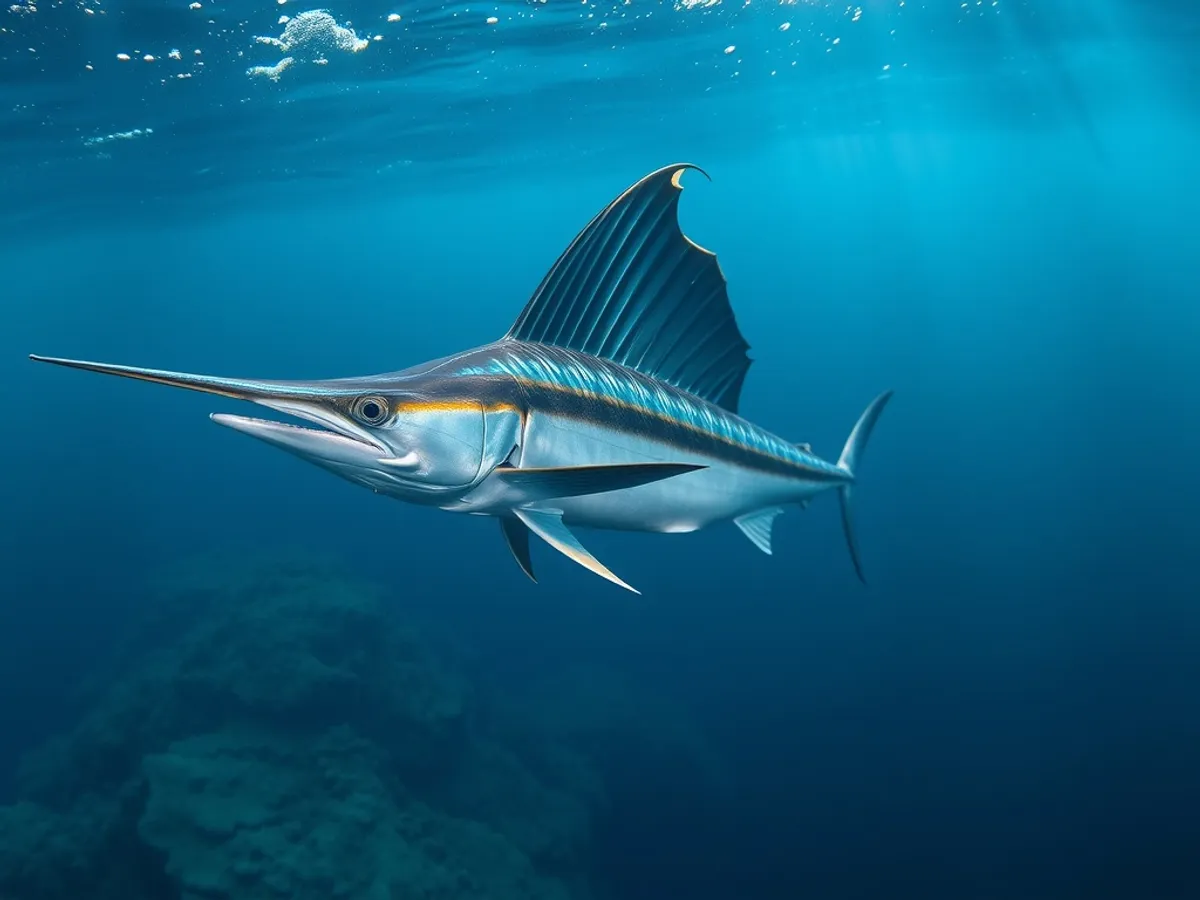
About the Sailfish
Istiophorus platypterus is routinely called the fastest fish in the sea at 110 km/h, and that figure is almost certainly wrong. It comes from a 1940s experiment in which a hooked sailfish stripped line off a reel, a method that measures the fish's panic and the drag of the gear, not sustained swimming. Modern accelerometer and high-speed video work puts realistic bursts closer to 35 to 55 km/h, and biomechanical modelling suggests that above roughly 10 to 15 m/s a fish's fins would cavitate and be destroyed. What the sailfish genuinely does have is the huge dorsal fin, the sail, which is not a speed aid — it is folded flat into a groove when the fish swims fast. It is raised during hunting, and high-speed footage of sailfish attacking sardine baitballs off Mexico shows the sail erected as the fish herds the shoal, apparently making the predator look larger and helping corral prey. The bill is then swept sideways through the ball at high angular velocity, and the rough, tooth-like denticles on it injure and stun individual sardines, which are then picked off. Sailfish hunting is coordinated, with several fish taking turns at the baitball, and a fish that has just attacked drops to the back of the queue. They also change colour rapidly, flashing bars and stripes, apparently to signal to each other during a group attack.
Fascinating facts
Ocean’s Fastest
Sailfish are the fastest fish in the ocean, reaching speeds up to 68 mph (110 km/h) during quick bursts.
Sport Fishing Icon
Their strength and acrobatics make sailfish a popular and prized catch among sport fishers worldwide.
Spectacular Sail
The tall dorsal fin or 'sail' can be raised to appear larger and to herd prey or intimidate rivals.
Detailed description
The sailfish (Istiophorus platypterus) is a large, predatory billfish distinguished by its elongated, spear-like upper jaw (rostrum) and its prominent, sail-like dorsal fin, which can be taller than the depth of its body and extends nearly the full length of its back. Adults typically measure between 1.5 and 3.4 meters (5–11 feet) in length and can weigh up to 100 kilograms (220 pounds), though most individuals are smaller. Their bodies are streamlined and laterally compressed, covered in small, cycloid scales, with coloration ranging from deep cobalt blue on the dorsal side to silvery white on the ventral side, often with vertical blue bars or spots. This coloration provides effective camouflage in the open ocean, aiding both predation and predator avoidance. The sailfish's large dorsal fin can be raised or lowered and is thought to play a role in both thermoregulation and herding prey. Their pectoral fins are long and slender, contributing to their agility and maneuverability. Sailfish are among the fastest marine animals, with burst speeds recorded at up to 68 miles per hour (110 km/h), a feat attributed to their muscular build, retractable fins, and specialized skin structure that reduces drag. They possess large eyes adapted for acute vision in the pelagic zone, aiding in the detection of prey. Sailfish are apex predators, feeding primarily on schooling fish and cephalopods, and are known for their spectacular leaps and acrobatic displays when hunting or evading capture. Socially, they may form loose aggregations, particularly when hunting cooperatively. Reproduction is oviparous, with females capable of releasing several million eggs per spawning event. Their unique combination of speed, agility, and specialized anatomy makes them one of the most efficient and iconic predators of the open ocean.
Did you know?
Despite their incredible speed, sailfish usually rely on stealth and teamwork rather than pure speed to capture prey.
Research & sources
Wikipedia summary
The sailfish is one or two species of marine fish in the genus Istiophorus, which belong to the family Istiophoridae (marlins). They are predominantly blue to gray in colour and have a characteristically large dorsal fin known as the sail, which often stretches the entire length of the back. Another notable characteristic is the elongated rostrum (bill) consistent with that of other marlins and the swordfish, which together constitute what are known as billfish in sport fishing circles. Sailfish live in colder pelagic waters of all Earth's oceans, and hold the record for the highest speed of any marine animal.
Behaviour & social structure
Sailfish exhibit both solitary and group behaviors, often forming small, transient groups when hunting. They are diurnal, with peak activity during daylight hours, especially at dawn and dusk when prey fish are most abundant near the surface. Their hunting strategy involves using their large dorsal fin to corral and herd schools of smaller fish, such as sardines, anchovies, or mackerel, into tight bait balls. Once the prey is concentrated, sailfish use their bills to slash through the school, stunning or injuring multiple fish in rapid succession before circling back to consume them. This cooperative hunting can involve several sailfish, each taking turns attacking the prey school. Sailfish are known for their high-speed pursuits and acrobatic leaps, which may serve to disorient prey or evade predators such as large sharks. When not actively hunting, sailfish may cruise at moderate speeds or rest near the surface with their dorsal fins exposed. They are highly migratory, often traveling long distances in response to ocean currents, water temperature, and prey availability.
Reproduction & life cycle
Sailfish are oviparous, with external fertilization. Spawning typically occurs in warm, offshore waters during the warmer months, with regional variation: in the Atlantic, peak spawning is observed from April to September, while in the Indo-Pacific, it may occur year-round with local peaks. Females are highly fecund, capable of releasing between 1 and 4.8 million eggs per spawning event. Eggs are pelagic, spherical, and buoyant, hatching within 36–48 hours depending on water temperature. Larvae are planktonic and undergo rapid growth, developing the characteristic bill and fin structures within weeks. There is no parental care; survival of offspring depends on rapid dispersal and high fecundity to offset high predation rates on eggs and larvae. Sexual maturity is reached at around 2–3 years of age, with males maturing slightly earlier and at smaller sizes than females.
Adaptations & survival
Sailfish possess a suite of adaptations for high-speed predation and pelagic life. Their streamlined, torpedo-shaped bodies minimize drag, while their retractable dorsal and pectoral fins further reduce resistance during rapid swimming. The bill is a specialized adaptation for hunting, used to slash and stun prey rather than impale. Their skin is covered with microscopic, tooth-like structures (dermal denticles) that reduce turbulence and increase swimming efficiency. Large, well-developed eyes provide acute vision in the variable light conditions of the open ocean. The ability to rapidly change skin coloration, including the display of iridescent stripes, is thought to facilitate communication and coordination during group hunting. Physiologically, sailfish have a high metabolic rate and efficient gill structures to support sustained activity and bursts of speed. Their endothermic capabilities, though limited compared to tunas, allow them to maintain muscle performance in cooler waters.
Cultural significance
Sailfish hold considerable cultural and economic importance, especially in regions with strong sport fishing traditions such as Florida, Mexico, and Southeast Asia. They are celebrated for their speed, strength, and acrobatic displays, making them a prized catch in big-game fishing tournaments. In some cultures, the sailfish is a symbol of agility, power, and freedom. Artistic depictions of sailfish appear in coastal art and folklore, and the fish is featured in the emblems and logos of various fishing clubs and organizations. Historically, indigenous peoples in the Indo-Pacific have utilized sailfish as a food resource, though today most catches are released or sold in commercial markets.
Recent research
Recent research has focused on the biomechanics of sailfish speed, revealing that their skin and fin morphology significantly reduce drag and turbulence. Studies using high-speed videography and tagging have elucidated their cooperative hunting strategies and social interactions. Genetic analyses have clarified the taxonomic relationship between Atlantic and Indo-Pacific populations, supporting the view that Istiophorus platypterus is a single, cosmopolitan species with regional genetic structuring. Ongoing research is investigating the impacts of climate change on migratory patterns and spawning success, as well as the effectiveness of international management measures. Satellite tagging and electronic monitoring are providing new insights into their long-distance movements and habitat preferences.
Videos
Habitat
Open ocean (pelagic zone)

Conservation
The Sailfish is currently classified as Least Concern on the IUCN Red List.
Threats & challenges
The primary threats to sailfish populations include overfishing, both as targeted species in commercial and recreational fisheries and as bycatch in longline and gillnet operations. Their popularity in sport fishing has led to significant harvests, though catch-and-release practices are increasingly promoted. Habitat degradation, particularly in spawning areas, and changes in oceanographic conditions due to climate change may also impact populations. While currently listed as Vulnerable (VU) by the IUCN, regional assessments indicate declining trends in some areas, particularly in the Atlantic. Bycatch mortality, especially of juveniles, remains a significant conservation challenge. International management is complicated by the species' wide-ranging, migratory nature, necessitating coordinated efforts across multiple jurisdictions.
Taxonomy
Scientific name
Istiophorus platypterus
- Kingdom
- Animalia
- Phylum
- Chordata
- Class
- Actinopterygii
- Order
- Istiophoriformes
- Family
- Istiophoridae
- Genus
- Istiophorus
- Species
- platypterus
Community notes
Share your observations about the Sailfish.
No community notes yet. Be the first!
Discover more wildlife
More fascinating animals from the encyclopedia.