
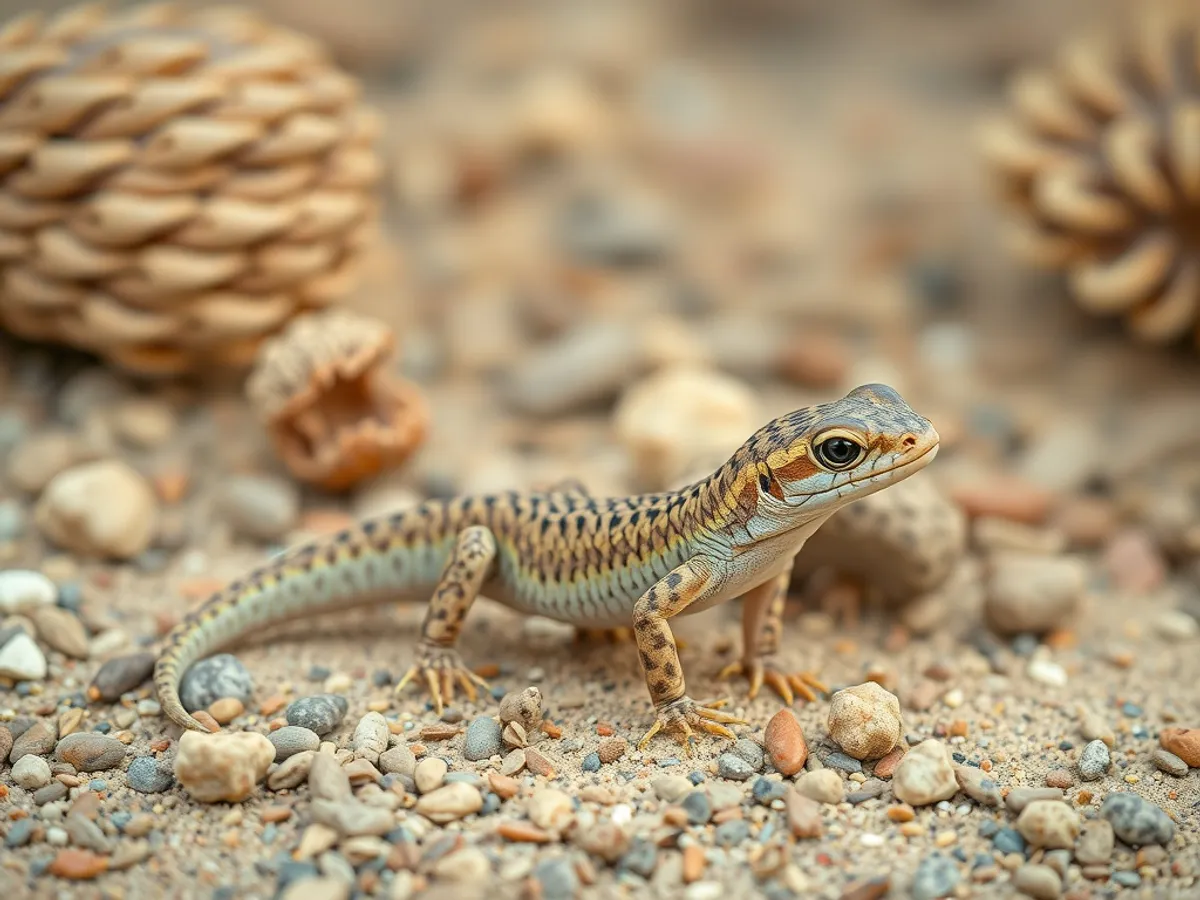
About the Sandfish Skink
The Sandfish Skink is a small, burrowing lizard native to the sandy deserts of North Africa and parts of the Middle East. Famous for its unique ability to 'swim' through loose sand, this reptile has a streamlined body and smooth, shiny scales that reduce friction. Its limbs are short and robust, aiding in rapid digging and movement beneath the surface. The sandfish skink spends most of its life hidden from predators and the harsh desert sun, emerging mainly to hunt for insects. Adapted to its arid habitat, it is an excellent example of desert specialization among reptiles.
Fascinating facts
Desert Specialist
The sandfish skink is expertly adapted to desert life, spending most of its time buried beneath the sand to escape extreme heat and predators.
Unique Locomotion
It uses a swimming motion to move through loose sand, reducing drag and preventing overheating on the surface.
Insect Hunter
Its diet mainly consists of insects, especially beetles and larvae, which it hunts beneath the sand.
Detailed description
The Sandfish Skink (Scincus scincus) is a small, robust lizard typically measuring 15–20 cm in total length, with a body mass ranging from 15 to 25 grams. Its body is distinctly streamlined, with a wedge-shaped snout and smooth, overlapping scales that minimize resistance as it moves through sand. The dorsal coloration is usually golden-yellow to light brown, often with subtle darker bands or spots, providing effective camouflage against desert substrates. The limbs are short but powerful, each ending in five strong, shovel-like toes adapted for digging. The tail is relatively short and tapers to a point, aiding in propulsion beneath the sand. Sandfish skinks possess eyelids and external ear openings that are protected by specialized scales, preventing sand ingress. Their ventral surface is lighter, often whitish or cream, which helps reflect heat from the hot desert ground. Internally, they have a highly efficient renal system for water conservation, and their lungs are adapted for low-oxygen environments encountered while 'swimming' under the sand. The species is primarily diurnal but avoids the hottest parts of the day by remaining buried, emerging at dawn and dusk to forage. Sandfish skinks are solitary and exhibit territorial behavior, especially during the breeding season.
Did you know?
Despite its name, the sandfish skink is not related to fish at all—its name comes from its remarkable swimming-like movement through sand.
Research & sources
Behaviour & social structure
Sandfish skinks are primarily fossorial, spending up to 80% of their time beneath the sand to avoid predators and extreme temperatures. They are most active during crepuscular hours (early morning and late afternoon), when surface temperatures are moderate. Their locomotion beneath the sand is unique: they use undulatory movements, similar to those of fish, to 'swim' through loose substrates at speeds up to 15 cm per second. Their diet consists mainly of small arthropods, especially beetle larvae, ants, and termites, which they detect using acute olfactory and vibrational senses. Hunting is typically ambush-based; the skink waits just below the surface and lunges at passing prey. Social interactions are minimal outside of the breeding season, with individuals maintaining exclusive home ranges. When threatened, sandfish skinks rapidly dive into the sand, a behavior that also serves as a primary escape mechanism from predators such as birds and snakes.
Reproduction & life cycle
Scincus scincus is oviparous, with breeding typically occurring in late spring to early summer, coinciding with increased insect abundance. Courtship involves males displaying head-bobbing and tail-waving behaviors to attract females. Females lay 2–4 leathery eggs per clutch, usually in a shallow burrow excavated in moist sand to prevent desiccation. Incubation lasts approximately 40–60 days, depending on ambient temperature. Hatchlings are precocial, emerging fully independent and measuring about 6–7 cm in length. There is no parental care post-oviposition. Sexual maturity is reached at around 1–2 years of age, with lifespan in the wild estimated at 6–8 years, though individuals in captivity may live longer.
Adaptations & survival
The sandfish skink exhibits several remarkable adaptations for desert life. Its smooth, shiny scales and wedge-shaped head reduce friction, enabling efficient sand-swimming. The limbs are robust with elongated, spade-like toes for rapid digging. Specialized eyelids and ear openings prevent sand intrusion. Physiologically, the skink has a highly efficient kidney system that minimizes water loss, and it can absorb moisture from its prey. Its coloration provides camouflage and reflects solar radiation. Behavioral adaptations include burrowing to escape heat and predators, and crepuscular activity patterns to avoid temperature extremes. Recent biomechanical studies have shown that the sandfish's locomotion is optimized for granular media, inspiring biomimetic robotics research.
Cultural significance
The sandfish skink holds a notable place in Middle Eastern and North African folklore, where its ability to 'swim' through sand has inspired myths about magical desert creatures. In ancient Egypt, it was sometimes depicted in art and associated with the desert's mystical qualities. Traditional medicine in some regions has used sandfish fat or oil as a remedy for skin ailments and joint pain, though there is no scientific basis for these practices. The skink's unique locomotion has also attracted attention from scientists and engineers, influencing the design of robots capable of moving through granular materials.
Recent research
Recent research has focused on the biomechanics of sand-swimming, with high-speed X-ray imaging revealing that Scincus scincus uses a lateral undulatory motion similar to that of aquatic fish. Studies in granular physics have used the sandfish as a model organism to understand movement through complex media. Genetic analyses have clarified its phylogenetic relationships within the Scincidae family, and ongoing ecological studies are examining its role in desert food webs. There is also interest in its physiological adaptations to aridity, particularly its renal function and water economy. The sandfish has become a model species for bioinspired robotics, with several research groups developing sand-swimming robots based on its morphology and movement patterns.
Sources
Biomechanics of sand-swimming in the sandfish lizard Scincus scincus
Maladen, R.D., Ding, Y., Li, C., & Goldman, D.I. (2009)
scientificThe sandfish lizard: A model for biomimetic sand-swimming robots
Sharpe, S.S., Kuckuk, R., & Goldman, D.I. (2015)
scientificBiomechanics of sand-swimming in the sandfish lizard (Scincus scincus)
Maladen, R.D., Ding, Y., Li, C., & Goldman, D.I. (2009)
scientificEcology and biology of the sandfish skink (Scincus scincus) in North Africa
Baha El Din, S. (2006)
scientificScincus scincus: The IUCN Red List of Threatened Species 2021
IUCN SSC Amphibian and Reptile Specialist Group
conservationSandfish Lizard Locomotion: A Biomechanical Analysis
Maladen, R.D., Ding, Y., Li, C., & Goldman, D.I. (2009)
scientificVideos
Habitat
Desert

Conservation
The Sandfish Skink is currently classified as Least Concern on the IUCN Red List.
Threats & challenges
Currently, the sandfish skink faces few major threats and is classified as Least Concern by the IUCN. However, localized pressures include habitat degradation due to urbanization, off-road vehicle activity, and over-collection for the pet trade in some regions. Climate change poses a potential long-term threat by altering desert ecosystems and prey availability. Despite these challenges, the species remains widespread and abundant across its range, with stable population trends reported. Continued monitoring is recommended to detect any emerging threats, particularly in areas experiencing rapid environmental change.
Taxonomy
Scientific name
Scincus scincus
- Kingdom
- Animalia
- Phylum
- Chordata
- Class
- Reptilia
- Order
- Squamata
- Family
- Scincidae
- Genus
- Scincus
- Species
- scincus
Community notes
Share your observations about the Sandfish Skink.
No community notes yet. Be the first!
Discover more wildlife
More fascinating animals from the encyclopedia.