
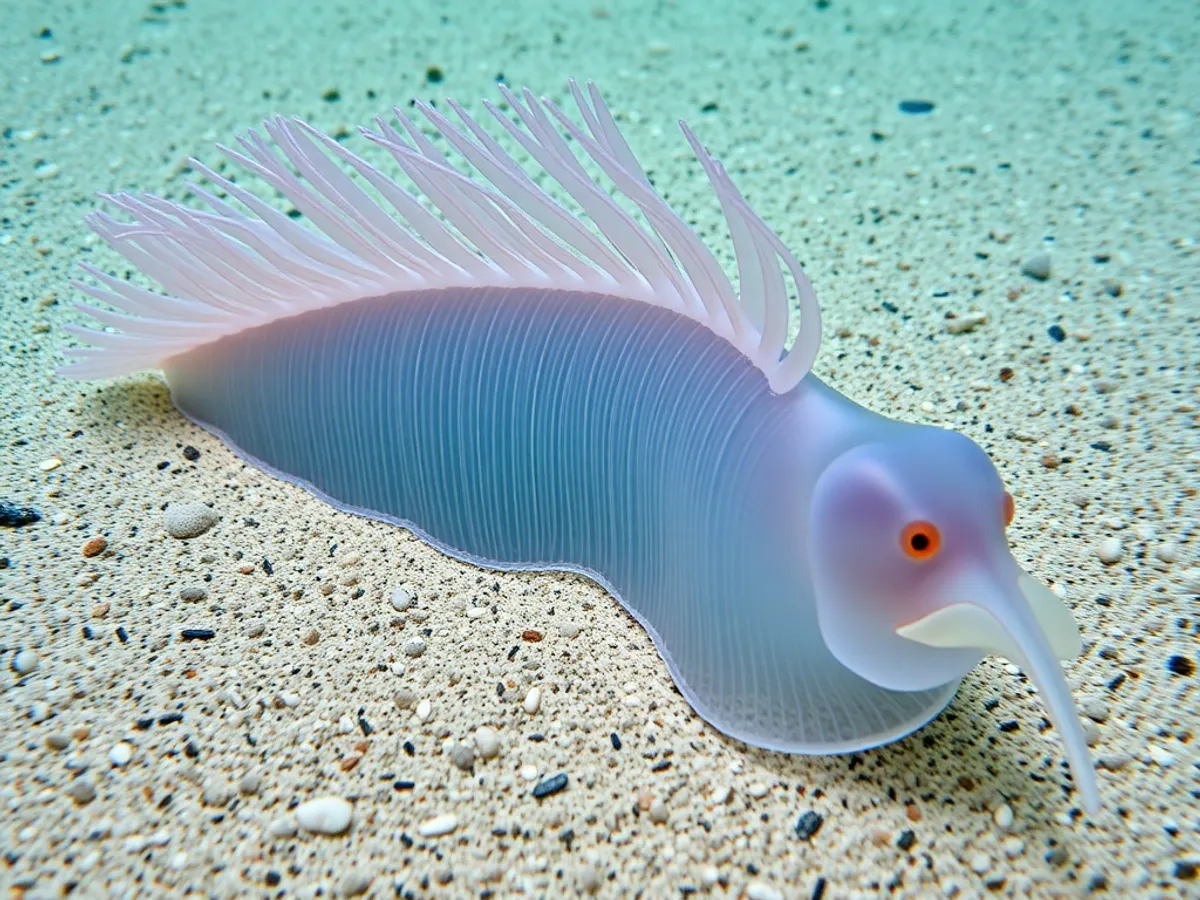
About the Sea Pen
The sea pen is a colonial marine invertebrate belonging to the order Pennatulacea, resembling a quill pen anchored in soft sea bottoms. Composed of hundreds to thousands of polyps, sea pens display a central stalk with feathery branches, each housing feeding or reproductive polyps. They use their root-like peduncle to anchor themselves in sandy or muddy substrates, often found in deeper waters. Sea pens are bioluminescent and can emit light when disturbed, serving as a defense mechanism against predators. Despite their delicate appearance, they are resilient and can retract into the substrate when threatened.
Fascinating facts
Colonial Creatures
Sea pens are not single animals but colonies made up of many polyps, each with specialized functions such as feeding, reproduction, or water movement.
Glowing Defense
When threatened, sea pens can emit a bright green or blue bioluminescent glow to startle predators or attract attention away from themselves.
Anchored for Life
Sea pens anchor themselves deeply in soft sediments using a bulbous peduncle, allowing them to remain upright and stable in ocean currents.
Detailed description
Pennatula phosphorea, commonly known as the phosphorescent sea pen, is a colonial cnidarian distinguished by its feather-like appearance, which inspired its common name. The colony consists of a central, fleshy stalk (rachis) that can reach up to 40 cm in length, anchored into the substrate by a bulbous peduncle. The rachis supports lateral branches known as pinnae, each lined with numerous polyps specialized for feeding (autozooids) or water circulation and reproduction (siphonozooids). The body is translucent to pale pink or orange, often exhibiting striking bioluminescence when disturbed, due to specialized photocytes. Sea pens are sessile but capable of limited movement; they can retract entirely into the sediment to avoid predation or environmental stress. Individual polyps within the colony are interconnected by a common tissue (coenenchyme), enabling coordinated responses to stimuli. The colony is supported by a central axial rod composed of calcium carbonate, providing structural rigidity. Pennatula phosphorea inhabits temperate to cold waters, typically at depths ranging from 10 to over 2000 meters, though most commonly found between 20 and 400 meters. The species is an important component of benthic ecosystems, providing habitat and shelter for various invertebrates and juvenile fish.
Did you know?
Sea pens can retract their entire bodies into the sediment if they sense danger, effectively hiding from predators.
Research & sources
Wikipedia summary
Sea pens are marine cnidarians belonging to the superfamily Pennatuloidea, which are colony-forming benthic filter feeders within the order Scleralcyonacea. There are 14 families within the order and 35 extant genera, and it is estimated as of 2011 that, of 450 described species, around 200 are valid.
Behaviour & social structure
Sea pens are primarily nocturnal, extending their polyps at night to feed on plankton and organic detritus suspended in the water column. During the day or when threatened, they retract into the substrate, minimizing exposure to predators such as nudibranchs and sea stars. Feeding polyps use tentacles armed with nematocysts to capture zooplankton, while siphonozooids facilitate water movement through the colony, aiding both respiration and waste removal. Colonies can exhibit a coordinated response to tactile stimulation, such as emitting blue-green bioluminescent flashes that may startle predators or serve as a warning signal. While generally solitary, sea pens can occur in dense aggregations in favorable habitats, sometimes forming 'sea pen fields' that enhance local biodiversity. They are non-motile as adults but can slowly relocate by inflating their tissues with water and shifting position within the substrate.
Reproduction & life cycle
Pennatula phosphorea reproduces sexually via broadcast spawning, typically synchronized with lunar or seasonal cycles to maximize fertilization success. Both male and female gametes are released into the water column, where external fertilization occurs. Spawning events often involve multiple colonies releasing gametes simultaneously, triggered by environmental cues such as temperature changes or plankton blooms. The resulting planula larvae are planktonic for several days to weeks, dispersing with currents before settling onto suitable soft substrates. Upon settlement, the larva metamorphoses into a primary polyp, which then buds to form the initial colony. There is no parental care; survival of larvae and juveniles depends on environmental conditions and predation pressure. Some evidence suggests that asexual reproduction via budding may occur, contributing to local population maintenance.
Adaptations & survival
Sea pens exhibit several adaptations for life in soft-bottom, low-light environments. Their root-like peduncle anchors them securely in shifting sediments, while the flexible axial rod allows them to withstand moderate currents. Bioluminescence, produced by luciferin-luciferase reactions in specialized cells, serves as a defense mechanism and possibly as intraspecific communication. The division of labor among polyps—autozooids for feeding, siphonozooids for water movement and waste removal—enhances colony efficiency. The ability to retract into the substrate reduces predation risk and protects against physical disturbances. Their filter-feeding strategy allows them to exploit abundant plankton resources in nutrient-rich benthic zones.
Cultural significance
Sea pens have historically been noted for their unusual appearance and bioluminescence, inspiring curiosity among naturalists and early marine explorers. Their resemblance to quill pens has led to mentions in maritime folklore and natural history literature, but there is little evidence of direct economic or traditional use by humans. In recent years, sea pens have gained attention in public aquaria and educational programs as representatives of deep-sea biodiversity and bioluminescent organisms.
Recent research
Recent research has focused on the ecological role of sea pens as habitat engineers, supporting diverse assemblages of invertebrates and juvenile fish in benthic communities. Studies have examined their sensitivity to trawling and sediment disturbance, highlighting their potential as bioindicators of benthic ecosystem health. Advances in molecular phylogenetics have clarified relationships within Pennatulacea, revealing cryptic diversity and informing conservation assessments. Ongoing research explores the biochemical pathways of bioluminescence and its ecological functions, as well as the impacts of ocean acidification on skeletal formation and larval development.
Videos
Habitat
Soft-bottom ocean floors (sandy or muddy substrates), usually in deeper waters

Conservation
The Sea Pen is currently classified as Least Concern on the IUCN Red List.
Threats & challenges
While currently listed as Least Concern, Pennatula phosphorea faces localized threats from bottom trawling, dredging, and other destructive fishing practices that disturb or remove benthic habitats. Pollution, sedimentation, and climate change-induced shifts in ocean chemistry may also impact populations by altering habitat suitability and food availability. Some populations have shown declines in heavily fished or industrialized regions, though comprehensive population trends are not well-documented. The species' slow growth and low reproductive output may limit its resilience to large-scale disturbances.
Taxonomy
Scientific name
Pennatula phosphorea
- Kingdom
- Animalia
- Phylum
- Cnidaria
- Class
- Anthozoa
- Order
- Pennatulacea
- Family
- Pennatulidae
- Genus
- Pennatula
- Species
- phosphorea
Community notes
Share your observations about the Sea Pen.
No community notes yet. Be the first!
Discover more wildlife
More fascinating animals from the encyclopedia.